
Robinhood Cortex Digests review: its numbers checked against Meta
- Updated 23 Aug 2026
- 13 min read
This site is the AI Reliability Tracker: we check six AI apps’ answers every month.
One input to Robinhood's AI digest is other customers' trading in the same stock, its methodology page says.
Verification note, 23 August 2026, re-checked 9 October 2026: Robinhood’s public UK homepage advertises Cortex Digests and carries a “Try now” link. No new logged-in account test was performed for this update, so it does not establish whether the feature returned to the account below. The May and June observations remain a dated field record.
Update, 11 June 2026: four weeks after this test, Cortex Digests vanished from my account entirely, the mobile app included. The update at the end has the details. The review stands as the record of what that account showed while it had access.
On 17 May 2026, Cortex Digests worked in the Robinhood UK mobile app on META and nowhere else I could find. On the website, same account, same stock, same day, it wasn’t there. Not on META, not on the portfolio dashboard, not in the Legend chart workspace. That is the test result below, not a claim about what every UK account shows now.
No Digest anywhere. Four places checked: the META page, the BMNR page, the portfolio dashboard, the Legend chart workspace.
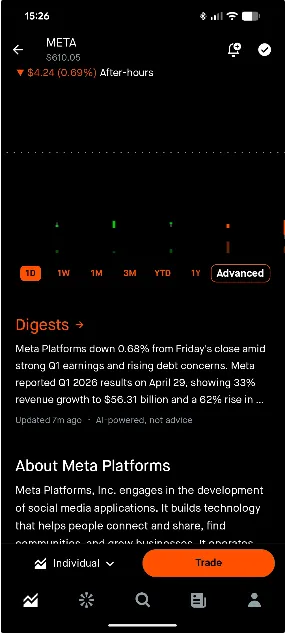
There it was. A Digest panel sitting inline on the META page, carrying numbers I could check against Meta's own results.
That’s the Robinhood Cortex Digests review in two sentences. The rest is the evidence: a logged-in session on my own UK ISA, screenshots timestamped, the Digest’s numbers checked against Meta’s reported results, plus the three things still missing even where the feature works.
The marketing called Cortex Digests an AI feature that summarises news and technicals in plain English for “Robinhood customers.” I went looking on the website first. Nothing, four times over. Then I opened the mobile app and went to META. There it was. Same account, same stock, same day, two different products, and the same company sells both of them.
A feature you've announced is not the same as a feature your users can see.
Four places on the website, four times nothing
A Playwright session against my logged-in UK ISA account, 1440×900 viewport, 17 May 2026.
Four places, one logged-in account, and the same answer every time.
- META detail page. Stock rendered at $610.05, full layout present: chart, About, Key statistics, Related lists, News, Trading Trends, Analyst ratings. No Digest panel. I searched the page text for digest or cortex. Zero matches.
- BMNR detail page. Stock at $19.81, same layout shape. No Digest panel. Same page-text search, and again nothing.
- Portfolio dashboard. The classic UK home view. No Digest panel. Nothing.
- Robinhood Legend. The chart workspace. No Digest panel. Nothing.
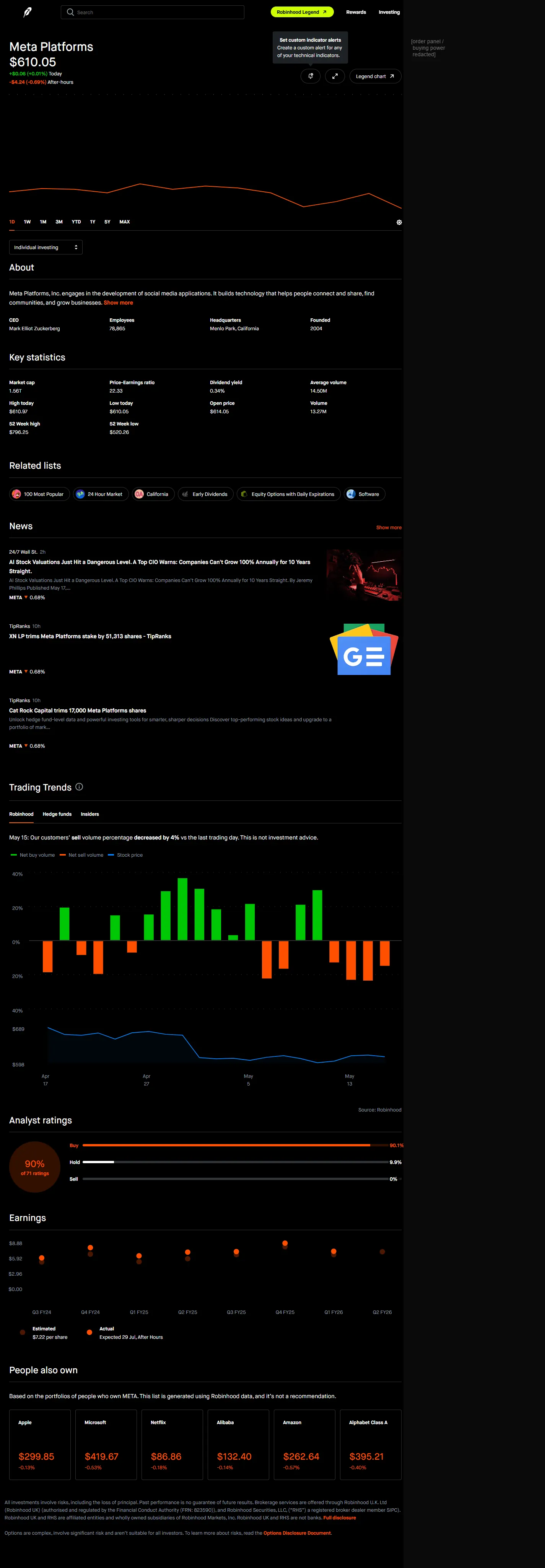
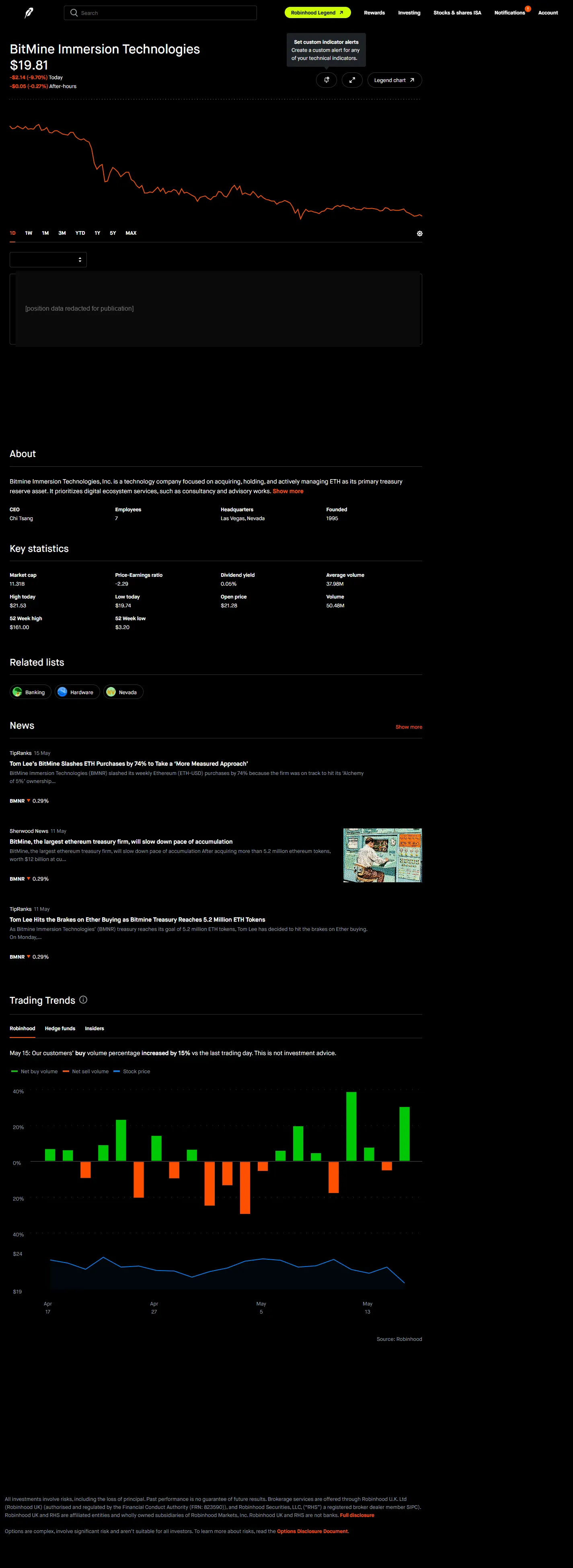
Robinhood’s August 2025 launch announcement said Cortex Digests was “free to all UK customers at launch” and noted it was “not available for every company or security”. Coverage is gated partly by detail-page views, per the methodology page. META was the large-company control in this test; its absence on the web established the web-app gap for this account.
Free, with Confidently Wrong every fortnight.
In the app it was sitting right there, above the About section
Then I opened the mobile app on the same account and tapped through to META. The Digest panel sits inline on the detail page, above the “About Meta Platforms” section, labelled clearly with a Digests → chevron. The headline read: “Meta Platforms down 0.68% from Friday’s close amid strong Q1 earnings and rising debt concerns.” Below it: “Updated 7m ago · AI-powered, not advice.”
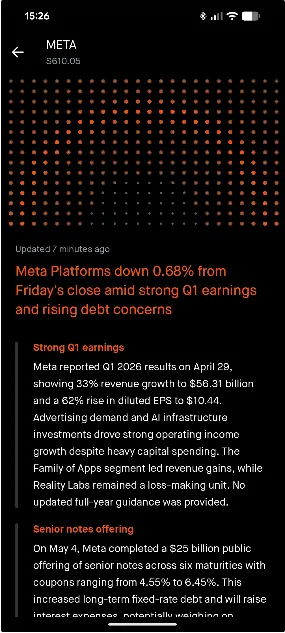
Tapping the chevron opens the full reading view. It’s structured: two named sub-sections, plain English, with verifiable numbers. The first sub-section, “Strong Q1 earnings”, reads:
Meta reported Q1 2026 results on April 29, showing 33% revenue growth to $56.31 billion and a 62% rise in diluted EPS to $10.44. Advertising demand and AI infrastructure investments drove strong operating income growth despite heavy capital spending. The Family of Apps segment led revenue gains, while Reality Labs remained a loss-making unit. No updated full-year guidance was provided.
The second, “Senior notes offering”, picks up the May 4 $25bn debt issuance: six maturities, coupons from 4.55% to 6.45%, the implications for interest expense.
So I checked them.
Checked line by line against Meta's reported results.
The numbers track. $56.31bn is what Meta reported. 33% year-on-year growth is correct. $10.44 diluted EPS is correct. The $25bn senior notes offering on May 4 happened. The Digest does what its disclaimer says it does: passive news synthesis with sources behind it, presented as text and not as a recommendation.
The number it quoted, and the number it didn’t
One thing it didn’t flag is worth holding next to that “the numbers track” verdict.
The headline earnings-per-share figure the Digest quoted, against the comparable figure once the one-off tax benefit comes out. The year-on-year jump goes from 62% to nearer 14%.
That $10.44 earnings-per-share figure, the profit Meta made for each share you own, included an $8.03bn one-off tax benefit. Strip that out and the comparable figure is nearer $7.31, which makes the year-on-year jump closer to 14% than the headline 62%. Both numbers are real. The Digest quoted the one that flatters, read the company’s own release accurately, and inherited the company’s own framing wholesale.
That's the quiet limit of a summary tool. It's only ever as sceptical as the document it's summarising, and a results announcement is not a sceptical document.
It does this well enough that, on the right name, it’d save you opening three tabs. That’s the use case Robinhood marketed and that’s what it does: a quick mobile-app news summary on big, well-known companies.
Even on the phone where it worked, three things weren’t there
The wins above are narrow. The same screenshots are the evidence for what isn’t there.
It has nothing to say about options
The methodology page is explicit: options and futures are out of scope. For anyone running a covered-call income strategy (selling the right to buy your shares at a set price in exchange for a cash premium, a use case on the account tested here), the AI feature says nothing about the contract you’re trading. Not the strike price, not implied volatility (how big a move the market is pricing in), not whether the premium is worth taking.
That isn’t a bug. It’s the product boundary. But it does mean the AI feature attached to your broker has nothing to say about the thing you actually opened the broker to do.
Portfolio-level mobile availability wasn’t captured
The August 2025 UK launch described asset-level (single-stock) Digests only. Robinhood’s current US help page puts Portfolio Digests inside Gold and says their release is still rolling. I found no UK Portfolio Digests announcement in this recheck. The mobile test was limited to the META detail page, so this review cannot say whether a portfolio-level mobile view was present on the account.
The coverage wall on less-tracked names is still open
The web test recorded the absence on the less-tracked stock I trade (BMNR). The mobile version hasn’t been tested. The methodology gates Digests by page views. If that rule also runs on mobile, the verdict holds on both web and app. If it doesn’t, the gap is narrower than the methodology page reads.
I'd rather flag the unverified dimension honestly than write a verdict around evidence I don't have.
One provenance note worth carrying, because it is the sort of thing nobody reads a methodology page to find.
It isn’t a conspiracy, and it isn’t the same provenance as an independent research tool. It shouldn’t be read as one.
The short version
What worked: On a well-known company like Meta, the mobile Digest does what it claims: numbers that match the reported results, two structured sub-sections, and a footer that calls itself AI-powered rather than advice. It quoted the company accurately, including the flattering headline EPS, without the caveat a sceptical reader would want.
What didn’t: Missing from every place tested on the Robinhood UK web interface. No options coverage. Portfolio-level mobile availability was not tested in the captured session.
Bottom line: Was useful as a quick mobile news summary on well-known names like Meta, until it vanished from the app in June 2026 (see the update below). While it existed: missing on the website, no options coverage, a faster way to read the headlines, not research.
The next four paragraphs are the original 17 May conclusion. Their present tense belongs to that test date.
If you bank on the AI feature in the Robinhood UK announcement and you’re working from your laptop, the mobile app is where it lives. It’s useful in one narrow way: a quick way to scan the news on well-known companies, the kind of name where the news is already everywhere and the model’s job is to thin it down. It’s no use for any decision involving options. It reads as something to glance at above your own research, not in place of it.
A product is whatever the user can see. On the Robinhood UK website on 17 May, this product was invisible. That gap would close. Robinhood would either bring Cortex to the web or stop marketing the feature as available to UK customers at large. The timestamp on these screenshots shows what was true that day.
Five questions to ask before depending on any broker's built-in AI feature, drawn from what this review found missing.
- Does it cover options? Cortex Digests explicitly excludes options and futures, which means the AI has nothing to say about the contract you may have opened the platform to trade.
- Does it work where you work? Cortex Digests was invisible on the web in the 17 May test and appeared in the mobile app. Check the surface you use rather than assuming one account behaves the same everywhere.
- Does it cover the stocks you actually hold? Robinhood says coverage is selected partly by detail-page views. The test captured META on mobile but did not test BMNR there, so the smaller-name question remains open.
- Is it available in your country and account tier? Cortex Digests launched free for UK users in 2025, disappeared from this account in June 2026 and is now advertised on the UK homepage again. Public marketing and logged-in access are different checks.
- Does it tell you what the numbers mean, or just what they are? The Meta Digest quoted the headline earnings figure accurately, including the one that flattered. It did not flag that a large one-off tax benefit inflated the year-on-year jump. A summary tool inherits the framing of whatever document it summarises.
Update: gone from mobile too (11 June 2026)
The May verdict above was “missing on web, working on mobile.” As of this evening, the second half of that sentence was dead. I checked NVDA, META and MSFT on the mobile app, including the same META detail page where the Digest panel sat in May, and the panels were gone. The web version never had them in the May test. On 11 June, Cortex Digests no longer appeared on my UK account.
I couldn’t find an announcement in June. Robinhood’s US support page describes Digests as a benefit of Robinhood Gold, the $5-a-month US subscription; Robinhood’s public UK product list does not include Gold. My reading at the time, offered as a reading and not a fact, was that the feature launched “free to all UK customers” had been folded into that US tier. The UK homepage’s current Cortex promotion means that inference cannot stand as today’s availability verdict.
The original close of this review said the web-mobile gap would resolve one of two ways: Robinhood brings Cortex to the web, or quietly stops marketing it to UK customers. I missed the third option. Remove it from the app as well and say nothing. A product is whatever the user can see, and on this account that is now nothing.
The review above stands as the record of what Cortex Digests did between its UK launch and its disappearance from this account, including a line-by-line accuracy check of a META Digest. It is a dated field record, not a current availability test. And if part of your research routine ever comes to depend on an AI feature inside your broker, this page is the case for keeping the manual version of that step warm. The wider record of how AI reliability holds up on checkable facts, across every assistant this site tests, is the State of AI Reliability report.
Can you still get Cortex Digests? (June 2026)
The June evidence still needs a current caveat. The feature was missing from my UK account on 11 June, while the old UK launch page said Digests was free to all UK customers at launch. As of 23 August, Robinhood’s UK homepage again promotes Cortex Digests with a “Try now” link. The US support page puts Digests inside the five-dollar-a-month Gold tier; Robinhood’s UK public product list does not show Gold. No new logged-in UK account test was performed for this update.
Advertised. “Meet your AI investment assistant,” Cortex Digests and a “Try now” link; no price stated.
Yes, inside Gold. The five-dollar-a-month US tier; Robinhood's UK public product list does not show it.
No. Nothing appeared on NVDA, META or MSFT on 11 June. It has not been rechecked for this update.
Those sources do not answer the same question. The current UK homepage advertises Cortex; the US help route describes Gold access; the dated account check recorded no panel. None proves what that UK account shows today without a fresh logged-in test.
Do not read the June absence as today’s answer. Before depending on Cortex Digests, check the account and surface you use. What’s useful alongside it does not depend on one broker: the free AI tools I rate for stock research run on a laptop and are independently checkable. A new logged-in UK result belongs here when Ben chooses to run one.
Common questions
- Does Cortex Digests cover options?
- No. Robinhood's current Cortex methodology explicitly excludes options and futures, so its Digests do not analyse the contract you may have opened the platform to trade.
- Does Cortex Digests work on the Robinhood website?
- It did not in the 17 May 2026 test. The same UK account showed a META Digest in the mobile app but none on four web surfaces. That is a dated result, not a claim about every account today.
- Does Cortex Digests cover the stocks you actually hold?
- Robinhood says stock coverage is selected partly by detail-page views and is not universal. This test captured META on mobile but did not test BMNR there, so it cannot say whether that smaller holding qualified.
- Is Cortex Digests available in the UK and at your account tier?
- Robinhood launched it free to UK customers in 2025. It disappeared from the tested UK account in June 2026, while the US help page put Digests inside Gold. Robinhood's UK homepage now advertises Cortex again, so current account access needs a fresh check.
- Does Cortex Digests tell you what the numbers mean, or just what they are?
- The Meta Digest quoted the headline earnings figure accurately, including the one that flattered. It did not flag that a large one-off tax benefit inflated the year-on-year jump. A summary tool inherits the framing of whatever document it summarises.
- Can you still get Cortex Digests? (June 2026)
- The tested UK account had no Digests on 11 June 2026. Robinhood's UK homepage advertises Cortex again as of 9 October 2026 (first seen 23 August), but no new logged-in test was performed for this update, so this page does not claim whether access has returned.
Confidently Wrong, every fortnight.
Which AI told the truth this month, with the receipts, plus an AI story worth retelling in between.
Free. Leave whenever you like.