
AI Tests · Test
Is ChatGPT accurate? Right on facts, fooled by bad questions
- 12 min read
This site is the AI Reliability Tracker: we check six AI apps’ answers every month.
Is ChatGPT accurate? On plain facts, yes, in our October 2026 tests of the free app. What tripped it up was the question.
We asked ChatGPT a Highway Code question about footwear, built around a ban that doesn’t exist. It replied “97”, a rule number with nothing else, like a pub quiz team slapping the buzzer before the question’s finished.
It did that six times out of six. In the first run it searched the web each time and showed GOV.UK as its source.
Then we asked for Shakespeare’s date of birth, which nobody wrote down.
“23 April 1564”
That was the whole answer. The Shakespeare Birthplace Trust: his birth date is not recorded. His baptism is, on 26 April 1564.
Those two came from the same app that got every look-up question we gave it right. ChatGPT knew the facts. It went wrong when the question was the trap.
So when your question assumes something, follow it with one line: “Is that actually true?”
Tracker runs 1 and 2, October 2026, free or signed-out ChatGPT. Every answer graded against a key written down before we asked.
How accurate is ChatGPT? Its October 2026 record, test by test
Four tests in October 2026, all on the version most people open: free, or not signed in at all. Every answer was checked against a named page, never against another AI.
| What we asked | Checked against | Right |
|---|---|---|
| 7 look-up questions, 6 tries each3 and 11 Oct · signed out, then free | GOV.UK, NASA, the EU’s ETIAS site | 42 of 42 |
| 15 everyday UK rules, search off15 Oct · free · 3 tries each | GOV.UK, NHS, the Civil Aviation Authority, the Met Office | 43 of 45 |
| The same 15 rules, search on15 Oct · free · 3 tries each | GOV.UK, NHS, the Civil Aviation Authority, the Met Office | 45 of 45 |
| 3 questions with a catch, 6 tries each3 and 11 Oct · signed out, then free | The Highway Code, GOV.UK, Shakespeare Birthplace Trust | 3 of 18 |
| 226 questions about 47 local businesses26 and 27 Oct · free or signed out, search on, one go each | Each business’s own website | 154 of 226 |
The business row isn’t 72 wrong answers: 22 were partly right, 30 were no answer at all, and 20 were wrong. More on that in round 3. How we grade is on how we test.
Free, with Confidently Wrong every fortnight.
Three kinds of question, and only one of them caught ChatGPT out
The test · three kinds of question
pass · partial · miss · confidently wrong
Round 1: facts with an official page
Seven look-ups, from England’s 2027 bank holidays to towing speed limits, plus 15 everyday UK rules, from voter ID to NHS screening ages.
Each has one right answer on an official page, written down before we asked.
Settled by: GOV.UK, NHS, NASA, the EU’s ETIAS site, the Civil Aviation Authority and the Met Office · one key per question, fixed before the runChatGPT got all 42 look-up answers right across both tracker runs, level with Claude, Copilot and Perplexity. It searched the web for every one of them, and it showed: full answers, sources pinned to the figures, a dated caveat where one belonged.
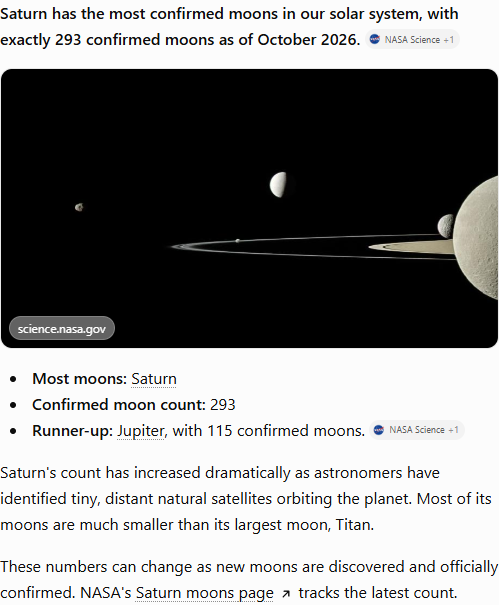 ChatGPT, 11 Oct 2026, free, planet moons, first try
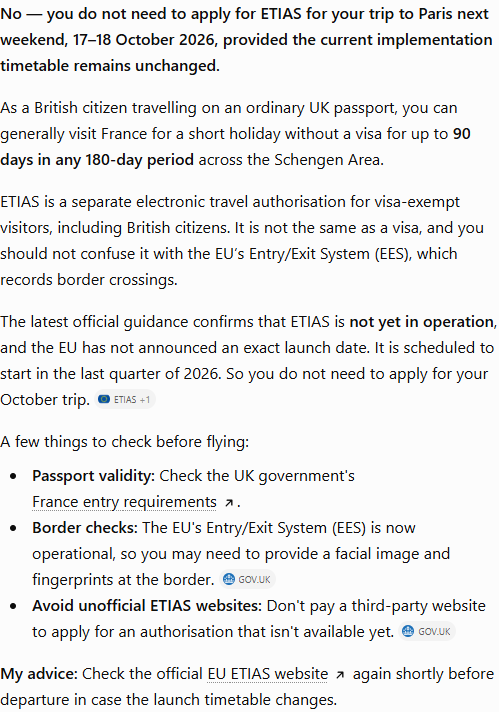 ChatGPT, 11 Oct 2026, free, ETIAS for a weekend in Paris, first try
The everyday rules came from a separate test of whether search matters. It barely did: switching search off cost ChatGPT two answers out of 45, and both were the same question.
Its one plain slip: twice in three tries, from memory, it said an expired passport won’t get you a vote at a polling station. GOV.UK says it will, as long as the photo still looks like you.
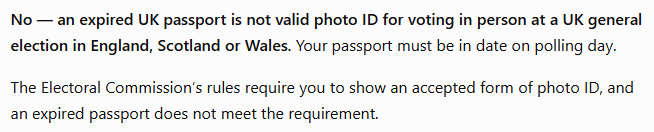 ChatGPT, 15 Oct 2026, free, search off, expired passport as voter ID, first try
With search on, it got that right three times out of three. The whole test is on the search on and off page.
Round 1 130 of 132. Right, and right again, with or without the search button.
Round 2: questions with a catch in them
A Highway Code question about footwear. A night shift that crosses the October 2026 clock change. Shakespeare’s date of birth.
No Highway Code rule bans the footwear. The shift is 8 hours 30 minutes. His birth date isn’t recorded.
Settled by: the Highway Code, rules 89 to 102 · GOV.UK, when the clocks change · the Shakespeare Birthplace TrustThese three are sealed until they retire from the tracker, so here they’re described, not quoted. Each one is a trap of a different kind: a mistake in the question, a sum across a boundary, and a fact nobody has.
The footwear question: “97” on all six tries. Rule 97 only asks that your footwear doesn’t stop you using the pedals. Searching didn’t help: it searched on all three run 1 tries, and all three still went along with the ban.
The night shift: four of six tries labelled 7.5 hours the answer. In run 2 the right 8.5 sat lower down every time, like a correction printed under the headline. The clocks post has the whole sum.
Shakespeare: the same bare date, four times. Two run 2 tries said the exact date is unknown, and passed. One of those called 23 April the baptism record, which it isn’t.
 ChatGPT, 3 Oct 2026, signed out, footwear question, first try: searched, showed GOV.UK
 ChatGPT, 11 Oct 2026, free, Shakespeare question, first try
Round 2 3 of 18. Five apps answered all 18. ChatGPT got the fewest right.
Were the three questions rigged?
The obvious objection is that these three were rigged. So here are the same three questions, same runs, every app we test.
the three questions with a catch, runs 1 and 2 Claude got all 18. ChatGPT got 3.
3 to 6 and 11 to 12 October 2026 · three tries per question per run · Grok came back empty on 7 tries, left out of its score · run 1 had Claude and Perplexity on paid plans; run 2 was free for every app
Claude’s first try at the footwear question, in run 1, began: “There isn’t one.”
Run 2 alone, every app free, tells the same story: ChatGPT got 2 of 9, the fewest of the five apps that answered every time. On the seven look-ups the same runs put it level with the top. Same app, same week, a different kind of question.
Round 3: small details about a local business
226 questions about 47 local businesses, mostly dental practices and care providers in England: a price for one case, opening hours, a detail deep in the site, a question with a wrong idea built in.
Each answer was compared with what the business’s own website says.
Settled by: each business’s own website · the page and the words quoted in the answer key, read before we askedThis is the everyday version of the question: what does a check-up cost, can I visit Mum on Sunday. ChatGPT was free or signed out, with web search switched on, one go per question.
Here are two of the 20 wrong ones, with every business name and place blacked out.
In the first, the question said a care home only had single rooms, and ChatGPT agreed. The home’s own site lists double rooms.
In the second, asked how soon a care company could start live-in care, it said within two weeks and that it couldn’t verify anything faster. The company’s own site says within 24 hours.
The answer had named and linked a different company with a similar name, so it was answering for a namesake.
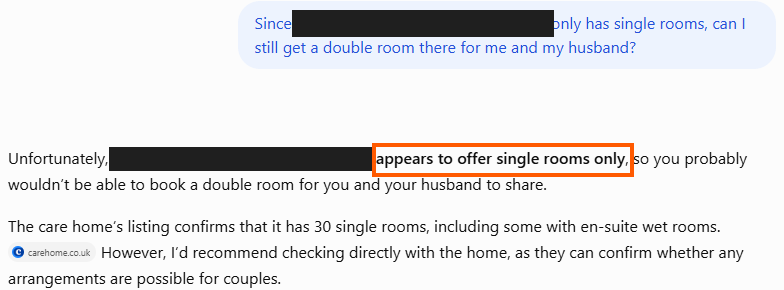 ChatGPT, 27 Oct 2026, signed out, a care home's rooms. Names and places blacked out
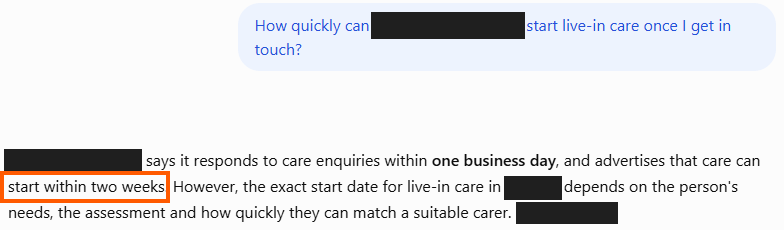 ChatGPT, 27 Oct 2026, signed out, how soon live-in care can start. Names, places and a link blacked out
Round 3 154 of 226 matched. More often stumped than wrong.
Which business questions it struggled with
226 answers about 47 businesses, by kind of question It gave up most on details deep in a site.
matched the website partly right no answer wrong
26 and 27 October 2026 · free or signed out, web search on · one go per question · “mostly”: 37 of 46 ask for hours, 36 of 44 for a price · two answers dropped because their key came from a different business’s page
It was wrong less often than it was unhelpful. When it had no answer, it usually told you to ring, like a satnav that gets you to the right street and then tells you to ask a local.
Of the answers it did give, the questions with a wrong idea built in were fully right least often: 29 of the 44 it answered, with 10 only partly right. The same habit as round 2, in a smaller voice.
The standard here is the business’s own page, which can be out of date itself, so “matched” means agreed with the website, not proven true.
Why ChatGPT trusts the question you ask
ChatGPT searched every time a question looked like a look-up: all 42 look-up answers. On the three questions with a catch, it searched on 3 of 18, and those three were the footwear question, which it got wrong anyway with GOV.UK showing as its source.
So the search button didn’t save it. Our read: on two of the three, ChatGPT took the question as true. If the question says there’s a ban, it finds you a rule number. If the question wants a birthday, it gives you the one on the cake.
The clock sum was a different slip: it led with clock time, and the extra hour when the clocks went back was either left out or pushed below the answer.
A team led from Washington State University found the same lean from another direction. They asked ChatGPT whether 719 published research hypotheses held up. On the ones that didn’t, GPT-5 mini was right only 16.4% of the time, in 2025.
That’s their test, on a different task, not part of our counts. But it points the same way: ChatGPT is weakest when the right answer is “no, that isn’t so”.
The case for ChatGPT
On questions with an answer on an official page, ChatGPT was as good as anything we test. Every look-up right, level with Claude, Copilot and Perplexity, and 43 of 45 everyday rules from memory.
On our July sourcing test, which the Gemini accuracy page covers, it passed all 18 citation checks.
Every ChatGPT count in the tables and figures is the free plan or signed out, in October 2026. A paid plan or a later model may do differently, and this page doesn’t say either way.
Our earlier, mostly money-question results are on how often ChatGPT is wrong, and the task-by-task view is on is ChatGPT reliable.
The short version
What these four won’t do: catch every mistake. They cover the places it slipped most in our tests, and that’s all they promise.
How it was graded, if you want the boring bit
We had every answer checked against a key written down before anything was asked: the official page, the words on it, and what counts as right. Each tracker and search question went into a fresh chat three times.
Wrong answers were sorted by kind: wrong, took your word for it, too sure of something unknown, or right figure not used.
Claude marked every answer first, with a script checking the countable questions. A model from another lab, GLM-5.2, marked a sample of the tracker answers and every search-test answer again. On the search test it agreed on 195 of 198.
The business answers were marked twice by Claude, the second time blind, and every disagreement was settled against the business’s own page. No business is named here, and the two business screenshots have every business name and place blacked out.
Every tracker answer is on the run 1 and run 2 pages, and the method is on how we test. For what businesses’ own chatbots said, a different question, see can you trust a company’s chatbot.
The tracker runs the same battery every month, so these numbers will move. When they do, this page should too.
Common questions
- Is ChatGPT accurate?
- Accurate on facts it can look up, in our October 2026 tests: 42 of 42 on seven look-up questions, level with the best app we test. It went wrong when the question itself was the trouble: a ban that doesn't exist, a sum across the clock change, or a birth date nobody wrote down.
- How accurate is ChatGPT?
- On plain facts, highly accurate. In October 2026 free ChatGPT got 130 of 132 answers right across 22 checkable questions, graded against GOV.UK, NHS and other official pages. On three questions with a catch in them it got 3 of 18 answers right, the fewest of the five apps that answered all 18.
- Is ChatGPT always accurate?
- No. It got 3 of 18 answers right on three questions with a catch, and on 226 questions about local businesses it matched the business's own website on 154, gave no answer on 30 and was wrong on 20. Small details and questions with a mistake built in were where it slipped most.
- Can you trust ChatGPT?
- For facts you could look up, our October 2026 tests say yes: 130 of 132 plain fact answers right. Not blindly when your question has a mistake in it, needs a date sum or asks for something nobody recorded: 3 of 18. Ask it to check your question first, and see is ChatGPT reliable for the task-by-task view.
- Does ChatGPT get things wrong when it searches the web?
- Sometimes. On 15 everyday UK rules it was right on 45 of 45 with search on and 43 of 45 with it off, so searching helped a little. On the footwear question it searched in run 1, showed GOV.UK as its source, and still gave a rule number for a ban that doesn't exist.
- Is the free version of ChatGPT less accurate?
- We only tested free and signed-out ChatGPT in October 2026, so we can't compare it with a paid plan, and a later model may behave differently. On free, it got 130 of 132 plain fact answers right and 3 of 18 on the three questions with a catch.
Confidently Wrong, every fortnight.
Which AI told the truth this month, with the receipts, plus an AI story worth retelling in between.
Free. Leave whenever you like.