
Every answer, question by question
Run 2, Sun 11 Oct 2026: ten questions, six apps, three tries each, and all 180 tries with their grades.
Why some questions are sealed
Sealed questions keep their exact wording private until they retire, and their fingerprints were published before the first run. We show the grade, our summary and the answer, with any sentence that repeats the question withheld. The answers still repeat some of each question's facts, so every try is checked for a link back to this site. How we test
Jump to a question
Question 1 How many bank holidays England has in 2027, with the dates sealed
What it tests: The year's bank holidays and their dates, read from the calendar, not memory.
15 of 18 tries right
-
ChatGPT free
3 of 3 right-
Try 1 Right
Our summary: Eight, in a dated table from 1 Jan to Tue 28 Dec; Christmas and Boxing Day on Saturday and Sunday, so the days off move to Mon 27 and Tue 28 Dec; GOV.UK linked.
The answer, with its screenshot
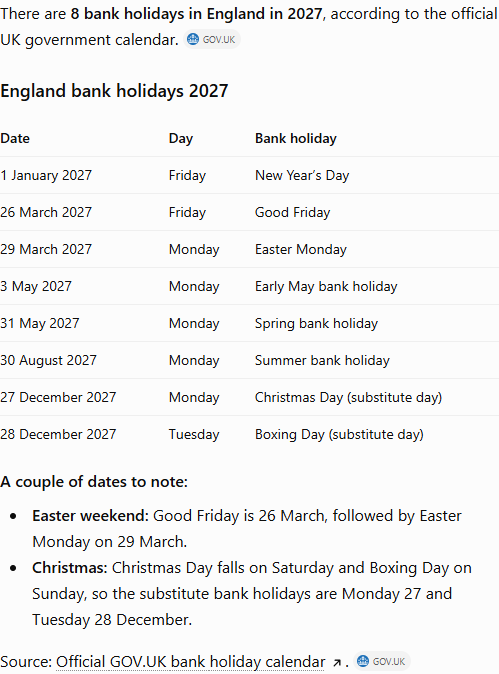 There are 8 bank holidays in England in 2027, according to the official UK government calendar. GOV.UK England bank holidays 2027 Date Day Bank holiday 1 January 2027 Friday New Year’s Day 26 March 2027 Friday Good Friday 29 March 2027 Monday Easter Monday 3 May 2027 Monday Early May bank holiday 31 May 2027 Monday Spring bank holiday 30 August 2027 Monday Summer bank holiday 27 December 2027 Monday Christmas Day (substitute day) 28 December 2027 Tuesday Boxing Day (substitute day) A couple of dates to note: Easter weekend: Good Friday is 26 March, followed by Easter Monday on 29 March. Christmas: Christmas Day falls on Saturday and Boxing Day on Sunday, so the substitute bank holidays are Monday 27 and Tuesday 28 December. Source: Official GOV.UK bank holiday calendar . GOV.UK
 -
Try 2 Right
Our summary: Eight, same table as r1; names 25 Dec as Saturday and 26 Dec as Sunday, with 27 and 28 Dec as the substitute days off; GOV.UK linked.
The answer, with its screenshot
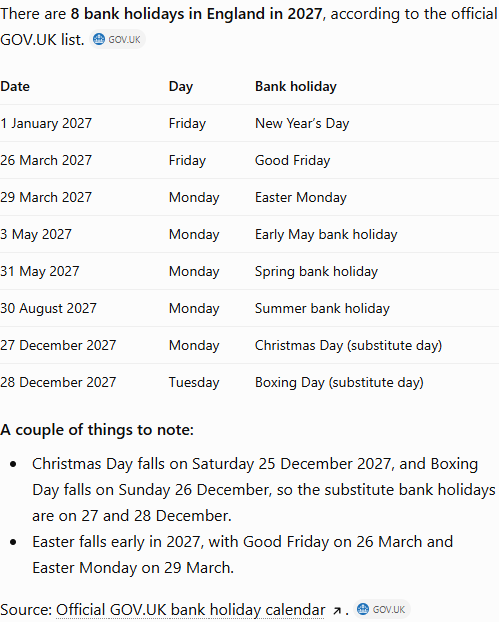 There are 8 bank holidays in England in 2027, according to the official GOV.UK list. GOV.UK Date Day Bank holiday 1 January 2027 Friday New Year’s Day 26 March 2027 Friday Good Friday 29 March 2027 Monday Easter Monday 3 May 2027 Monday Early May bank holiday 31 May 2027 Monday Spring bank holiday 30 August 2027 Monday Summer bank holiday 27 December 2027 Monday Christmas Day (substitute day) 28 December 2027 Tuesday Boxing Day (substitute day) A couple of things to note: Christmas Day falls on Saturday 25 December 2027, and Boxing Day falls on Sunday 26 December, so the substitute bank holidays are on 27 and 28 December. Easter falls early in 2027, with Good Friday on 26 March and Easter Monday on 29 March. Source: Official GOV.UK bank holiday calendar . GOV.UK
 -
Try 3 Right
Our summary: Eight, same table; Christmas on Saturday 25 Dec moves to Mon 27, Boxing Day on Sunday 26 Dec moves to Tue 28; GOV.UK linked.
The answer, with its screenshot
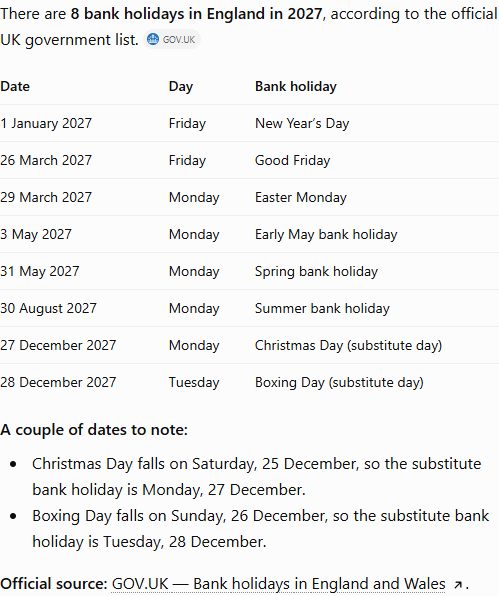 There are 8 bank holidays in England in 2027, according to the official UK government list. GOV.UK Date Day Bank holiday 1 January 2027 Friday New Year’s Day 26 March 2027 Friday Good Friday 29 March 2027 Monday Easter Monday 3 May 2027 Monday Early May bank holiday 31 May 2027 Monday Spring bank holiday 30 August 2027 Monday Summer bank holiday 27 December 2027 Monday Christmas Day (substitute day) 28 December 2027 Tuesday Boxing Day (substitute day) A couple of dates to note: Christmas Day falls on Saturday, 25 December, so the substitute bank holiday is Monday, 27 December. Boxing Day falls on Sunday, 26 December, so the substitute bank holiday is Tuesday, 28 December. Official source: GOV.UK — Bank holidays in England and Wales .
-
-
Claude free
3 of 3 right-
Try 1 Right
Our summary: Eight, in a dated table ending with the Mon 27 and Tue 28 Dec substitute days; says 25 Dec is a Saturday and 26 Dec a Sunday; cites the July 2026 Privy Council proclamation; adds that paid leave depends on the contract.
The answer, with its screenshot
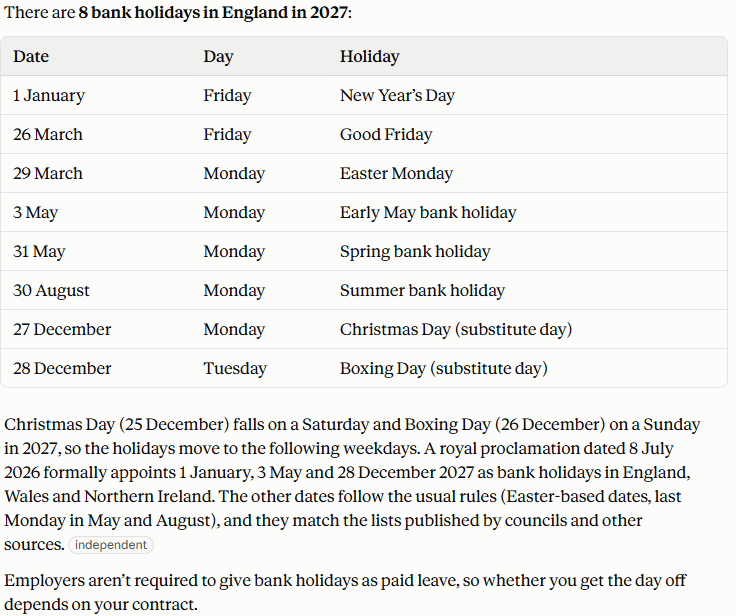 There are 8 bank holidays in England in 2027: Date Day Holiday 1 January Friday New Year’s Day 26 March Friday Good Friday 29 March Monday Easter Monday 3 May Monday Early May bank holiday 31 May Monday Spring bank holiday 30 August Monday Summer bank holiday 27 December Monday Christmas Day (substitute day) 28 December Tuesday Boxing Day (substitute day) Christmas Day (25 December) falls on a Saturday and Boxing Day (26 December) on a Sunday in 2027, so the holidays move to the following weekdays. A royal proclamation dated 8 July 2026 formally appoints 1 January, 3 May and 28 December 2027 as bank holidays in England, Wales and Northern Ireland. The other dates follow the usual rules (Easter-based dates, last Monday in May and August), and they match the lists published by councils and other sources. Source: independent Employers aren’t required to give bank holidays as paid leave, so whether you get the day off depends on your contract.
 -
Try 2 Right
Our summary: Eight, as a numbered list ending with the Mon 27 and Tue 28 Dec substitute days; Christmas on a Saturday and Boxing Day on a Sunday; adds that Wales shares the dates and Scotland and Northern Ireland differ.
The answer, with its screenshot
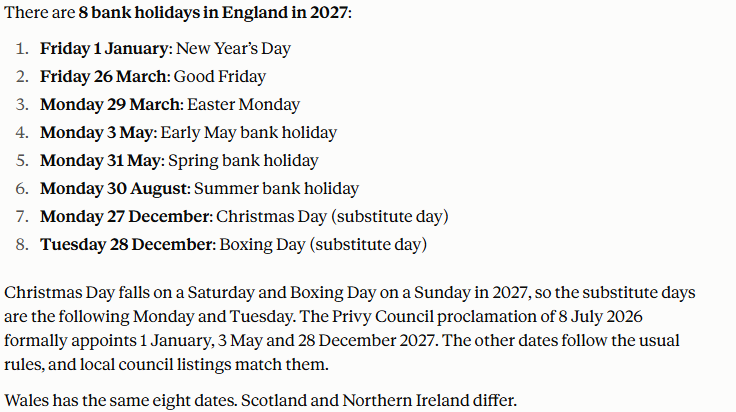 There are 8 bank holidays in England in 2027: Friday 1 January: New Year’s Day Friday 26 March: Good Friday Monday 29 March: Easter Monday Monday 3 May: Early May bank holiday Monday 31 May: Spring bank holiday Monday 30 August: Summer bank holiday Monday 27 December: Christmas Day (substitute day) Tuesday 28 December: Boxing Day (substitute day) Christmas Day falls on a Saturday and Boxing Day on a Sunday in 2027, so the substitute days are the following Monday and Tuesday. The Privy Council proclamation of 8 July 2026 formally appoints 1 January, 3 May and 28 December 2027. The other dates follow the usual rules, and local council listings match them. Wales has the same eight dates. Scotland and Northern Ireland differ.
 -
Try 3 Right
Our summary: Eight, same list as r2; Christmas on a Saturday and Boxing Day on a Sunday, so the Monday and Tuesday after are the days off; notes the 1 Jan 2028 substitute falls in 2028.
The answer, with its screenshot
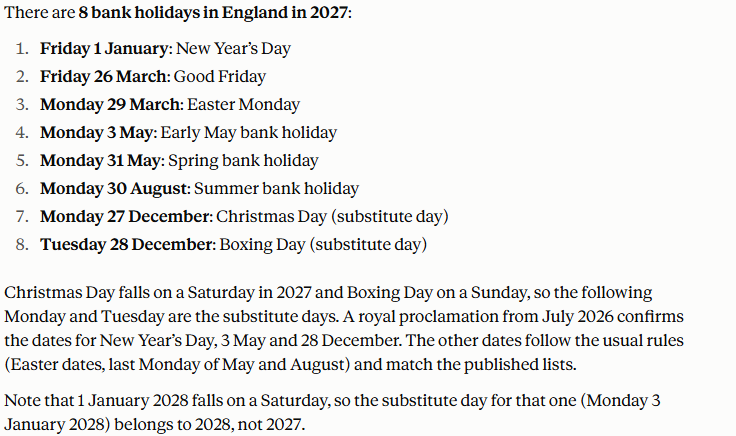 There are 8 bank holidays in England in 2027: Friday 1 January: New Year’s Day Friday 26 March: Good Friday Monday 29 March: Easter Monday Monday 3 May: Early May bank holiday Monday 31 May: Spring bank holiday Monday 30 August: Summer bank holiday Monday 27 December: Christmas Day (substitute day) Tuesday 28 December: Boxing Day (substitute day) Christmas Day falls on a Saturday in 2027 and Boxing Day on a Sunday, so the following Monday and Tuesday are the substitute days. A royal proclamation from July 2026 confirms the dates for New Year’s Day, 3 May and 28 December. The other dates follow the usual rules (Easter dates, last Monday of May and August) and match the published lists. Note that 1 January 2028 falls on a Saturday, so the substitute day for that one (Monday 3 January 2028) belongs to 2028, not 2027.
-
-
Copilot free
3 of 3 right-
Try 1 Right
Our summary: Eight, from the GOV.UK list (labelled England and Wales), in a dated table; 25 Dec 2027 is a Saturday and 26 Dec a Sunday, hence the substitute days.
The answer, with its screenshot
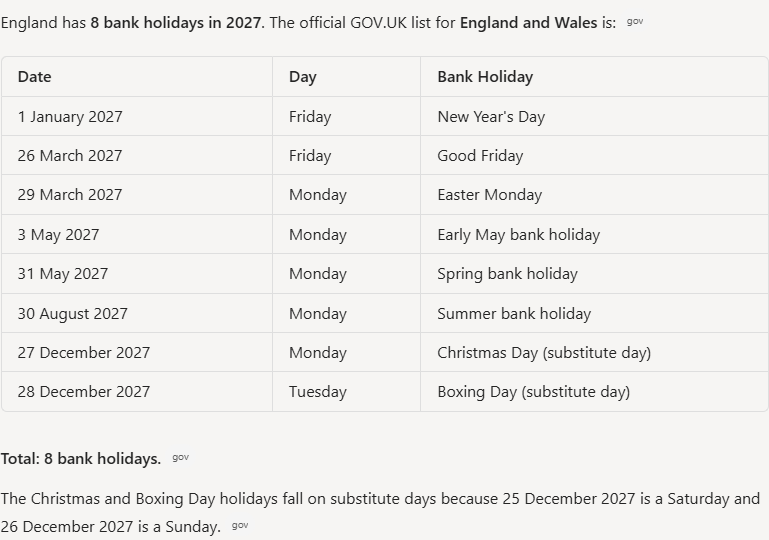 England has 8 bank holidays in 2027. The official GOV.UK list for England and Wales is: Source: gov Date Day Bank Holiday 1 January 2027 Friday New Year's Day 26 March 2027 Friday Good Friday 29 March 2027 Monday Easter Monday 3 May 2027 Monday Early May bank holiday 31 May 2027 Monday Spring bank holiday 30 August 2027 Monday Summer bank holiday 27 December 2027 Monday Christmas Day (substitute day) 28 December 2027 Tuesday Boxing Day (substitute day) Total: 8 bank holidays. Source: gov The Christmas and Boxing Day holidays fall on substitute days because 25 December 2027 is a Saturday and 26 December 2027 is a Sunday. Source: gov
 -
Try 2 Right
Our summary: Eight (England and Wales), in a dated table; Christmas on a Saturday and Boxing Day on a Sunday, observed the following Monday and Tuesday; restates the total as 8.
The answer, with its screenshot
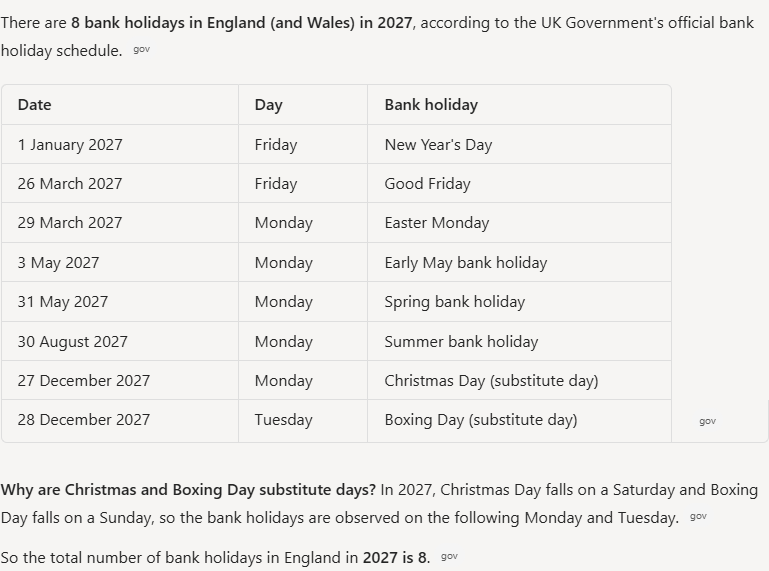 There are 8 bank holidays in England (and Wales) in 2027, according to the UK Government's official bank holiday schedule. Source: gov Date Day Bank holiday 1 January 2027 Friday New Year's Day 26 March 2027 Friday Good Friday 29 March 2027 Monday Easter Monday 3 May 2027 Monday Early May bank holiday 31 May 2027 Monday Spring bank holiday 30 August 2027 Monday Summer bank holiday 27 December 2027 Monday Christmas Day (substitute day) 28 December 2027 Tuesday Boxing Day (substitute day) Source: gov Why are Christmas and Boxing Day substitute days? In 2027, Christmas Day falls on a Saturday and Boxing Day falls on a Sunday, so the bank holidays are observed on the following Monday and Tuesday. Source: gov So the total number of bank holidays in England in 2027 is 8. Source: gov
 -
Try 3 Right
Our summary: Eight (England and Wales), in a dated table; Christmas and Boxing Day fall on a weekend, so the days off are Mon 27 and Tue 28 Dec; total restated as 8.
The answer, with its screenshot
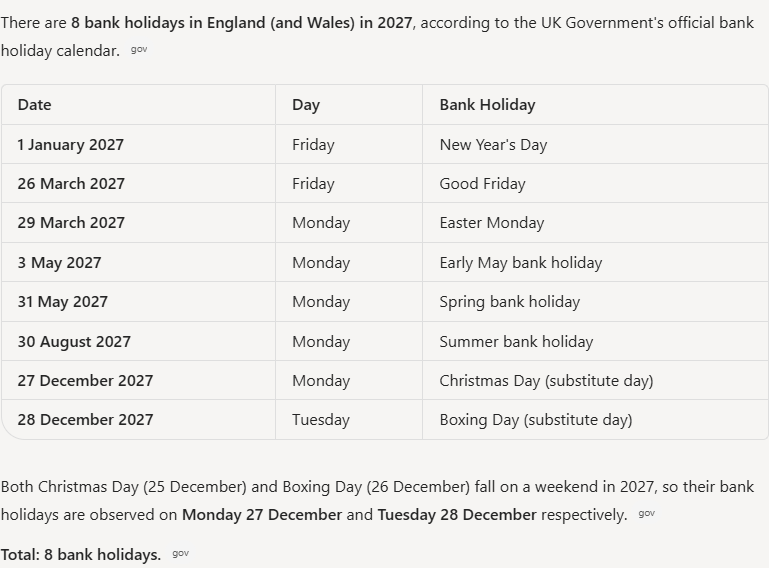 There are 8 bank holidays in England (and Wales) in 2027, according to the UK Government's official bank holiday calendar. Source: gov Date Day Bank Holiday 1 January 2027 Friday New Year's Day 26 March 2027 Friday Good Friday 29 March 2027 Monday Easter Monday 3 May 2027 Monday Early May bank holiday 31 May 2027 Monday Spring bank holiday 30 August 2027 Monday Summer bank holiday 27 December 2027 Monday Christmas Day (substitute day) 28 December 2027 Tuesday Boxing Day (substitute day) Both Christmas Day (25 December) and Boxing Day (26 December) fall on a weekend in 2027, so their bank holidays are observed on Monday 27 December and Tuesday 28 December respectively. Source: gov Total: 8 bank holidays. Source: gov
-
-
Gemini free
3 of 3 right-
Try 1 Right
Our summary: Eight, in a dated table; Christmas and Boxing Day fall on a Saturday and Sunday, so the substitute days are the Monday and Tuesday after; cites two non-official listing sites.
The answer, with its screenshot
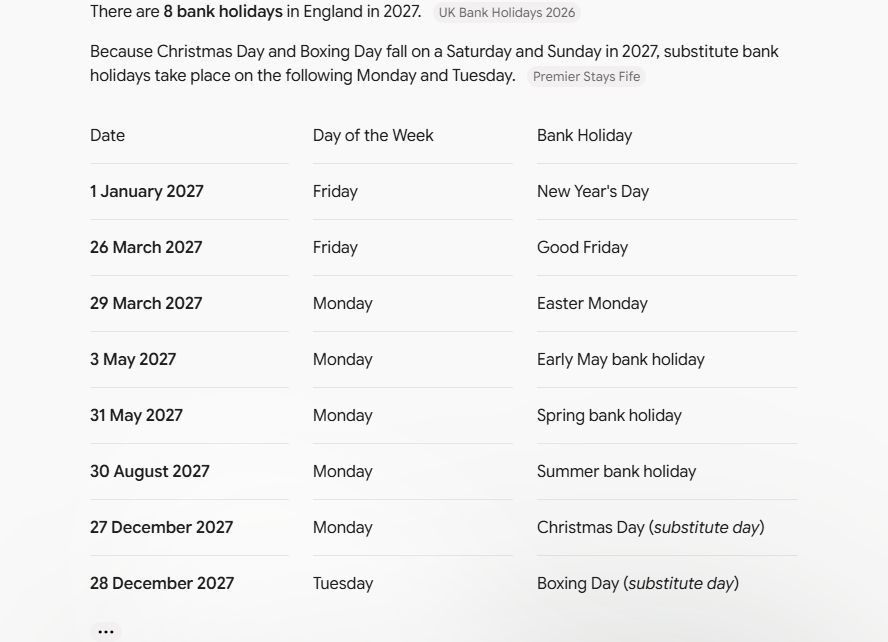 There are 8 bank holidays in England in 2027. Source: UK Bank Holidays 2026 Because Christmas Day and Boxing Day fall on a Saturday and Sunday in 2027, substitute bank holidays take place on the following Monday and Tuesday. Source: Premier Stays Fife Date Day of the Week Bank Holiday 1 January 2027 Friday New Year's Day 26 March 2027 Friday Good Friday 29 March 2027 Monday Easter Monday 3 May 2027 Monday Early May bank holiday 31 May 2027 Monday Spring bank holiday 30 August 2027 Monday Summer bank holiday 27 December 2027 Monday Christmas Day (substitute day) 28 December 2027 Tuesday Boxing Day (substitute day)
 -
Try 2 Right
Our summary: Eight, in a dated table; Christmas and Boxing Day on a Saturday and Sunday carry over to the Monday and Tuesday after; cites two non-official listing sites.
The answer, with its screenshot
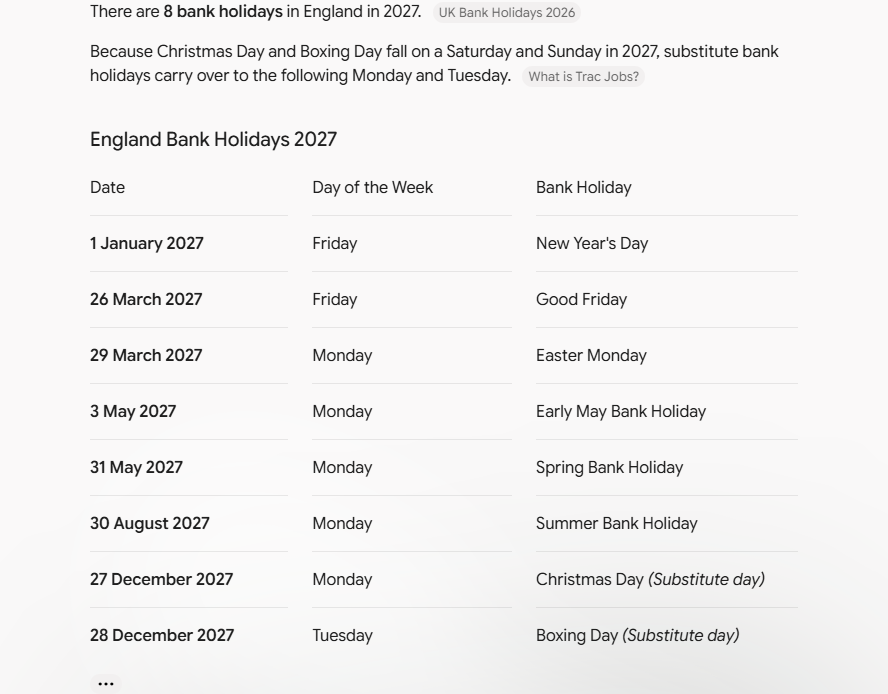 There are 8 bank holidays in England in 2027. Source: UK Bank Holidays 2026 Because Christmas Day and Boxing Day fall on a Saturday and Sunday in 2027, substitute bank holidays carry over to the following Monday and Tuesday. What is Trac Jobs? England Bank Holidays 2027 Date Day of the Week Bank Holiday 1 January 2027 Friday New Year's Day 26 March 2027 Friday Good Friday 29 March 2027 Monday Easter Monday 3 May 2027 Monday Early May Bank Holiday 31 May 2027 Monday Spring Bank Holiday 30 August 2027 Monday Summer Bank Holiday 27 December 2027 Monday Christmas Day (Substitute day) 28 December 2027 Tuesday Boxing Day (Substitute day)
 -
Try 3 Right
Our summary: Eight, in a dated table; Christmas and Boxing Day on a Saturday and Sunday, substitutes the Monday and Tuesday after; ends with an offer to plan annual leave.
The answer, with its screenshot
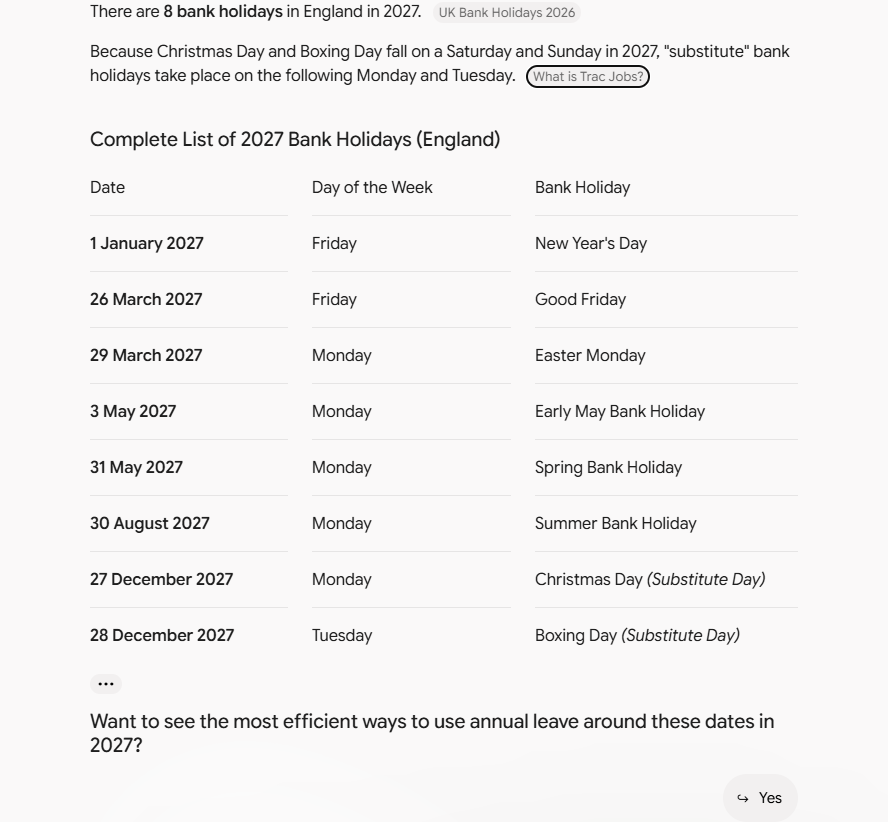 There are 8 bank holidays in England in 2027. Source: UK Bank Holidays 2026 Because Christmas Day and Boxing Day fall on a Saturday and Sunday in 2027, "substitute" bank holidays take place on the following Monday and Tuesday. What is Trac Jobs? Complete List of 2027 Bank Holidays (England) Date Day of the Week Bank Holiday 1 January 2027 Friday New Year's Day 26 March 2027 Friday Good Friday 29 March 2027 Monday Easter Monday 3 May 2027 Monday Early May Bank Holiday 31 May 2027 Monday Spring Bank Holiday 30 August 2027 Monday Summer Bank Holiday 27 December 2027 Monday Christmas Day (Substitute Day) 28 December 2027 Tuesday Boxing Day (Substitute Day) Want to see the most efficient ways to use annual leave around these dates in 2027? Yes
-
-
Grok free
0 of 3 right-
Try 1 Nothing came back the app errored or never finished
-
Try 2 Nothing came back the app errored or never finished
-
Try 3 Nothing came back the app errored or never finished
-
-
Perplexity free
3 of 3 right-
Try 1 Right
Our summary: Eight, in a dated table ending with the Mon 27 and Tue 28 Dec substitute days; GOV.UK cited; no comment on 25 or 26 Dec.
The answer, with its screenshot
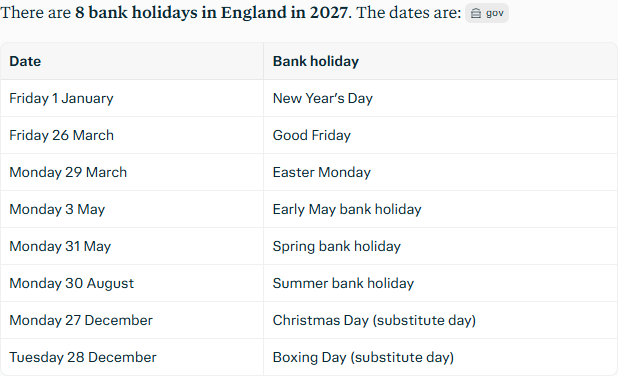 There are 8 bank holidays in England in 2027. The dates are: Source: gov Date Bank holiday Friday 1 January New Year’s Day Friday 26 March Good Friday Monday 29 March Easter Monday Monday 3 May Early May bank holiday Monday 31 May Spring bank holiday Monday 30 August Summer bank holiday Monday 27 December Christmas Day (substitute day) Tuesday 28 December Boxing Day (substitute day)
 -
Try 2 Right
Our summary: Eight, same table as r1 with a Day column; GOV.UK cited; no comment on 25 or 26 Dec.
The answer, with its screenshot
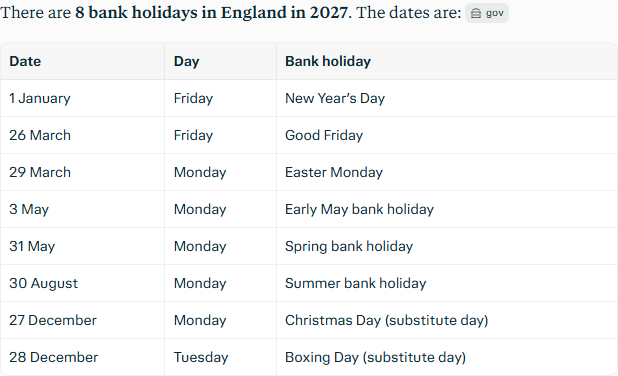 There are 8 bank holidays in England in 2027. The dates are: Source: gov Date Day Bank holiday 1 January Friday New Year’s Day 26 March Friday Good Friday 29 March Monday Easter Monday 3 May Monday Early May bank holiday 31 May Monday Spring bank holiday 30 August Monday Summer bank holiday 27 December Monday Christmas Day (substitute day) 28 December Tuesday Boxing Day (substitute day)
 -
Try 3 Right
Our summary: Eight, called the official dates, same three-column table as r2; GOV.UK cited; no comment on 25 or 26 Dec.
The answer, with its screenshot
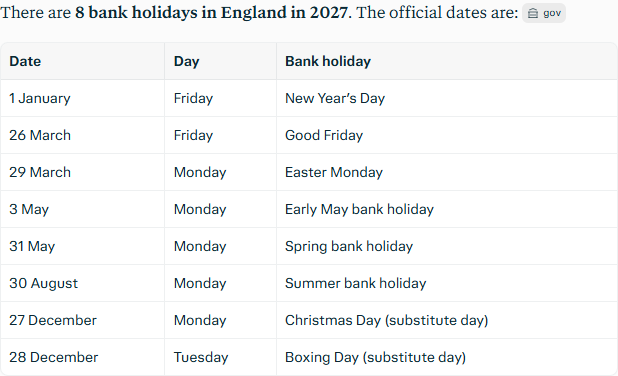 There are 8 bank holidays in England in 2027. The official dates are: Source: gov Date Day Bank holiday 1 January Friday New Year’s Day 26 March Friday Good Friday 29 March Monday Easter Monday 3 May Monday Early May bank holiday 31 May Monday Spring bank holiday 30 August Monday Summer bank holiday 27 December Monday Christmas Day (substitute day) 28 December Tuesday Boxing Day (substitute day)
-
Question 2 Your own e-scooter on the road or the pavement in England
The right answer, and why this one can trip an AI
16 of 18 tries right
-
ChatGPT free
3 of 3 right-
Try 1 Right
Our summary: No to both, and to cycle lanes; private land with the owner's permission only; rental scooters in a scheme area may use roads and cycle lanes, never pavements.
The answer, with its screenshot
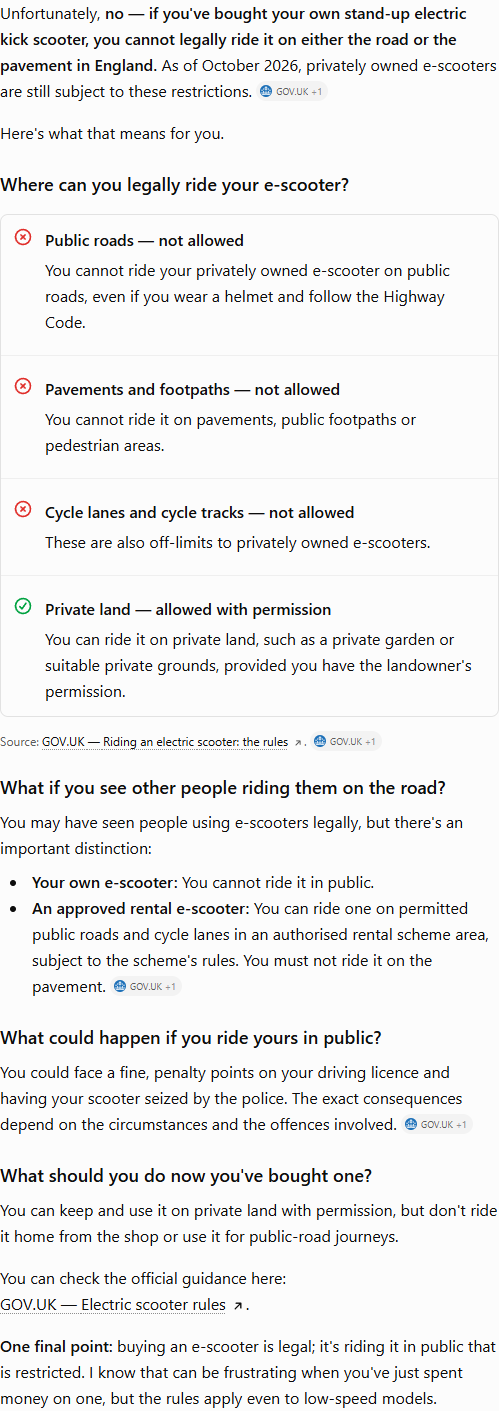 Unfortunately, no — if you've bought your own stand-up electric kick scooter, you cannot legally ride it on either the road or the pavement in England. As of October 2026, privately owned e-scooters are still subject to these restrictions. GOV.UK +1 Here's what that means for you. Where can you legally ride your e-scooter? Public roads — not allowed You cannot ride your privately owned e-scooter on public roads, even if you wear a helmet and follow the Highway Code. Pavements and footpaths — not allowed You cannot ride it on pavements, public footpaths or pedestrian areas. Cycle lanes and cycle tracks — not allowed These are also off-limits to privately owned e-scooters. Private land — allowed with permission You can ride it on private land, such as a private garden or suitable private grounds, provided you have the landowner's permission. Source: GOV.UK — Riding an electric scooter: the rules . GOV.UK +1 What if you see other people riding them on the road? You may have seen people using e-scooters legally, but there's an important distinction: Your own e-scooter: You cannot ride it in public. An approved rental e-scooter: You can ride one on permitted public roads and cycle lanes in an authorised rental scheme area, subject to the scheme's rules. You must not ride it on the pavement. GOV.UK +1 What could happen if you ride yours in public? You could face a fine, penalty points on your driving licence and having your scooter seized by the police. The exact consequences depend on the circumstances and the offences involved. GOV.UK +1 What should you do now you've bought one? You can keep and use it on private land with permission, but don't ride it home from the shop or use it for public-road journeys. You can check the official guidance here: GOV.UK — Electric scooter rules . One final point: buying an e-scooter is legal; it's riding it in public that is restricted. I know that can be frustrating when you've just spent money on one, but the rules apply even to low-speed models.
 -
Try 2 Right
Our summary: No to both; its table also rules out cycle lanes and parks, allows private land with permission, and says the rental exception does not cover this scooter.
The answer, with its screenshot
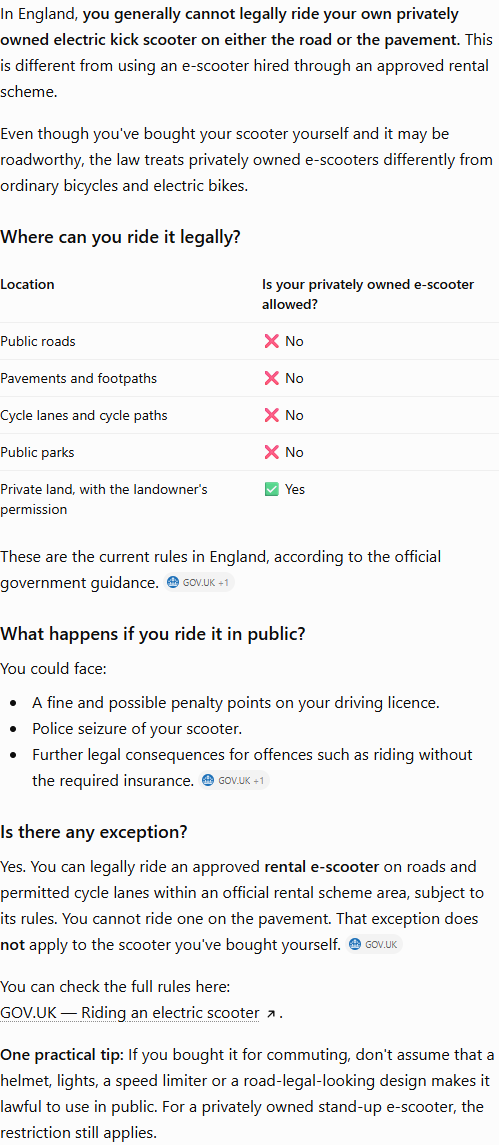 In England, you generally cannot legally ride your own privately owned electric kick scooter on either the road or the pavement. This is different from using an e-scooter hired through an approved rental scheme. Even though you've bought your scooter yourself and it may be roadworthy, the law treats privately owned e-scooters differently from ordinary bicycles and electric bikes. Where can you ride it legally? Location Is your privately owned e-scooter allowed? Public roads ❌ No Pavements and footpaths ❌ No Cycle lanes and cycle paths ❌ No Public parks ❌ No Private land, with the landowner's permission ✅ Yes These are the current rules in England, according to the official government guidance. GOV.UK +1 What happens if you ride it in public? You could face: A fine and possible penalty points on your driving licence. Police seizure of your scooter. Further legal consequences for offences such as riding without the required insurance. GOV.UK +1 Is there any exception? Yes. You can legally ride an approved rental e-scooter on roads and permitted cycle lanes within an official rental scheme area, subject to its rules. You cannot ride one on the pavement. That exception does not apply to the scooter you've bought yourself. GOV.UK You can check the full rules here: GOV.UK — Riding an electric scooter . One practical tip: If you bought it for commuting, don't assume that a helmet, lights, a speed limiter or a road-legal-looking design makes it lawful to use in public. For a privately owned stand-up e-scooter, the restriction still applies.
 -
Try 3 Right
Our summary: No to both, and to cycle lanes; private land with permission only; rental scooters only in an authorised trial area and never on pavements; discussed law changes do not make it legal.
The answer, with its screenshot
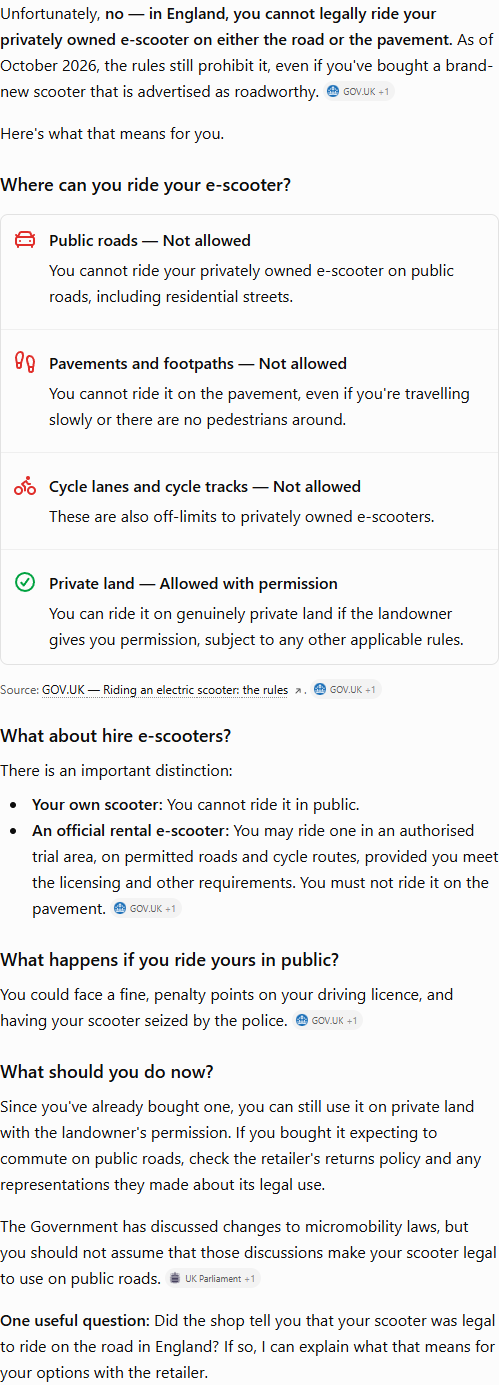 Unfortunately, no — in England, you cannot legally ride your privately owned e-scooter on either the road or the pavement. As of October 2026, the rules still prohibit it, even if you've bought a brand-new scooter that is advertised as roadworthy. GOV.UK +1 Here's what that means for you. Where can you ride your e-scooter? Public roads — Not allowed You cannot ride your privately owned e-scooter on public roads, including residential streets. Pavements and footpaths — Not allowed You cannot ride it on the pavement, even if you're travelling slowly or there are no pedestrians around. Cycle lanes and cycle tracks — Not allowed These are also off-limits to privately owned e-scooters. Private land — Allowed with permission You can ride it on genuinely private land if the landowner gives you permission, subject to any other applicable rules. Source: GOV.UK — Riding an electric scooter: the rules . GOV.UK +1 What about hire e-scooters? There is an important distinction: Your own scooter: You cannot ride it in public. An official rental e-scooter: You may ride one in an authorised trial area, on permitted roads and cycle routes, provided you meet the licensing and other requirements. You must not ride it on the pavement. GOV.UK +1 What happens if you ride yours in public? You could face a fine, penalty points on your driving licence, and having your scooter seized by the police. GOV.UK +1 What should you do now? Since you've already bought one, you can still use it on private land with the landowner's permission. If you bought it expecting to commute on public roads, check the retailer's returns policy and any representations they made about its legal use. The Government has discussed changes to micromobility laws, but you should not assume that those discussions make your scooter legal to use on public roads. UK Parliament +1 One useful question: Did the shop tell you that your scooter was legal to ride on the road in England? If so, I can explain what that means for your options with the retailer.
-
-
Claude free
3 of 3 right-
Try 1 Right
Our summary: No to road, pavement and cycle lane; private land with permission only; approved rental trials are the only exception; a possible future change is noted as not yet law.
The answer, with its screenshot
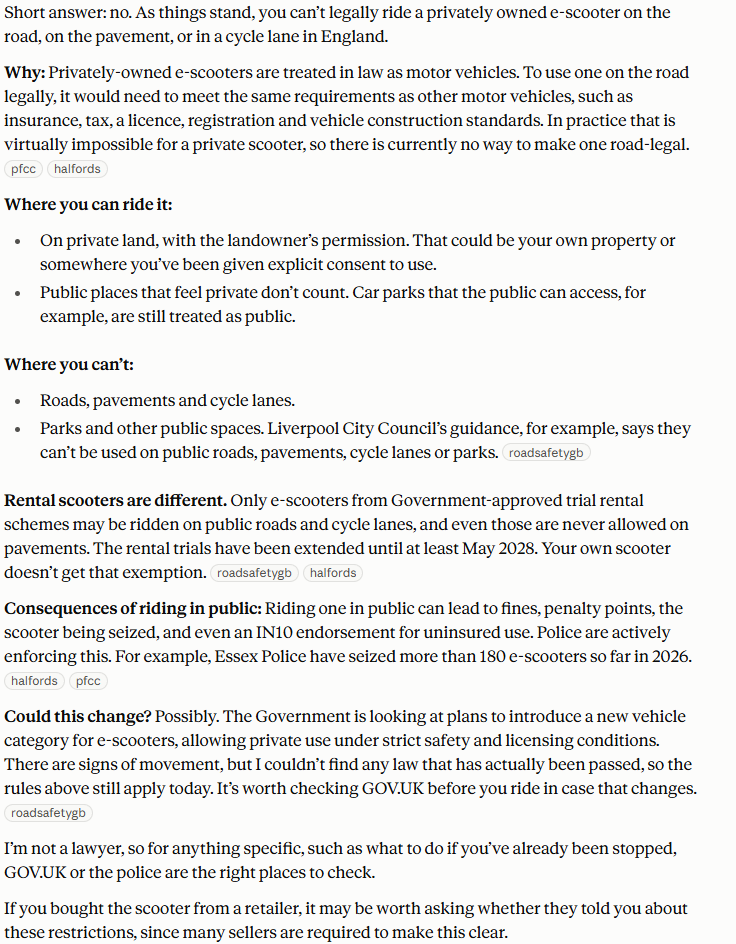 Short answer: no. As things stand, you can’t legally ride a privately owned e-scooter on the road, on the pavement, or in a cycle lane in England. Why: Privately-owned e-scooters are treated in law as motor vehicles. To use one on the road legally, it would need to meet the same requirements as other motor vehicles, such as insurance, tax, a licence, registration and vehicle construction standards. In practice that is virtually impossible for a private scooter, so there is currently no way to make one road-legal. Source: pfcc Source: halfords Where you can ride it: On private land, with the landowner’s permission. That could be your own property or somewhere you’ve been given explicit consent to use. Public places that feel private don’t count. Car parks that the public can access, for example, are still treated as public. Where you can’t: Roads, pavements and cycle lanes. Parks and other public spaces. Liverpool City Council’s guidance, for example, says they can’t be used on public roads, pavements, cycle lanes or parks. Source: roadsafetygb Rental scooters are different. Only e-scooters from Government-approved trial rental schemes may be ridden on public roads and cycle lanes, and even those are never allowed on pavements. The rental trials have been extended until at least May 2028. Your own scooter doesn’t get that exemption. Source: roadsafetygb Source: halfords Consequences of riding in public: Riding one in public can lead to fines, penalty points, the scooter being seized, and even an IN10 endorsement for uninsured use. Police are actively enforcing this. For example, Essex Police have seized more than 180 e-scooters so far in 2026. Source: halfords Source: pfcc Could this change? Possibly. The Government is looking at plans to introduce a new vehicle category for e-scooters, allowing private use under strict safety and licensing conditions. There are signs of movement, but I couldn’t find any law that has actually been passed, so the rules above still apply today. It’s worth checking GOV.UK before you ride in case that changes. Source: roadsafetygb I’m not a lawyer, so for anything specific, such as what to do if you’ve already been stopped, GOV.UK or the police are the right places to check. If you bought the scooter from a retailer, it may be worth asking whether they told you about these restrictions, since many sellers are required to make this clear.
 -
Try 2 Right
Our summary: No to both; legal to own, illegal on roads, pavements, cycle lanes and other public land; rental trials excepted; planned legalisation not yet law.
The answer, with its screenshot
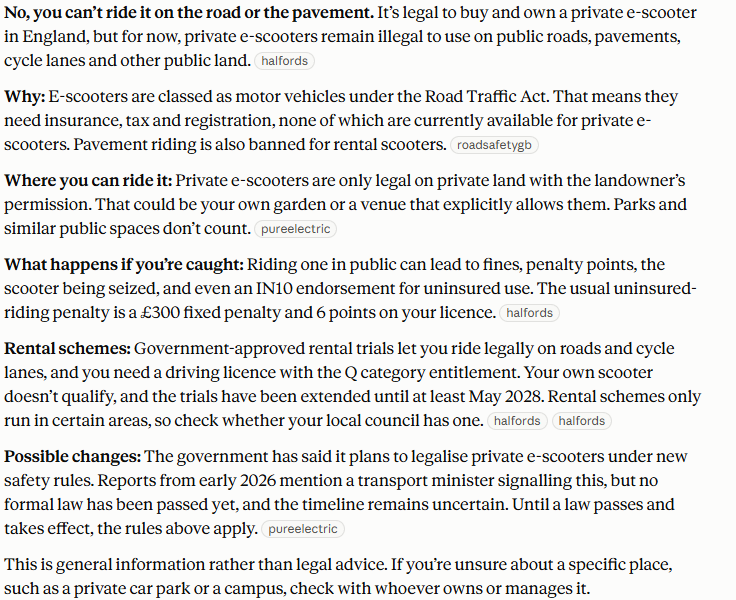 No, you can’t ride it on the road or the pavement. It’s legal to buy and own a private e-scooter in England, but for now, private e-scooters remain illegal to use on public roads, pavements, cycle lanes and other public land. Source: halfords Why: E-scooters are classed as motor vehicles under the Road Traffic Act. That means they need insurance, tax and registration, none of which are currently available for private e-scooters. Pavement riding is also banned for rental scooters. Source: roadsafetygb Where you can ride it: Private e-scooters are only legal on private land with the landowner’s permission. That could be your own garden or a venue that explicitly allows them. Parks and similar public spaces don’t count. Source: pureelectric What happens if you’re caught: Riding one in public can lead to fines, penalty points, the scooter being seized, and even an IN10 endorsement for uninsured use. The usual uninsured-riding penalty is a £300 fixed penalty and 6 points on your licence. Source: halfords Rental schemes: Government-approved rental trials let you ride legally on roads and cycle lanes, and you need a driving licence with the Q category entitlement. Your own scooter doesn’t qualify, and the trials have been extended until at least May 2028. Rental schemes only run in certain areas, so check whether your local council has one. Source: halfords Source: halfords Possible changes: The government has said it plans to legalise private e-scooters under new safety rules. Reports from early 2026 mention a transport minister signalling this, but no formal law has been passed yet, and the timeline remains uncertain. Until a law passes and takes effect, the rules above apply. Source: pureelectric This is general information rather than legal advice. If you’re unsure about a specific place, such as a private car park or a campus, check with whoever owns or manages it.
 -
Try 3 Right
Our summary: No to both; also cycle lanes and bridleways; private land with permission only; rental trials are the only legal public use; no law change passed yet.
The answer, with its screenshot
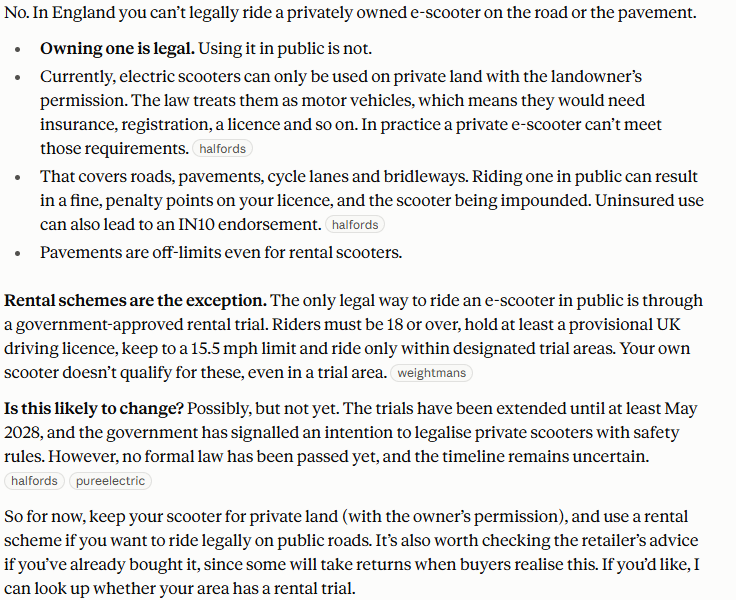 No. In England you can’t legally ride a privately owned e-scooter on the road or the pavement. Owning one is legal. Using it in public is not. Currently, electric scooters can only be used on private land with the landowner’s permission. The law treats them as motor vehicles, which means they would need insurance, registration, a licence and so on. In practice a private e-scooter can’t meet those requirements. Source: halfords That covers roads, pavements, cycle lanes and bridleways. Riding one in public can result in a fine, penalty points on your licence, and the scooter being impounded. Uninsured use can also lead to an IN10 endorsement. Source: halfords Pavements are off-limits even for rental scooters. Rental schemes are the exception. The only legal way to ride an e-scooter in public is through a government-approved rental trial. Riders must be 18 or over, hold at least a provisional UK driving licence, keep to a 15.5 mph limit and ride only within designated trial areas. Your own scooter doesn’t qualify for these, even in a trial area. Source: weightmans Is this likely to change? Possibly, but not yet. The trials have been extended until at least May 2028, and the government has signalled an intention to legalise private scooters with safety rules. However, no formal law has been passed yet, and the timeline remains uncertain. Source: halfords Source: pureelectric So for now, keep your scooter for private land (with the owner’s permission), and use a rental scheme if you want to ride legally on public roads. It’s also worth checking the retailer’s advice if you’ve already bought it, since some will take returns when buyers realise this. If you’d like, I can look up whether your area has a rental trial.
-
-
Copilot free
3 of 3 right-
Try 1 Right
Our summary: No to both, and to other public places such as parks; private land with permission only; rental scooters in approved trial schemes may use roads and cycle lanes, not pavements.
The answer, with its screenshot
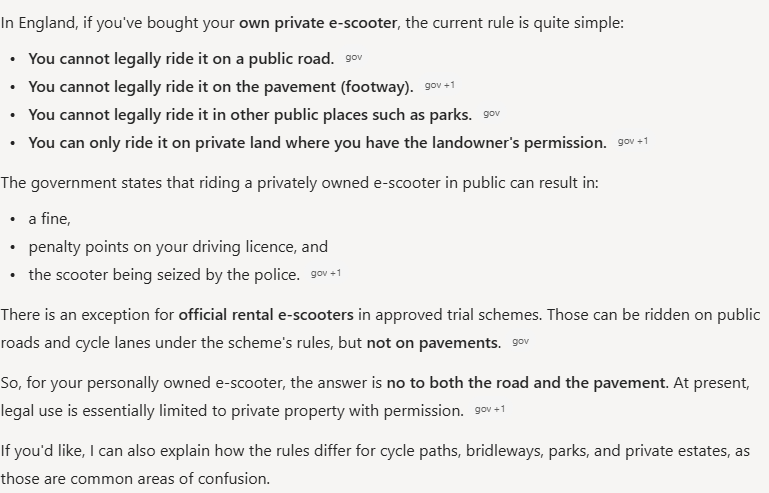 In England, if you've bought your own private e-scooter, the current rule is quite simple: You cannot legally ride it on a public road. Source: gov You cannot legally ride it on the pavement (footway). Source: gov +1 You cannot legally ride it in other public places such as parks. Source: gov You can only ride it on private land where you have the landowner's permission. Source: gov +1 The government states that riding a privately owned e-scooter in public can result in: a fine, penalty points on your driving licence, and the scooter being seized by the police. Source: gov +1 There is an exception for official rental e-scooters in approved trial schemes. Those can be ridden on public roads and cycle lanes under the scheme's rules, but not on pavements. Source: gov So, for your personally owned e-scooter, the answer is no to both the road and the pavement. At present, legal use is essentially limited to private property with permission. Source: gov +1 If you'd like, I can also explain how the rules differ for cycle paths, bridleways, parks, and private estates, as those are common areas of confusion.
 -
Try 2 Right
Our summary: No to both, and to parks and cycle lanes; private land with permission only; rental trial scooters may use roads and cycle lanes in participating areas, not pavements.
The answer, with its screenshot
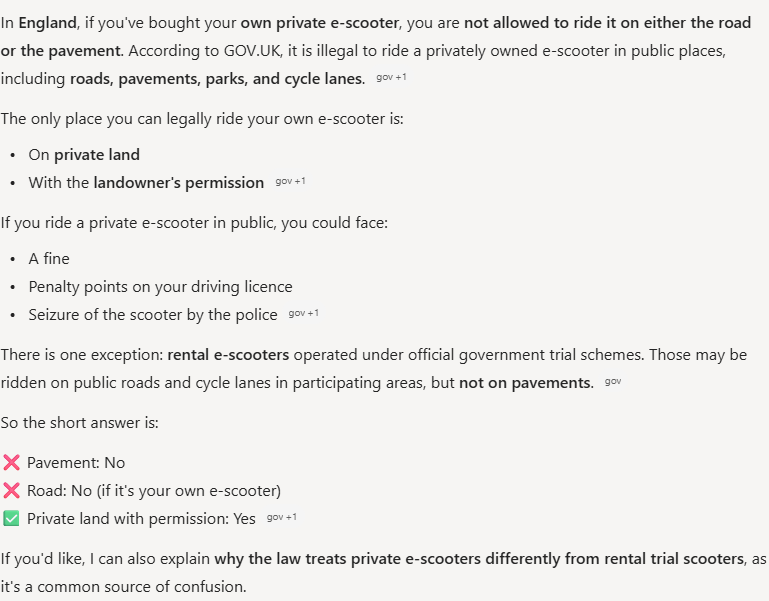 In England, if you've bought your own private e-scooter, you are not allowed to ride it on either the road or the pavement. According to GOV.UK, it is illegal to ride a privately owned e-scooter in public places, including roads, pavements, parks, and cycle lanes. Source: gov +1 The only place you can legally ride your own e-scooter is: On private land With the landowner's permission Source: gov +1 If you ride a private e-scooter in public, you could face: A fine Penalty points on your driving licence Seizure of the scooter by the police Source: gov +1 There is one exception: rental e-scooters operated under official government trial schemes. Those may be ridden on public roads and cycle lanes in participating areas, but not on pavements. Source: gov So the short answer is: ❌ Pavement: No ❌ Road: No (if it's your own e-scooter) ✅ Private land with permission: Yes Source: gov +1 If you'd like, I can also explain why the law treats private e-scooters differently from rental trial scooters, as it's a common source of confusion.
 -
Try 3 Right
Our summary: Road not legal, pavement not legal, public cycle lanes not legal; private land with permission legal; rental scooters only within the relevant trial area and not on pavements.
The answer, with its screenshot
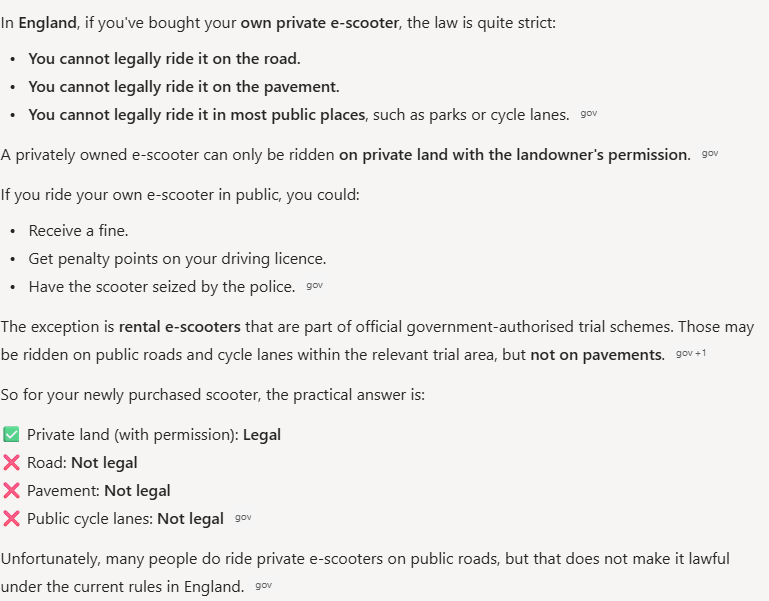 In England, if you've bought your own private e-scooter, the law is quite strict: You cannot legally ride it on the road. You cannot legally ride it on the pavement. You cannot legally ride it in most public places, such as parks or cycle lanes. Source: gov A privately owned e-scooter can only be ridden on private land with the landowner's permission. Source: gov If you ride your own e-scooter in public, you could: Receive a fine. Get penalty points on your driving licence. Have the scooter seized by the police. Source: gov The exception is rental e-scooters that are part of official government-authorised trial schemes. Those may be ridden on public roads and cycle lanes within the relevant trial area, but not on pavements. Source: gov +1 So for your newly purchased scooter, the practical answer is: ✅ Private land (with permission): Legal ❌ Road: Not legal ❌ Pavement: Not legal ❌ Public cycle lanes: Not legal Source: gov Unfortunately, many people do ride private e-scooters on public roads, but that does not make it lawful under the current rules in England. Source: gov
-
-
Gemini free
3 of 3 right-
Try 1 Right
Our summary: No to both; table: private land yes with permission, pavements, roads, cycle lanes and parks no; legal rental scooters belong to trial schemes in designated areas.
The answer, with its screenshot
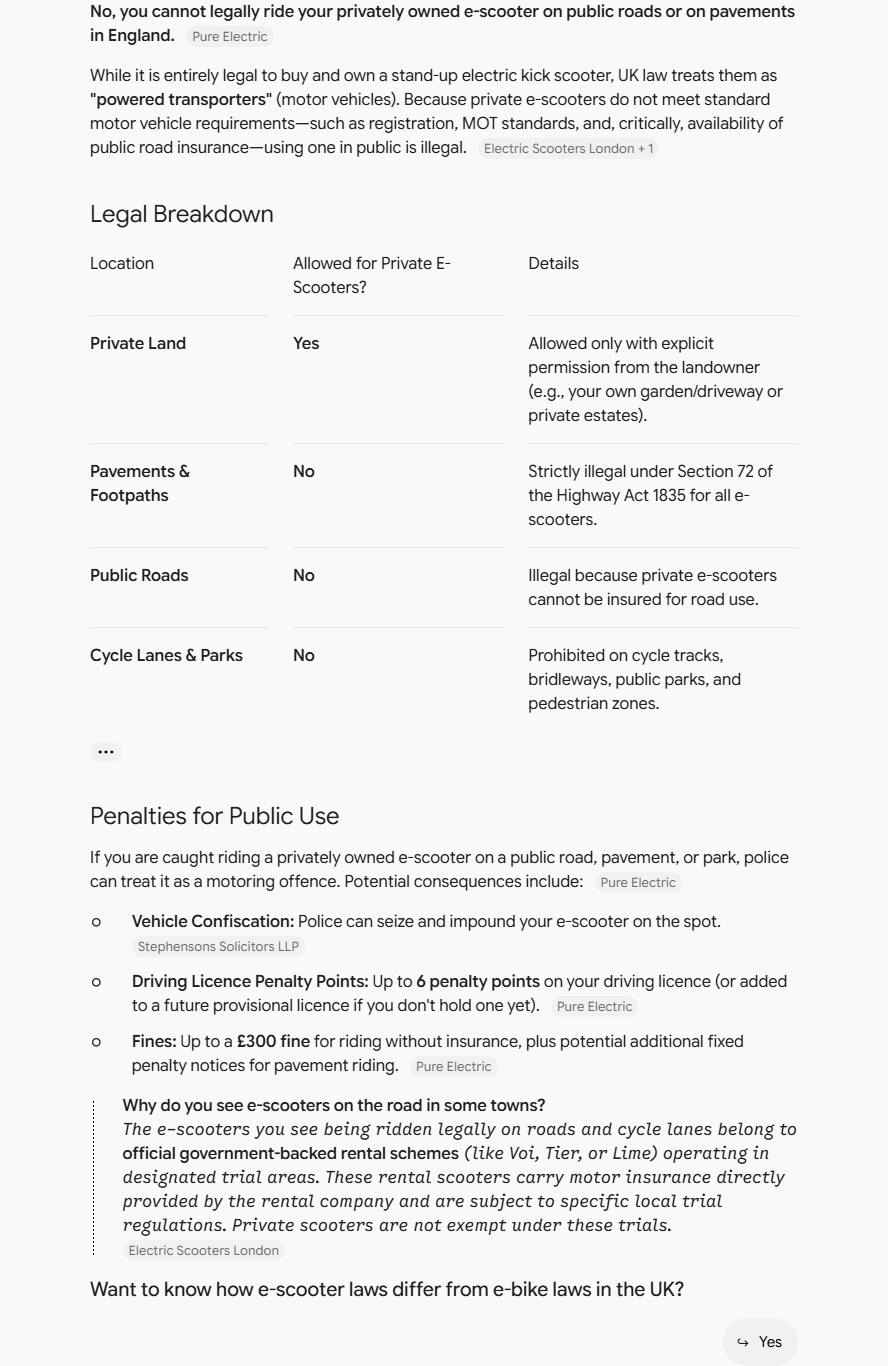 No, you cannot legally ride your privately owned e-scooter on public roads or on pavements in England. Source: Pure Electric While it is entirely legal to buy and own a stand-up electric kick scooter, UK law treats them as "powered transporters" (motor vehicles). Because private e-scooters do not meet standard motor vehicle requirements—such as registration, MOT standards, and, critically, availability of public road insurance—using one in public is illegal. Source: Electric Scooters London +1 Legal Breakdown Location Allowed for Private E-Scooters? Details Private Land Yes Allowed only with explicit permission from the landowner (e.g., your own garden/driveway or private estates). Pavements & Footpaths No Strictly illegal under Section 72 of the Highway Act 1835 for all e-scooters. Public Roads No Illegal because private e-scooters cannot be insured for road use. Cycle Lanes & Parks No Prohibited on cycle tracks, bridleways, public parks, and pedestrian zones. Penalties for Public Use If you are caught riding a privately owned e-scooter on a public road, pavement, or park, police can treat it as a motoring offence. Potential consequences include: Source: Pure Electric Vehicle Confiscation: Police can seize and impound your e-scooter on the spot. Source: Stephensons Solicitors LLP Driving Licence Penalty Points: Up to 6 penalty points on your driving licence (or added to a future provisional licence if you don't hold one yet). Source: Pure Electric Fines: Up to a £300 fine for riding without insurance, plus potential additional fixed penalty notices for pavement riding. Source: Pure Electric Why do you see e-scooters on the road in some towns? The e-scooters you see being ridden legally on roads and cycle lanes belong to official government-backed rental schemes (like Voi, Tier, or Lime) operating in designated trial areas. These rental scooters carry motor insurance directly provided by the rental company and are subject to specific local trial regulations. Private scooters are not exempt under these trials. Source: Electric Scooters London Want to know how e-scooter laws differ from e-bike laws in the UK? Yes
 -
Try 2 Right
Our summary: No to both, said twice (the reply holds a spliced second answer that also opens no); private land with permission only; rental trial scooters legal on roads and cycle lanes, never pavements.
The answer, with its screenshot
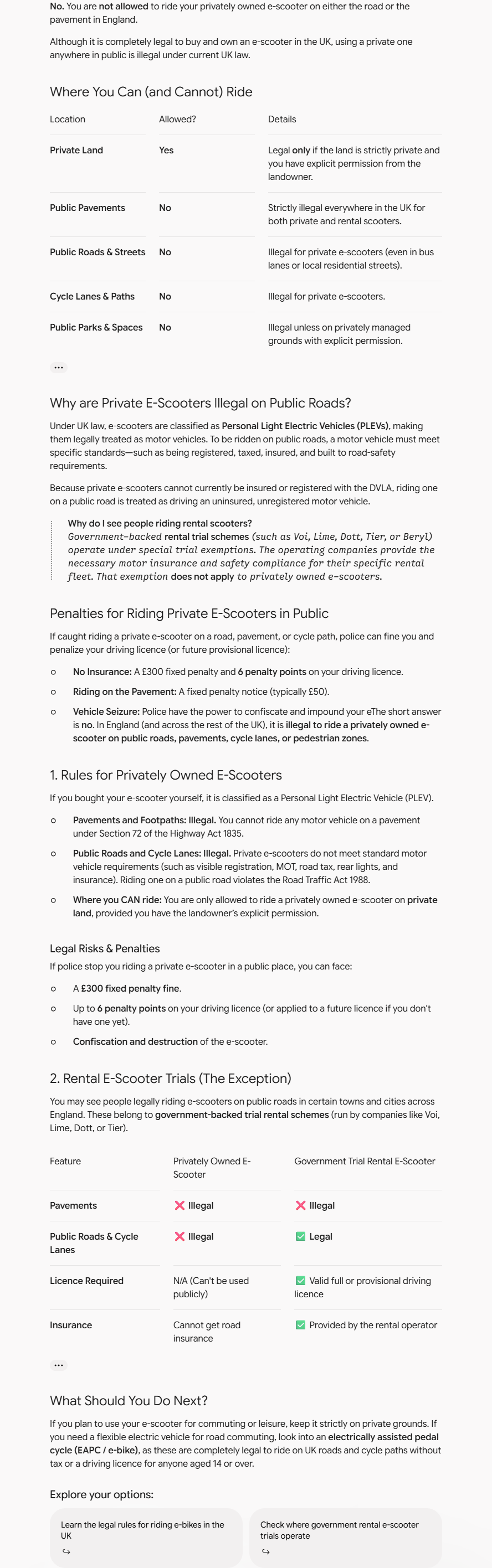 No. You are not allowed to ride your privately owned e-scooter on either the road or the pavement in England. Although it is completely legal to buy and own an e-scooter in the UK, using a private one anywhere in public is illegal under current UK law. Where You Can (and Cannot) Ride Location Allowed? Details Private Land Yes Legal only if the land is strictly private and you have explicit permission from the landowner. Public Pavements No Strictly illegal everywhere in the UK for both private and rental scooters. Public Roads & Streets No Illegal for private e-scooters (even in bus lanes or local residential streets). Cycle Lanes & Paths No Illegal for private e-scooters. Public Parks & Spaces No Illegal unless on privately managed grounds with explicit permission. Why are Private E-Scooters Illegal on Public Roads? Under UK law, e-scooters are classified as Personal Light Electric Vehicles (PLEVs), making them legally treated as motor vehicles. To be ridden on public roads, a motor vehicle must meet specific standards—such as being registered, taxed, insured, and built to road-safety requirements. Because private e-scooters cannot currently be insured or registered with the DVLA, riding one on a public road is treated as driving an uninsured, unregistered motor vehicle. Why do I see people riding rental scooters? Government-backed rental trial schemes (such as Voi, Lime, Dott, Tier, or Beryl) operate under special trial exemptions. The operating companies provide the necessary motor insurance and safety compliance for their specific rental fleet. That exemption does not apply to privately owned e-scooters. Penalties for Riding Private E-Scooters in Public If caught riding a private e-scooter on a road, pavement, or cycle path, police can fine you and penalize your driving licence (or future provisional licence): No Insurance: A £300 fixed penalty and 6 penalty points on your driving licence. Riding on the Pavement: A fixed penalty notice (typically £50). Vehicle Seizure: Police have the power to confiscate and impound your eThe short answer is no. In England (and across the rest of the UK), it is illegal to ride a privately owned e-scooter on public roads, pavements, cycle lanes, or pedestrian zones. 1. Rules for Privately Owned E-Scooters If you bought your e-scooter yourself, it is classified as a Personal Light Electric Vehicle (PLEV). Pavements and Footpaths: Illegal. You cannot ride any motor vehicle on a pavement under Section 72 of the Highway Act 1835. Public Roads and Cycle Lanes: Illegal. Private e-scooters do not meet standard motor vehicle requirements (such as visible registration, MOT, road tax, rear lights, and insurance). Riding one on a public road violates the Road Traffic Act 1988. Where you CAN ride: You are only allowed to ride a privately owned e-scooter on private land, provided you have the landowner’s explicit permission. Legal Risks & Penalties If police stop you riding a private e-scooter in a public place, you can face: A £300 fixed penalty fine. Up to 6 penalty points on your driving licence (or applied to a future licence if you don't have one yet). Confiscation and destruction of the e-scooter. 2. Rental E-Scooter Trials (The Exception) You may see people legally riding e-scooters on public roads in certain towns and cities across England. These belong to government-backed trial rental schemes (run by companies like Voi, Lime, Dott, or Tier). Feature Privately Owned E-Scooter Government Trial Rental E-Scooter Pavements ❌ Illegal ❌ Illegal Public Roads & Cycle Lanes ❌ Illegal ✅ Legal Licence Required N/A (Can't be used publicly) ✅ Valid full or provisional driving licence Insurance Cannot get road insurance ✅ Provided by the rental operator What Should You Do Next? If you plan to use your e-scooter for commuting or leisure, keep it strictly on private grounds. If you need a flexible electric vehicle for road commuting, look into an electrically assisted pedal cycle (EAPC / e-bike), as these are completely legal to ride on UK roads and cycle paths without tax or a driving licence for anyone aged 14 or over. Explore your options: Learn the legal rules for riding e-bikes in the UK Check where government rental e-scooter trials operate
 -
Try 3 Right
Our summary: No to both; legal to own, illegal anywhere in public; table: pavements, roads, cycle and bus lanes, parks no; private land with permission yes.
The answer, with its screenshot
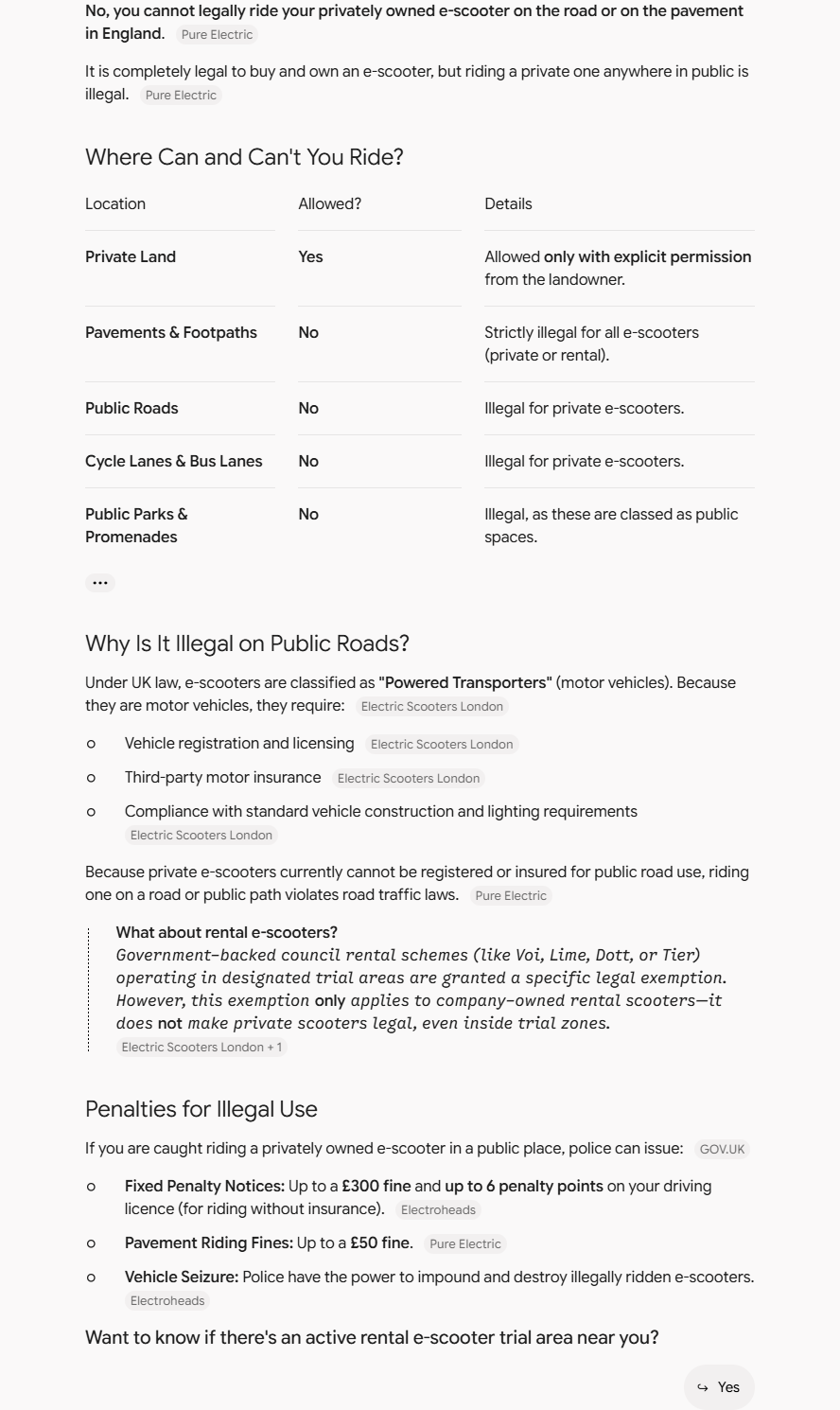 No, you cannot legally ride your privately owned e-scooter on the road or on the pavement in England. Source: Pure Electric It is completely legal to buy and own an e-scooter, but riding a private one anywhere in public is illegal. Source: Pure Electric Where Can and Can't You Ride? Location Allowed? Details Private Land Yes Allowed only with explicit permission from the landowner. Pavements & Footpaths No Strictly illegal for all e-scooters (private or rental). Public Roads No Illegal for private e-scooters. Cycle Lanes & Bus Lanes No Illegal for private e-scooters. Public Parks & Promenades No Illegal, as these are classed as public spaces. Why Is It Illegal on Public Roads? Under UK law, e-scooters are classified as "Powered Transporters" (motor vehicles). Because they are motor vehicles, they require: Source: Electric Scooters London Vehicle registration and licensing Source: Electric Scooters London Third-party motor insurance Source: Electric Scooters London Compliance with standard vehicle construction and lighting requirements Source: Electric Scooters London Because private e-scooters currently cannot be registered or insured for public road use, riding one on a road or public path violates road traffic laws. Source: Pure Electric What about rental e-scooters? Government-backed council rental schemes (like Voi, Lime, Dott, or Tier) operating in designated trial areas are granted a specific legal exemption. However, this exemption only applies to company-owned rental scooters—it does not make private scooters legal, even inside trial zones. Source: Electric Scooters London +1 Penalties for Illegal Use If you are caught riding a privately owned e-scooter in a public place, police can issue: Source: GOV.UK Fixed Penalty Notices: Up to a £300 fine and up to 6 penalty points on your driving licence (for riding without insurance). Source: Electroheads Pavement Riding Fines: Up to a £50 fine. Source: Pure Electric Vehicle Seizure: Police have the power to impound and destroy illegally ridden e-scooters. Source: Electroheads Want to know if there's an active rental e-scooter trial area near you? Yes
-
-
Grok free
1 of 3 right-
Try 1 Nothing came back the app errored or never finished
-
Try 2 Nothing came back the app errored or never finished
-
Try 3 Right
Our summary: No to both, citing GOV.UK; private land with permission only; rental trial scooters may use roads and cycle lanes in trial areas, not pavements or motorways; planned legislation not in force.
The answer, with its screenshot
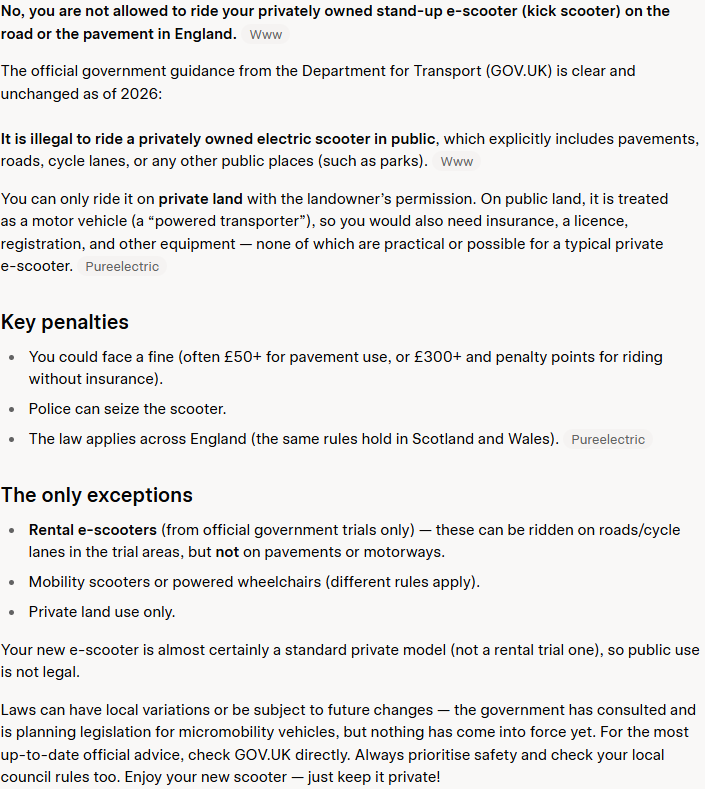 No, you are not allowed to ride your privately owned stand-up e-scooter (kick scooter) on the road or the pavement in England.Www The official government guidance from the Department for Transport (GOV.UK) is clear and unchanged as of 2026: It is illegal to ride a privately owned electric scooter in public, which explicitly includes pavements, roads, cycle lanes, or any other public places (such as parks).Www You can only ride it on private land with the landowner’s permission. On public land, it is treated as a motor vehicle (a “powered transporter”), so you would also need insurance, a licence, registration, and other equipment — none of which are practical or possible for a typical private e-scooter.Pureelectric Key penalties You could face a fine (often £50+ for pavement use, or £300+ and penalty points for riding without insurance). Police can seize the scooter. The law applies across England (the same rules hold in Scotland and Wales).Pureelectric The only exceptions Rental e-scooters (from official government trials only) — these can be ridden on roads/cycle lanes in the trial areas, but not on pavements or motorways. Mobility scooters or powered wheelchairs (different rules apply). Private land use only. Your new e-scooter is almost certainly a standard private model (not a rental trial one), so public use is not legal. Laws can have local variations or be subject to future changes — the government has consulted and is planning legislation for micromobility vehicles, but nothing has come into force yet. For the most up-to-date official advice, check GOV.UK directly. Always prioritise safety and check your local council rules too. Enjoy your new scooter — just keep it private!
-
-
Perplexity free
3 of 3 right-
Try 1 Right
Our summary: No to both, and to parks and cycle lanes; private land with permission only; rental scooters in designated trial areas may use roads and cycle lanes, not pavements.
The answer, with its screenshot
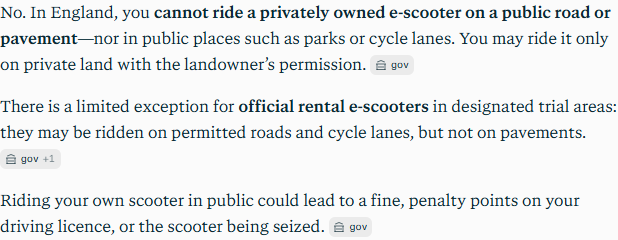 No. In England, you cannot ride a privately owned e-scooter on a public road or pavement—nor in public places such as parks or cycle lanes. You may ride it only on private land with the landowner’s permission. Source: gov There is a limited exception for official rental e-scooters in designated trial areas: they may be ridden on permitted roads and cycle lanes, but not on pavements. Source: gov +1 Riding your own scooter in public could lead to a fine, penalty points on your driving licence, or the scooter being seized. Source: gov
 -
Try 2 Right
Our summary: No to both, and to cycle lanes, parks and other public spaces; private land with permission only; an official rental scheme's scooters may use roads and cycle lanes where one operates, not pavements.
The answer, with its screenshot
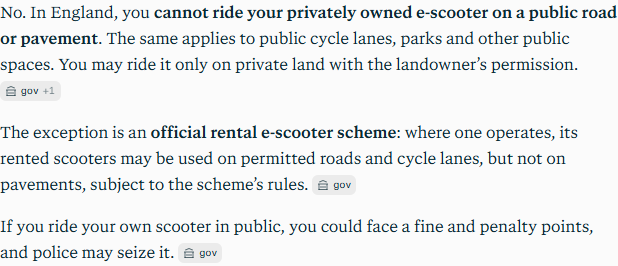 No. In England, you cannot ride your privately owned e-scooter on a public road or pavement. The same applies to public cycle lanes, parks and other public spaces. You may ride it only on private land with the landowner’s permission. Source: gov +1 The exception is an official rental e-scooter scheme: where one operates, its rented scooters may be used on permitted roads and cycle lanes, but not on pavements, subject to the scheme’s rules. Source: gov If you ride your own scooter in public, you could face a fine and penalty points, and police may seize it. Source: gov
 -
Try 3 Right
Our summary: No to both, and to cycle lanes and parks; private land with permission only; an official rental scheme's scooters may use roads and cycle lanes where one operates, not pavements.
The answer, with its screenshot
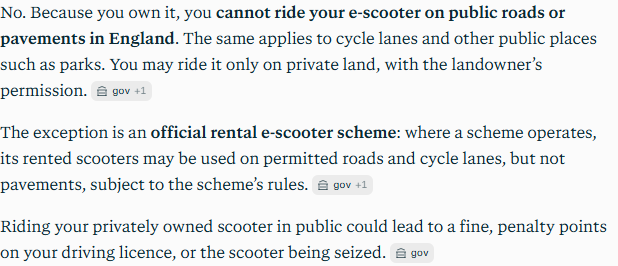 No. Because you own it, you cannot ride your e-scooter on public roads or pavements in England. The same applies to cycle lanes and other public places such as parks. You may ride it only on private land, with the landowner’s permission. Source: gov +1 The exception is an official rental e-scooter scheme: where a scheme operates, its rented scooters may be used on permitted roads and cycle lanes, but not pavements, subject to the scheme’s rules. Source: gov +1 Riding your privately owned scooter in public could lead to a fine, penalty points on your driving licence, or the scooter being seized. Source: gov
-
Question 3 A tenant given a no-fault eviction notice in September 2026: is it valid? sealed
What it tests: Whether an app is up to date on the rules for ending a private tenancy in England.
16 of 18 tries right
-
ChatGPT free
3 of 3 right-
Try 1 Right
Our summary: Said no: section 21 no-fault eviction was abolished from 1 May 2026 and the transitional rules cover only notices served before then; the landlord may still have other legal grounds.
Full answer
The key issue is the date your landlord served the notice: 28 September 2026. […] There are two separate questions: Can your landlord still use section 21 on that date? Even if they can, does your particular notice satisfy the legal requirements? Also, a section 21 notice does not itself end your tenancy or mean your landlord can immediately evict you. Usually, if you do not leave, the landlord must obtain a court possession order and follow the legal eviction process. The likely answer: no, the notice cannot be used to evict you under section 21. The government's guidance confirms that, from 1 May 2026, section 21 ‘no-fault’ evictions were abolished for private renters in England under the Renters’ Rights Act 2025. GOV.UK +1 Because your landlord served the notice on 28 September 2026, nearly five months after the change took effect, they cannot rely on section 21 to obtain a possession order. The transitional arrangements apply to qualifying notices served before 1 May 2026, not to a new notice served in September. GOV.UK +1 Your landlord may still be able to seek possession using a valid legal ground under the new rules, but a two-month section 21 notice does not achieve that. What you should do now Do not assume you must leave just because the notice gives you two months. Keep the notice, tenancy agreement and any messages from your landlord. If your landlord threatens eviction or starts court proceedings, seek advice from Shelter England Source: or Citizens Advice . Your landlord cannot lawfully force you out by changing the locks or removing your belongings without following the applicable legal process. One important distinction: your landlord may have other lawful grounds for possession, depending on the circumstances. The conclusion here is specifically about the section 21 notice served on 28 September 2026. -
Try 2 Right
Our summary: Said no: section 21 notices were abolished from 1 May 2026, the tenancy became an assured periodic tenancy that day, and the landlord would need a section 8 notice on a recognised ground.
Note: it named section 8, the route a landlord must now use.
The answer, with its screenshot
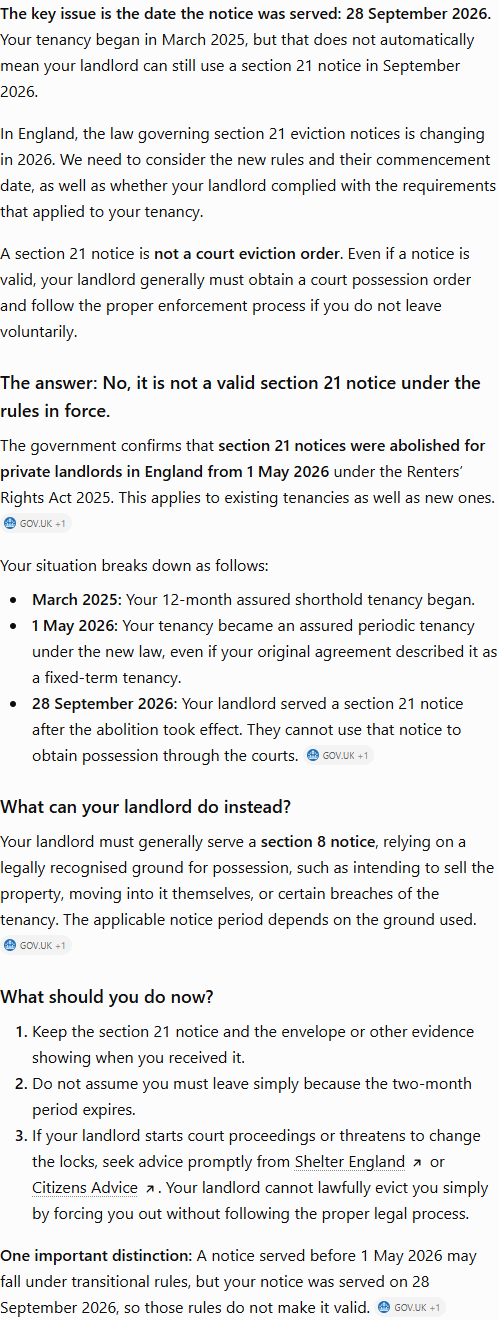 The key issue is the date the notice was served: 28 September 2026. Your tenancy began in March 2025, but that does not automatically mean your landlord can still use a section 21 notice in September 2026. In England, the law governing section 21 eviction notices is changing in 2026. We need to consider the new rules and their commencement date, as well as whether your landlord complied with the requirements that applied to your tenancy. A section 21 notice is not a court eviction order. Even if a notice is valid, your landlord generally must obtain a court possession order and follow the proper enforcement process if you do not leave voluntarily. The answer: No, it is not a valid section 21 notice under the rules in force. The government confirms that section 21 notices were abolished for private landlords in England from 1 May 2026 under the Renters’ Rights Act 2025. This applies to existing tenancies as well as new ones. GOV.UK +1 Your situation breaks down as follows: […] 1 May 2026: Your tenancy became an assured periodic tenancy under the new law, even if your original agreement described it as a fixed-term tenancy. 28 September 2026: Your landlord served a section 21 notice after the abolition took effect. They cannot use that notice to obtain possession through the courts. GOV.UK +1 What can your landlord do instead? Your landlord must generally serve a section 8 notice, relying on a legally recognised ground for possession, such as intending to sell the property, moving into it themselves, or certain breaches of the tenancy. The applicable notice period depends on the ground used. GOV.UK +1 What should you do now? Keep the section 21 notice and the envelope or other evidence showing when you received it. Do not assume you must leave simply because the two-month period expires. If your landlord starts court proceedings or threatens to change the locks, seek advice promptly from Shelter England Source: or Citizens Advice . Your landlord cannot lawfully evict you simply by forcing you out without following the proper legal process. One important distinction: A notice served before 1 May 2026 may fall under transitional rules, but your notice was served on 28 September 2026, so those rules do not make it valid. GOV.UK +1
 -
Try 3 Right
Our summary: Opened with "may be invalid", then a "Why the notice is not valid" section and a labelled "In short" conclusion: not a valid route; section 21 abolished 1 May 2026; tenancy now assured periodic; section 8 needed.
Note: it named section 8, the route a landlord must now use.
The answer, with its screenshot
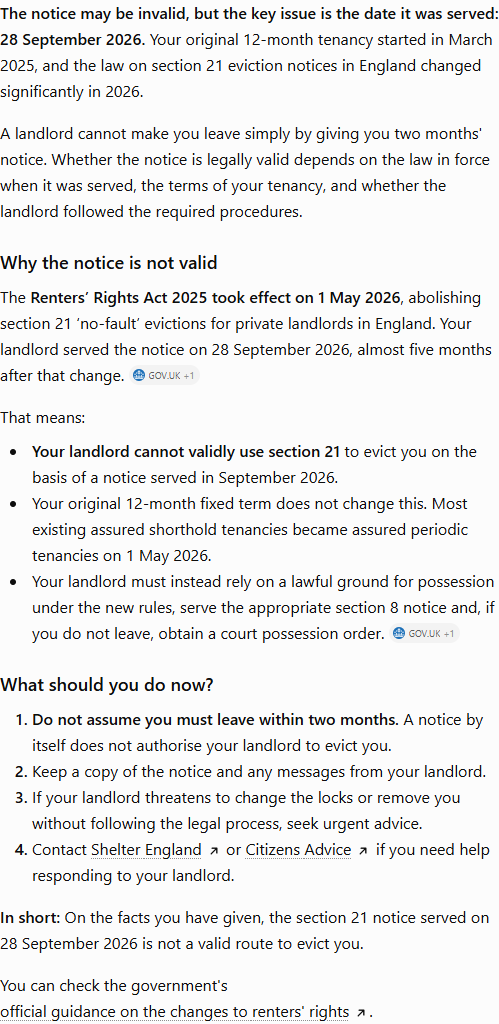 The notice may be invalid, but the key issue is the date it was served: 28 September 2026. […] A landlord cannot make you leave simply by giving you two months' notice. Whether the notice is legally valid depends on the law in force when it was served, the terms of your tenancy, and whether the landlord followed the required procedures. Why the notice is not valid The Renters’ Rights Act 2025 took effect on 1 May 2026, abolishing section 21 ‘no-fault’ evictions for private landlords in England. Your landlord served the notice on 28 September 2026, almost five months after that change. GOV.UK +1 That means: Your landlord cannot validly use section 21 to evict you on the basis of a notice served in September 2026. Your original 12-month fixed term does not change this. Most existing assured shorthold tenancies became assured periodic tenancies on 1 May 2026. Your landlord must instead rely on a lawful ground for possession under the new rules, serve the appropriate section 8 notice and, if you do not leave, obtain a court possession order. GOV.UK +1 What should you do now? Do not assume you must leave within two months. A notice by itself does not authorise your landlord to evict you. Keep a copy of the notice and any messages from your landlord. If your landlord threatens to change the locks or remove you without following the legal process, seek urgent advice. Contact Shelter England Source: or Citizens Advice if you need help responding to your landlord. In short: On the facts you have given, the section 21 notice served on 28 September 2026 is not a valid route to evict you. You can check the government's official guidance on the changes to renters' rights .
-
-
Claude free
3 of 3 right-
Try 1 Right
Our summary: Said no, almost certainly invalid: section 21 abolished from 1 May 2026; every AST converted to an assured periodic tenancy that day; the only legal route is a section 8 notice on a statutory ground.
Note: it named section 8, the route a landlord must now use.
The answer, with its screenshot
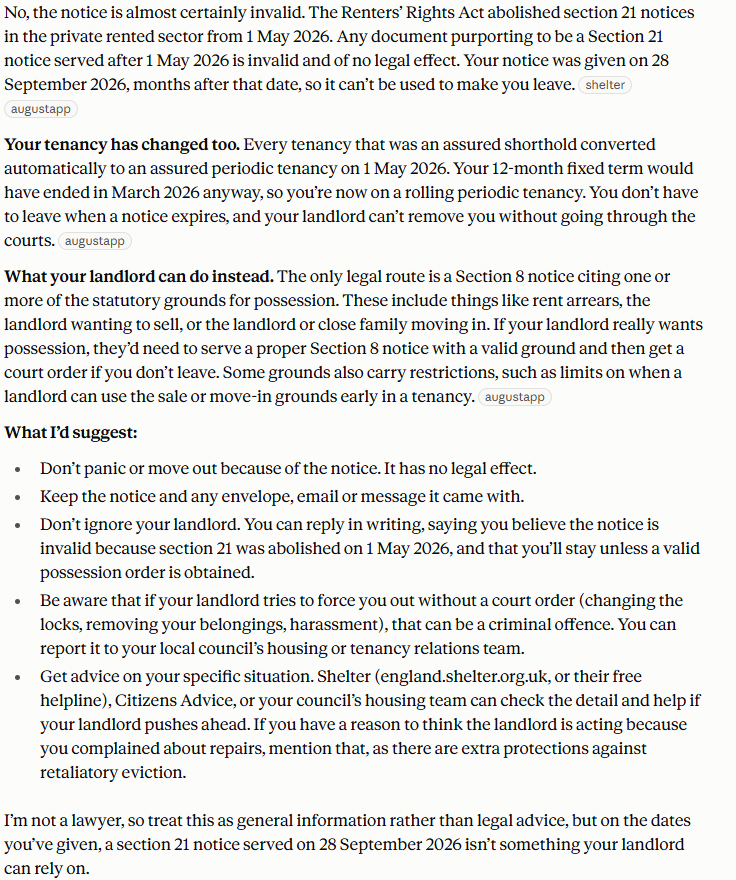 No, the notice is almost certainly invalid. The Renters’ Rights Act abolished section 21 notices in the private rented sector from 1 May 2026. Any document purporting to be a Section 21 notice served after 1 May 2026 is invalid and of no legal effect. Your notice was given on 28 September 2026, months after that date, so it can’t be used to make you leave. Source: shelter Source: augustapp Your tenancy has changed too. Every tenancy that was an assured shorthold converted automatically to an assured periodic tenancy on 1 May 2026. Your 12-month fixed term would have ended in March 2026 anyway, so you’re now on a rolling periodic tenancy. You don’t have to leave when a notice expires, and your landlord can’t remove you without going through the courts. Source: augustapp What your landlord can do instead. The only legal route is a Section 8 notice citing one or more of the statutory grounds for possession. These include things like rent arrears, the landlord wanting to sell, or the landlord or close family moving in. If your landlord really wants possession, they’d need to serve a proper Section 8 notice with a valid ground and then get a court order if you don’t leave. Some grounds also carry restrictions, such as limits on when a landlord can use the sale or move-in grounds early in a tenancy. Source: augustapp What I’d suggest: Don’t panic or move out because of the notice. It has no legal effect. Keep the notice and any envelope, email or message it came with. Don’t ignore your landlord. You can reply in writing, saying you believe the notice is invalid because section 21 was abolished on 1 May 2026, and that you’ll stay unless a valid possession order is obtained. Be aware that if your landlord tries to force you out without a court order (changing the locks, removing your belongings, harassment), that can be a criminal offence. You can report it to your local council’s housing or tenancy relations team. Get advice on your specific situation. Shelter (england.shelter.org.uk, or their free helpline), Citizens Advice, or your council’s housing team can check the detail and help if your landlord pushes ahead. If you have a reason to think the landlord is acting because you complained about repairs, mention that, as there are extra protections against retaliatory eviction. I’m not a lawyer, so treat this as general information rather than legal advice, but on the dates you’ve given, a section 21 notice served on 28 September 2026 isn’t something your landlord can rely on.
 -
Try 2 Right
Our summary: Said no: section 21 notices and ASTs were abolished from 1 May 2026; the tenancy now rolls on as an assured periodic tenancy; possession goes through section 8 grounds and the court.
Note: it named section 8, the route a landlord must now use.
The answer, with its screenshot
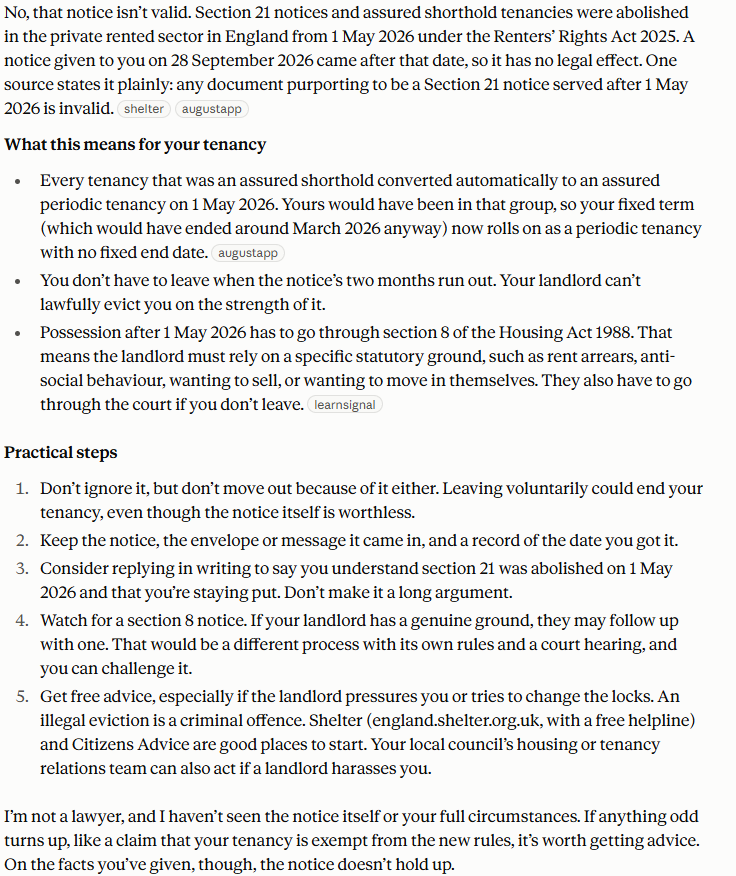 No, that notice isn’t valid. Section 21 notices and assured shorthold tenancies were abolished in the private rented sector in England from 1 May 2026 under the Renters’ Rights Act 2025. A notice given to you on 28 September 2026 came after that date, so it has no legal effect. One source states it plainly: any document purporting to be a Section 21 notice served after 1 May 2026 is invalid. Source: shelter Source: augustapp What this means for your tenancy Every tenancy that was an assured shorthold converted automatically to an assured periodic tenancy on 1 May 2026. Yours would have been in that group, so your fixed term (which would have ended around March 2026 anyway) now rolls on as a periodic tenancy with no fixed end date. Source: augustapp You don’t have to leave when the notice’s two months run out. Your landlord can’t lawfully evict you on the strength of it. Possession after 1 May 2026 has to go through section 8 of the Housing Act 1988. That means the landlord must rely on a specific statutory ground, such as rent arrears, anti-social behaviour, wanting to sell, or wanting to move in themselves. They also have to go through the court if you don’t leave. Source: learnsignal Practical steps Don’t ignore it, but don’t move out because of it either. Leaving voluntarily could end your tenancy, even though the notice itself is worthless. Keep the notice, the envelope or message it came in, and a record of the date you got it. Consider replying in writing to say you understand section 21 was abolished on 1 May 2026 and that you’re staying put. Don’t make it a long argument. Watch for a section 8 notice. If your landlord has a genuine ground, they may follow up with one. That would be a different process with its own rules and a court hearing, and you can challenge it. Get free advice, especially if the landlord pressures you or tries to change the locks. An illegal eviction is a criminal offence. Shelter (england.shelter.org.uk, with a free helpline) and Citizens Advice are good places to start. Your local council’s housing or tenancy relations team can also act if a landlord harasses you. I’m not a lawyer, and I haven’t seen the notice itself or your full circumstances. If anything odd turns up, like a claim that your tenancy is exempt from the new rules, it’s worth getting advice. On the facts you’ve given, though, the notice doesn’t hold up.
 -
Try 3 Right
Our summary: Said no: section 21 abolished on 1 May 2026; notices served before then needed a court claim by 31 July 2026; the tenancy is now periodic assured; the landlord needs a section 8 ground.
Note: it named section 8, the route a landlord must now use.
The answer, with its screenshot
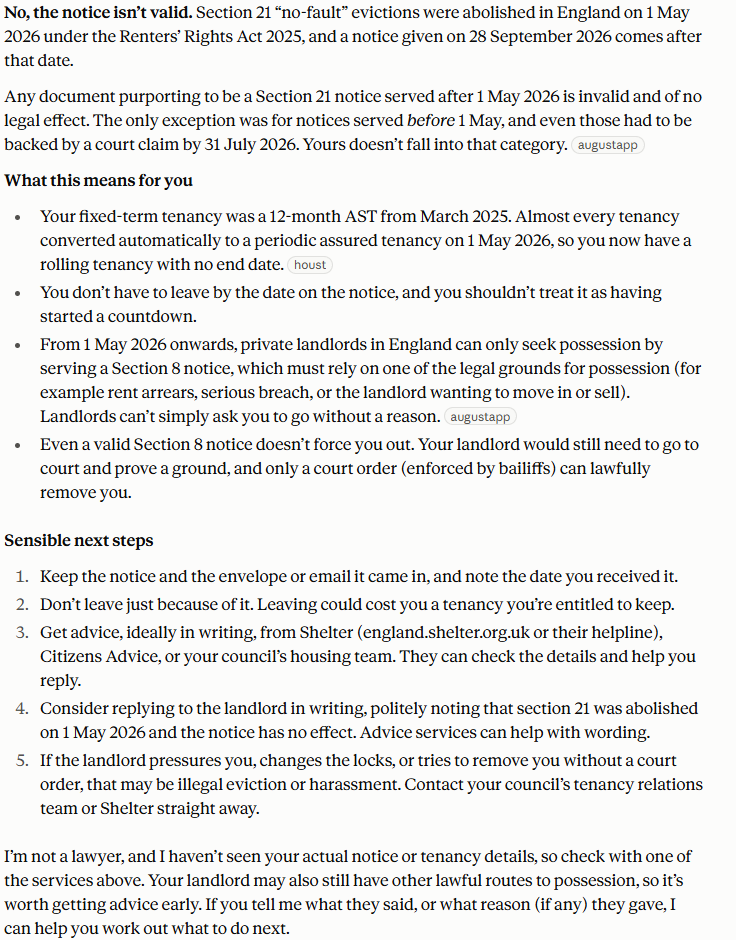 No, the notice isn’t valid. Section 21 “no-fault” evictions were abolished in England on 1 May 2026 under the Renters’ Rights Act 2025, and a notice given on 28 September 2026 comes after that date. Any document purporting to be a Section 21 notice served after 1 May 2026 is invalid and of no legal effect. The only exception was for notices served before 1 May, and even those had to be backed by a court claim by 31 July 2026. Yours doesn’t fall into that category. Source: augustapp What this means for you Your fixed-term tenancy was a 12-month AST from March 2025. Almost every tenancy converted automatically to a periodic assured tenancy on 1 May 2026, so you now have a rolling tenancy with no end date. Source: houst You don’t have to leave by the date on the notice, and you shouldn’t treat it as having started a countdown. From 1 May 2026 onwards, private landlords in England can only seek possession by serving a Section 8 notice, which must rely on one of the legal grounds for possession (for example rent arrears, serious breach, or the landlord wanting to move in or sell). Landlords can’t simply ask you to go without a reason. Source: augustapp Even a valid Section 8 notice doesn’t force you out. Your landlord would still need to go to court and prove a ground, and only a court order (enforced by bailiffs) can lawfully remove you. Sensible next steps Keep the notice and the envelope or email it came in, and note the date you received it. Don’t leave just because of it. Leaving could cost you a tenancy you’re entitled to keep. Get advice, ideally in writing, from Shelter (england.shelter.org.uk or their helpline), Citizens Advice, or your council’s housing team. They can check the details and help you reply. Consider replying to the landlord in writing, politely noting that section 21 was abolished on 1 May 2026 and the notice has no effect. Advice services can help with wording. If the landlord pressures you, changes the locks, or tries to remove you without a court order, that may be illegal eviction or harassment. Contact your council’s tenancy relations team or Shelter straight away. I’m not a lawyer, and I haven’t seen your actual notice or tenancy details, so check with one of the services above. Your landlord may also still have other lawful routes to possession, so it’s worth getting advice early. If you tell me what they said, or what reason (if any) they gave, I can help you work out what to do next.
-
-
Copilot free
3 of 3 right-
Try 1 Right
Our summary: Hedged no: unlikely to be valid, and it would expect the notice to be invalid; section 21 abolished from 1 May 2026 for most private tenancies; earlier notices needed proceedings by 31 July 2026.
The answer, with its screenshot
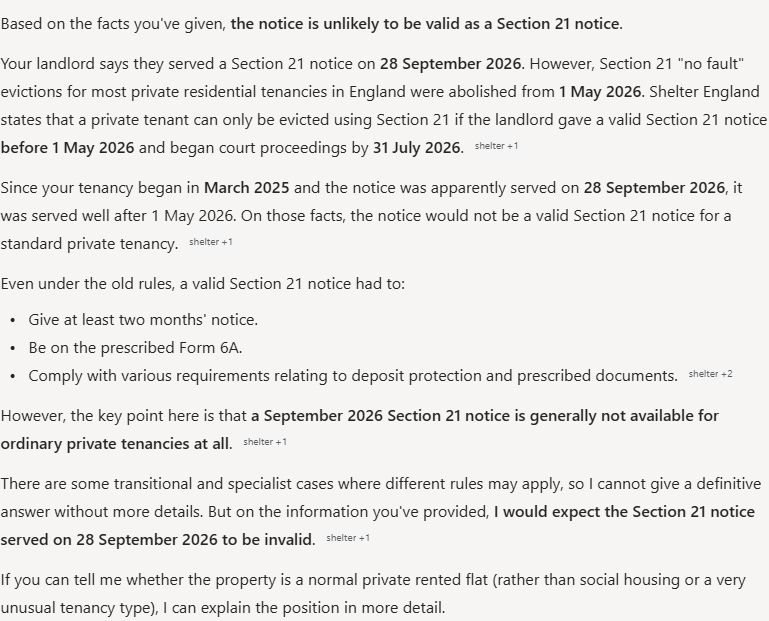 Based on the facts you've given, the notice is unlikely to be valid as a Section 21 notice. Your landlord says they served a Section 21 notice on 28 September 2026. However, Section 21 "no fault" evictions for most private residential tenancies in England were abolished from 1 May 2026. Shelter England states that a private tenant can only be evicted using Section 21 if the landlord gave a valid Section 21 notice before 1 May 2026 and began court proceedings by 31 July 2026. Source: shelter +1 Since your tenancy began in March 2025 and the notice was apparently served on 28 September 2026, it was served well after 1 May 2026. On those facts, the notice would not be a valid Section 21 notice for a standard private tenancy. Source: shelter +1 Even under the old rules, a valid Section 21 notice had to: Give at least two months' notice. Be on the prescribed Form 6A. Comply with various requirements relating to deposit protection and prescribed documents. Source: shelter +2 However, the key point here is that a September 2026 Section 21 notice is generally not available for ordinary private tenancies at all. Source: shelter +1 There are some transitional and specialist cases where different rules may apply, so I cannot give a definitive answer without more details. But on the information you've provided, I would expect the Section 21 notice served on 28 September 2026 to be invalid. Source: shelter +1 If you can tell me whether the property is a normal private rented flat (rather than social housing or a very unusual tenancy type), I can explain the position in more detail.
 -
Try 2 Right
Our summary: Opened "probably not", then concluded the notice is not valid: section 21 abolished from 1 May 2026; earlier notices needed a possession claim before 1 August 2026.
The answer, with its screenshot
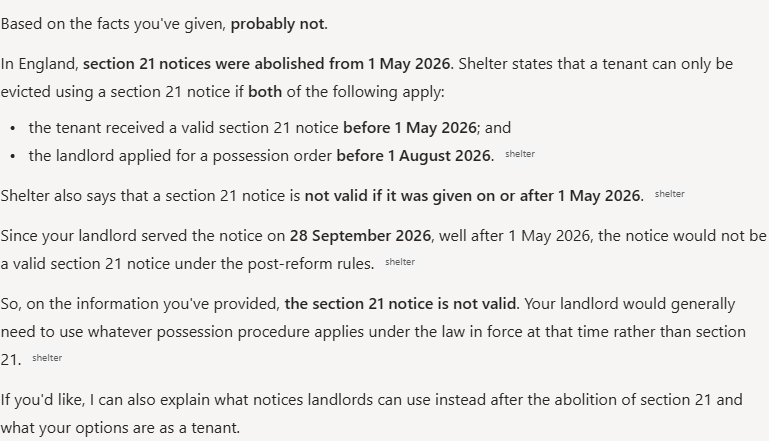 Based on the facts you've given, probably not. In England, section 21 notices were abolished from 1 May 2026. Shelter states that a tenant can only be evicted using a section 21 notice if both of the following apply: the tenant received a valid section 21 notice before 1 May 2026; and the landlord applied for a possession order before 1 August 2026. Source: shelter Shelter also says that a section 21 notice is not valid if it was given on or after 1 May 2026. Source: shelter Since your landlord served the notice on 28 September 2026, well after 1 May 2026, the notice would not be a valid section 21 notice under the post-reform rules. Source: shelter So, on the information you've provided, the section 21 notice is not valid. Your landlord would generally need to use whatever possession procedure applies under the law in force at that time rather than section 21. Source: shelter If you'd like, I can also explain what notices landlords can use instead after the abolition of section 21 and what your options are as a tenant.
 -
Try 3 Right
Our summary: Hedged no: very likely not valid, and it would expect the notice to be invalid; section 21 abolished from 1 May 2026 save limited transitional cases tied to earlier notices and proceedings by 31 July 2026.
The answer, with its screenshot
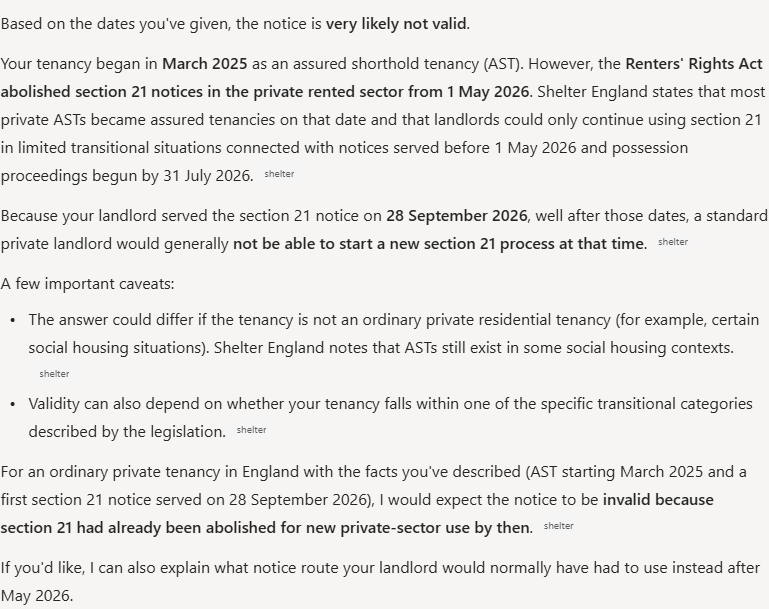 Based on the dates you've given, the notice is very likely not valid. Your tenancy began in March 2025 as an assured shorthold tenancy (AST). However, the Renters' Rights Act abolished section 21 notices in the private rented sector from 1 May 2026. Shelter England states that most private ASTs became assured tenancies on that date and that landlords could only continue using section 21 in limited transitional situations connected with notices served before 1 May 2026 and possession proceedings begun by 31 July 2026. Source: shelter Because your landlord served the section 21 notice on 28 September 2026, well after those dates, a standard private landlord would generally not be able to start a new section 21 process at that time. Source: shelter A few important caveats: The answer could differ if the tenancy is not an ordinary private residential tenancy (for example, certain social housing situations). Shelter England notes that ASTs still exist in some social housing contexts. Source: shelter Validity can also depend on whether your tenancy falls within one of the specific transitional categories described by the legislation. Source: shelter For an ordinary private tenancy in England with the facts you've described (AST starting March 2025 and a first section 21 notice served on 28 September 2026), I would expect the notice to be invalid because section 21 had already been abolished for new private-sector use by then. Source: shelter If you'd like, I can also explain what notice route your landlord would normally have had to use instead after May 2026.
-
-
Gemini free
3 of 3 right-
Try 1 Right
Our summary: Said no: section 21 abolished on 1 May 2026; the AST converted to an assured periodic tenancy that day; earlier notices needed a court claim by 31 July 2026; the landlord needs a section 8 ground.
Note: it named section 8, the route a landlord must now use.
The answer, with its screenshot
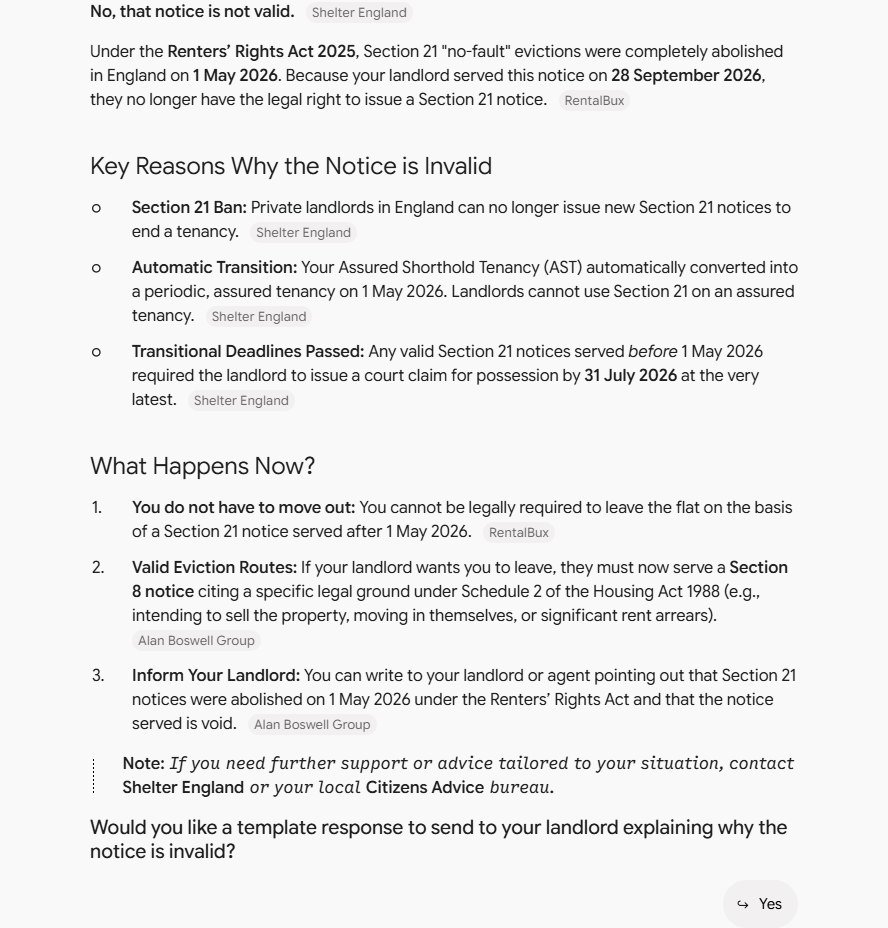 No, that notice is not valid. Source: Shelter England Under the Renters’ Rights Act 2025, Section 21 "no-fault" evictions were completely abolished in England on 1 May 2026. Because your landlord served this notice on 28 September 2026, they no longer have the legal right to issue a Section 21 notice. Source: RentalBux Key Reasons Why the Notice is Invalid Section 21 Ban: Private landlords in England can no longer issue new Section 21 notices to end a tenancy. Source: Shelter England Automatic Transition: Your Assured Shorthold Tenancy (AST) automatically converted into a periodic, assured tenancy on 1 May 2026. Landlords cannot use Section 21 on an assured tenancy. Source: Shelter England Transitional Deadlines Passed: Any valid Section 21 notices served before 1 May 2026 required the landlord to issue a court claim for possession by 31 July 2026 at the very latest. Source: Shelter England What Happens Now? You do not have to move out: You cannot be legally required to leave the flat on the basis of a Section 21 notice served after 1 May 2026. Source: RentalBux Valid Eviction Routes: If your landlord wants you to leave, they must now serve a Section 8 notice citing a specific legal ground under Schedule 2 of the Housing Act 1988 (e.g., intending to sell the property, moving in themselves, or significant rent arrears). Source: Alan Boswell Group Inform Your Landlord: You can write to your landlord or agent pointing out that Section 21 notices were abolished on 1 May 2026 under the Renters’ Rights Act and that the notice served is void. Source: Alan Boswell Group Note: If you need further support or advice tailored to your situation, contact Shelter England or your local Citizens Advice bureau. Would you like a template response to send to your landlord explaining why the notice is invalid? Yes
 -
Try 2 Right
Our summary: Said no, invalid: section 21 abolished on 1 May 2026; the 31 July 2026 window for earlier notices has closed; ASTs converted to periodic tenancies; the landlord needs a section 8 ground.
Note: it named section 8, the route a landlord must now use.
The answer, with its screenshot
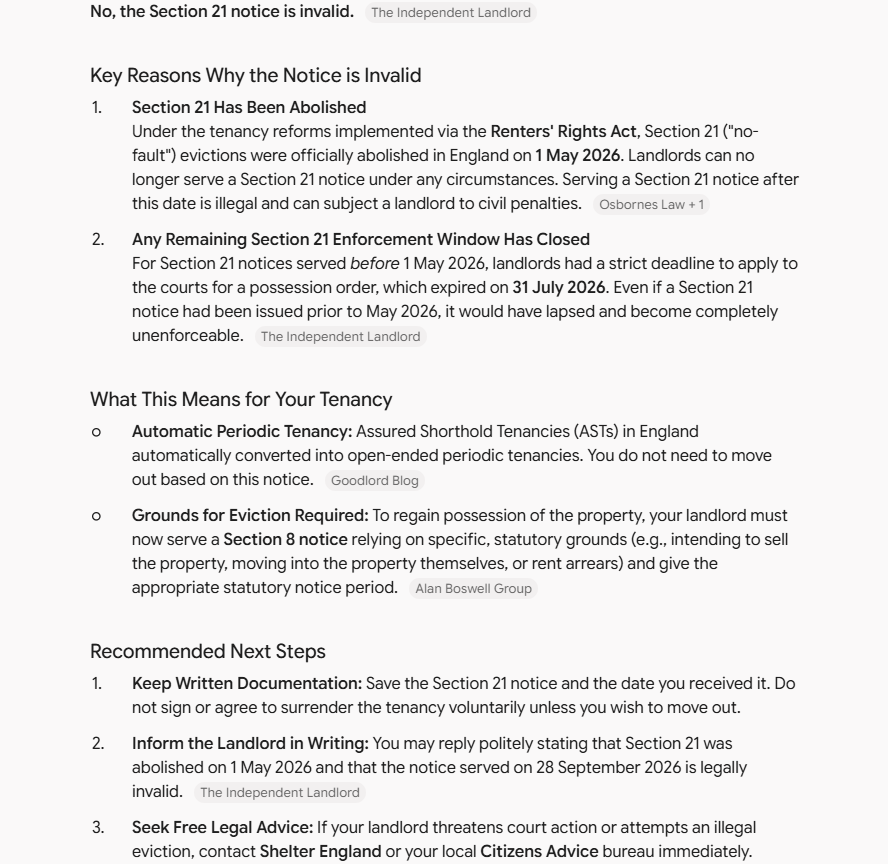 No, the Section 21 notice is invalid. Source: The Independent Landlord Key Reasons Why the Notice is Invalid Section 21 Has Been Abolished Under the tenancy reforms implemented via the Renters' Rights Act, Section 21 ("no-fault") evictions were officially abolished in England on 1 May 2026. Landlords can no longer serve a Section 21 notice under any circumstances. Serving a Section 21 notice after this date is illegal and can subject a landlord to civil penalties. Source: Osbornes Law +1 Any Remaining Section 21 Enforcement Window Has Closed For Section 21 notices served before 1 May 2026, landlords had a strict deadline to apply to the courts for a possession order, which expired on 31 July 2026. Even if a Section 21 notice had been issued prior to May 2026, it would have lapsed and become completely unenforceable. Source: The Independent Landlord What This Means for Your Tenancy Automatic Periodic Tenancy: Assured Shorthold Tenancies (ASTs) in England automatically converted into open-ended periodic tenancies. You do not need to move out based on this notice. Source: Goodlord Blog Grounds for Eviction Required: To regain possession of the property, your landlord must now serve a Section 8 notice relying on specific, statutory grounds (e.g., intending to sell the property, moving into the property themselves, or rent arrears) and give the appropriate statutory notice period. Source: Alan Boswell Group Recommended Next Steps Keep Written Documentation: Save the Section 21 notice and the date you received it. Do not sign or agree to surrender the tenancy voluntarily unless you wish to move out. Inform the Landlord in Writing: You may reply politely stating that Section 21 was abolished on 1 May 2026 and that the notice served on 28 September 2026 is legally invalid. Source: The Independent Landlord Seek Free Legal Advice: If your landlord threatens court action or attempts an illegal eviction, contact Shelter England or your local Citizens Advice bureau immediately.
 -
Try 3 Right
Our summary: Said no: section 21 abolished on 1 May 2026; ASTs became periodic tenancies that day; the landlord must use section 8, with 4 months' notice for the sell or move-in grounds.
Note: it named section 8, the route a landlord must now use.
Note: it mentioned four months' notice.
The answer, with its screenshot
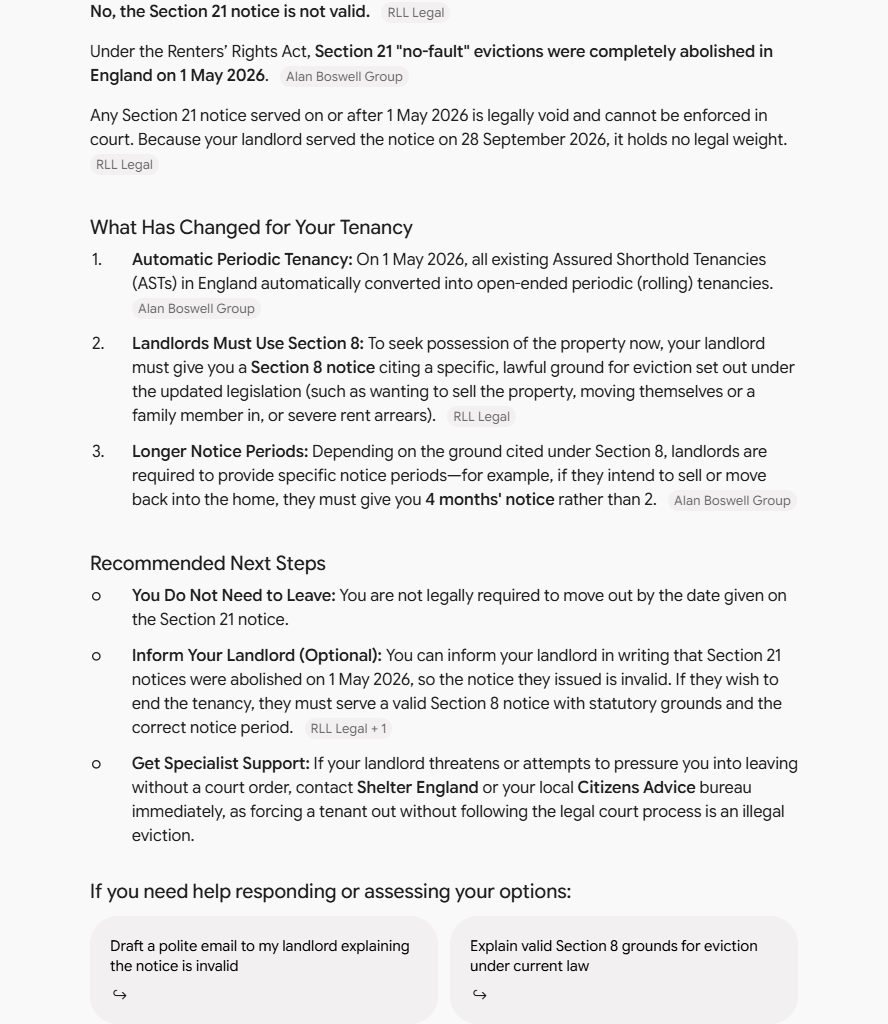 No, the Section 21 notice is not valid. Source: RLL Legal Under the Renters’ Rights Act, Section 21 "no-fault" evictions were completely abolished in England on 1 May 2026. Source: Alan Boswell Group Any Section 21 notice served on or after 1 May 2026 is legally void and cannot be enforced in court. Because your landlord served the notice on 28 September 2026, it holds no legal weight. Source: RLL Legal What Has Changed for Your Tenancy Automatic Periodic Tenancy: On 1 May 2026, all existing Assured Shorthold Tenancies (ASTs) in England automatically converted into open-ended periodic (rolling) tenancies. Source: Alan Boswell Group Landlords Must Use Section 8: To seek possession of the property now, your landlord must give you a Section 8 notice citing a specific, lawful ground for eviction set out under the updated legislation (such as wanting to sell the property, moving themselves or a family member in, or severe rent arrears). Source: RLL Legal Longer Notice Periods: Depending on the ground cited under Section 8, landlords are required to provide specific notice periods—for example, if they intend to sell or move back into the home, they must give you 4 months' notice rather than 2. Source: Alan Boswell Group Recommended Next Steps You Do Not Need to Leave: You are not legally required to move out by the date given on the Section 21 notice. Inform Your Landlord (Optional): You can inform your landlord in writing that Section 21 notices were abolished on 1 May 2026, so the notice they issued is invalid. If they wish to end the tenancy, they must serve a valid Section 8 notice with statutory grounds and the correct notice period. Source: RLL Legal +1 Get Specialist Support: If your landlord threatens or attempts to pressure you into leaving without a court order, contact Shelter England or your local Citizens Advice bureau immediately, as forcing a tenant out without following the legal court process is an illegal eviction. If you need help responding or assessing your options: Draft a polite email to my landlord explaining the notice is invalid Explain valid Section 8 grounds for eviction under current law
-
-
Grok free
1 of 3 right-
Try 1 Right
Our summary: Said no: the Renters' Rights Act abolished section 21 from 1 May 2026; earlier notices may be usable in limited cases; the landlord must follow the section 8 process with a ground for possession.
Note: it named section 8, the route a landlord must now use.
The answer, with its screenshot
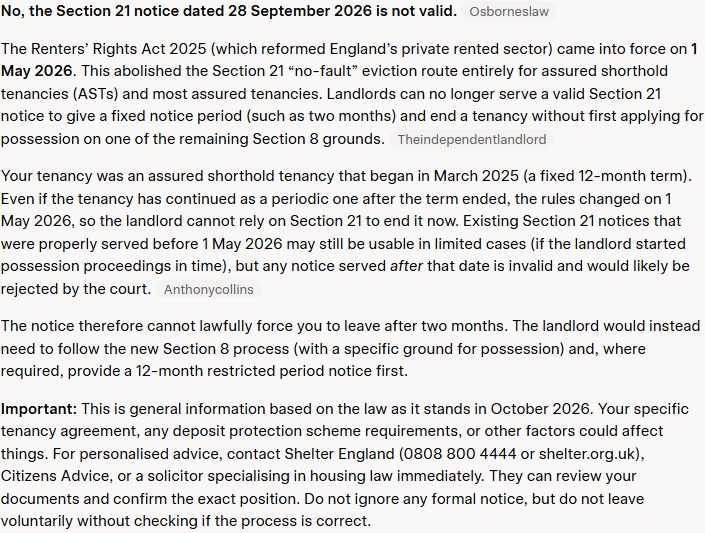 No, the Section 21 notice dated 28 September 2026 is not valid.Osborneslaw The Renters’ Rights Act 2025 (which reformed England’s private rented sector) came into force on 1 May 2026. This abolished the Section 21 “no-fault” eviction route entirely for assured shorthold tenancies (ASTs) and most assured tenancies. Landlords can no longer serve a valid Section 21 notice to give a fixed notice period (such as two months) and end a tenancy without first applying for possession on one of the remaining Section 8 grounds.Theindependentlandlord Your tenancy was an assured shorthold tenancy that began in March 2025 (a fixed 12-month term). Even if the tenancy has continued as a periodic one after the term ended, the rules changed on 1 May 2026, so the landlord cannot rely on Section 21 to end it now. Existing Section 21 notices that were properly served before 1 May 2026 may still be usable in limited cases (if the landlord started possession proceedings in time), but any notice served after that date is invalid and would likely be rejected by the court.Anthonycollins The notice therefore cannot lawfully force you to leave after two months. The landlord would instead need to follow the new Section 8 process (with a specific ground for possession) and, where required, provide a 12-month restricted period notice first. Important: This is general information based on the law as it stands in October 2026. Your specific tenancy agreement, any deposit protection scheme requirements, or other factors could affect things. For personalised advice, contact Shelter England (0808 800 4444 or shelter.org.uk), Citizens Advice, or a solicitor specialising in housing law immediately. They can review your documents and confirm the exact position. Do not ignore any formal notice, but do not leave voluntarily without checking if the process is correct.
 -
Try 2 Nothing came back the app errored or never finished
-
Try 3 Nothing came back the app errored or never finished
-
-
Perplexity free
3 of 3 right-
Try 1 Right
Our summary: Said no: section 21 notices ended for private tenancies on 1 May 2026 and the tenancy became assured periodic that day; the landlord would need a section 8 notice on a legal ground.
Note: it named section 8, the route a landlord must now use.
The answer, with its screenshot
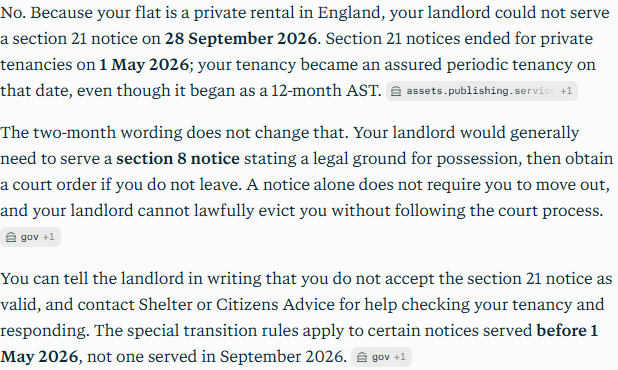 No. Because your flat is a private rental in England, your landlord could not serve a section 21 notice on 28 September 2026. Section 21 notices ended for private tenancies on 1 May 2026; your tenancy became an assured periodic tenancy on that date, even though it began as a 12-month AST. Source: assets.publishing.service.gov +1 The two-month wording does not change that. Your landlord would generally need to serve a section 8 notice stating a legal ground for possession, then obtain a court order if you do not leave. A notice alone does not require you to move out, and your landlord cannot lawfully evict you without following the court process. Source: gov +1 You can tell the landlord in writing that you do not accept the section 21 notice as valid, and contact Shelter or Citizens Advice for help checking your tenancy and responding. The special transition rules apply to certain notices served before 1 May 2026, not one served in September 2026. Source: gov +1
 -
Try 2 Right
Our summary: Said no: section 21 notices were abolished for private tenancies on 1 May 2026, when the tenancy became assured periodic; the landlord would need a possession ground and a section 8 notice.
Note: it named section 8, the route a landlord must now use.
The answer, with its screenshot
 No. Your landlord served the notice on 28 September 2026, after section 21 notices were abolished for private tenancies in England on 1 May 2026. Your March 2025 fixed-term AST automatically became an assured periodic tenancy on that date, so the two-month section 21 notice cannot end it. Source: assets.publishing.service.gov +1 The landlord would generally need to rely on a valid possession ground and serve the appropriate section 8 notice. The notice itself does not require you to leave immediately: a landlord must obtain a court possession order, and cannot lawfully evict you without following the court process. Source: gov +1 You could show the landlord or an adviser the government guidance on notices served after the 1 May 2026 changes . If you receive court papers or your landlord threatens to change the locks, seek prompt advice from Shelter or a housing solicitor.
 -
Try 3 Right
Our summary: Said no: section 21 ended on 1 May 2026, the tenancy became assured periodic that day, and the landlord needs a valid reason through the section 8 process.
Note: it named section 8, the route a landlord must now use.
The answer, with its screenshot
 No. Because this is a private tenancy in England and the notice was served on 28 September 2026, after section 21 ended on 1 May 2026, the landlord cannot use a section 21 notice to end your tenancy—even though it gives two months’ notice. Your tenancy became an assured periodic tenancy on 1 May 2026; the landlord generally needs a valid reason and must use the section 8 process instead. Source: gov +1 You do not have to leave just because the notice says to. A landlord must obtain a court possession order and follow the court enforcement process to evict you. Source: gov If the landlord is asking you to leave, keep the notice and tenancy paperwork, and contact Shelter or Citizens Advice for advice specific to your circumstances. If you receive court papers, respond by the deadline stated. Source: gov
-
Question 4 Paternity leave for an employee who has just started a new job sealed
What it tests: Whether an app knows today's rules on time off for a new parent who has only just started a job.
15 of 18 tries right
-
ChatGPT free
3 of 3 right-
Try 1 Right
Our summary: Said yes: leave is a day-one right since 6 April 2026; statutory pay unlikely, short of 26 weeks' service by the qualifying week.
Note: it said there would be no statutory paternity pay.
Full answer
[…] In England, the rules changed on 6 April 2026, so you no longer need to have worked for your employer for 26 weeks to qualify for paternity leave. You can qualify from your first day of employment. GOV.UK +1 There is, however, an important distinction between paternity leave and statutory paternity pay. How the rules apply to you Your circumstances What this means You started on 1 September 2026 You qualify for paternity leave from your first day, subject to the other conditions. Your baby is due on 1 May 2027 Your new job's start date does not prevent you from taking paternity leave. You gave written notice in your first week This is early enough to satisfy the notice deadline for the due date, but you must also meet the separate deadline for your intended leave dates. You are on a permanent employment contract This is consistent with employee status, which is required for statutory paternity leave. GOV.UK +2 What about paternity pay? Statutory Paternity Pay has a separate qualifying period. You generally must: Have worked continuously for the same employer for at least 26 weeks by the qualifying week (the 15th week before the baby is due). Still be employed by that employer when your baby is born. Earn an average of at least £129 per week before tax during the relevant earnings period. Give the required notice. GOV.UK +1 For a baby due on 1 May 2027, your qualifying week is approximately 17–23 January 2027. As you started on 1 September 2026, you will not have completed 26 weeks with this employer by then. So, based on your dates, you should qualify for paternity leave, but you are unlikely to qualify for Statutory Paternity Pay from this employer. The statutory weekly rate is currently £194.32, or 90% of your average weekly earnings if lower, although the applicable rate may change before May 2027. GOV.UK +1 Have you given notice in time? Yes, on the information you've provided, your first-week notice was early enough. For a baby due on 1 May 2027, you must notify your employer of the due date at least 15 weeks beforehand. You must also give at least 28 days' notice of when you want your leave to start and whether you want one or two weeks. GOV.UK +1 For official guidance, see GOV.UK: Paternity Pay and Leave eligibility . […] Your short length of service is likely to affect statutory pay, not your right to take the leave. -
Try 2 Right
Our summary: Said yes, a day-one right since 6 April 2026, up to two weeks within 52 weeks of the birth; no statutory pay under the 26-week rule; the employer may pay more.
Note: it said there would be no statutory paternity pay.
Full answer
Yes. […] In England, the rules changed on 6 April 2026, making paternity leave a day-one employment right. You no longer need to have worked for your employer for 26 weeks to qualify for the leave itself. Business.gov.uk +1 However, paternity leave and statutory paternity pay have different eligibility rules, so you may qualify for time off without qualifying for statutory pay. 1. Are you eligible for paternity leave? Based on the dates you gave: Job start date: 1 September 2026 Baby's due date: 1 May 2027 Employment status: Permanent employee Notice: You informed your employer in writing during your first week. You can qualify for up to two weeks of statutory paternity leave, provided you meet the relationship and childcare conditions and give the required notice. You can take the two weeks together or as two separate one-week blocks. Your leave cannot start before the birth and must finish within 52 weeks of the birth (or the due date if the baby arrives early). GOV.UK +1 Your short length of service does not prevent you from taking this leave. 2. Are you eligible for statutory paternity pay? On the dates you've given, you will not qualify for Statutory Paternity Pay from this employer under the normal rules. To receive statutory pay, you generally need to have worked continuously for the same employer for at least 26 weeks by the end of the qualifying week, which is the 15th week before the baby is due. You must also still be employed when the baby is born and earn at least £129 a week on average before tax. GOV.UK +1 Your qualifying week falls in January 2027. Because you started work on 1 September 2026, you will have been employed for only around 18–20 weeks by then, rather than the required 26 weeks. Your employer may nevertheless offer enhanced contractual paternity pay under its own policy, so it is worth checking your contract or staff handbook. 3. Was your notice early enough? Yes. You notified your employer in writing during your first week, which is well ahead of the usual deadline of 15 weeks before the expected week of childbirth. GOV.UK +1 To make sure everything is in order: Confirm that your notice states the expected week of childbirth and that you intend to take paternity leave. Check that you have provided any required written declaration confirming your relationship to the child and that you will take the leave to care for your child or partner. Give at least 28 days' notice of the dates for each period of leave, following the applicable notice rules. See the official GOV.UK paternity leave guidance for the requirements. In summary: You are entitled to statutory paternity leave from your first day of employment, so your September 2026 start date does not prevent you taking time off after your baby arrives in May 2027. However, you will not meet the usual length-of-service requirement for statutory paternity pay. Your employer could still offer paid leave through its own scheme. -
Try 3 Right
Our summary: Said yes, a day-one right from 6 April 2026; one or two weeks within 52 weeks of the birth; statutory pay unlikely.
Note: it said there would be no statutory paternity pay.
Full answer
Yes. You should be entitled to statutory paternity leave from your new job, even though you will have worked there for less than a year when your baby is born. The key change is that, from 6 April 2026, paternity leave became a day-one employment right in England. You no longer need 26 weeks of service to qualify for the leave itself. However, statutory paternity pay still has a qualifying service requirement. GOV.UK +1 How the rules apply to you Requirement Your circumstances Result Be an employee Permanent employee Meets this condition Length of service for leave Started 1 September 2026 No minimum service required Give notice Written notice in your first week Given well in advance Length of service for statutory pay Baby due 1 May 2027 Likely not enough service 1. Your right to take paternity leave You can take one or two weeks of statutory paternity leave, provided you meet the other eligibility conditions, including being the baby's father or your partner's spouse or partner and taking the leave to care for your child. Your employer cannot refuse statutory paternity leave simply because you are a new employee. Leave must be taken after the birth and within 52 weeks of the birth. GOV.UK +1 2. Will you receive statutory paternity pay? This is where your start date matters. For a baby due on 1 May 2027, the relevant qualifying week is 10–16 January 2027. To qualify for Statutory Paternity Pay, you generally need 26 weeks of continuous employment with the same employer by the end of that week. Because you started on 1 September 2026, you will have been employed for only around 19–20 weeks by then. So, you are unlikely to qualify for Statutory Paternity Pay from this employer, even though you qualify for the leave itself. GOV.UK +1 Your employer may nevertheless offer enhanced paternity pay under its own policy. 3. Was your notice in the first week sufficient? It appears to have been given early enough to meet the standard notice deadline. For babies due from 26 July 2026 onwards, the usual notice rules apply: you must notify your employer of your intention to take leave at least 15 weeks before the expected week of childbirth, and generally give 28 days' notice of the intended start date. Keep a copy of your written notice and ask HR to confirm that it has recorded your intended leave dates correctly. Business.gov.uk +1 In summary: you should qualify for paternity leave, but probably not statutory paternity pay. Check whether your employer offers its own paid paternity leave scheme. You can read the official guidance here: GOV.UK — Paternity pay and leave .
-
-
Claude free
3 of 3 right-
Try 1 Right
Our summary: Said yes from day one (the 26-week rule is gone for leave); one or two weeks; statutory pay likely not, short of 26 weeks by the qualifying week.
Note: it said there would be no statutory paternity pay.
Full answer
Yes, you’re entitled to the leave, but probably not to statutory paternity pay. Leave: The qualifying service requirement no longer applies where the expected week of childbirth is on or after 5 April 2026. Your baby is due in May 2027, so you’re covered from day one. You don’t need the 26 weeks’ service that used to be required. Paternity leave is either one or two weeks, taken consecutively or as separate weeks. Giving written notice in your first week was fine. Source: brightmine Source: bpcollins Pay: The pay rules are different. To be eligible for statutory paternity pay, you still need at least 26 weeks’ service by the 15th week before the expected week of childbirth. Source: citation Your due date, 1 May 2027, falls in the week starting Sunday 25 April 2027. Fifteen weeks before that is the week of 10–16 January 2027. By the end of that week you’ll have about 19 weeks’ service, since you started on 1 September 2026. You’d reach 26 weeks around 2 March 2027, which is too late. So you likely won’t qualify for statutory paternity pay from your employer. Unless the company’s policy says otherwise, or the company uses its discretion, leave taken in your first 26 weeks would be unpaid. Source: wallace What to do next: Check your contract, staff handbook or HR policy. Some employers offer enhanced paternity pay from day one, or will agree to pay you at their discretion. Ask your employer to confirm your leave dates in writing and whether it will be paid. If it’s unpaid, you could ask to use annual leave for the time off, or check whether you’d qualify for any means-tested support such as Universal Credit. Acas has a free helpline and guidance if your employer disputes any of this. I’m not a lawyer, and individual circumstances such as how continuous service is counted can matter. Your employer or Acas can confirm the exact dates for you. -
Try 2 Right
Our summary: Said yes, a day-one right since 6 April 2026; one or two weeks; statutory pay probably not under the 26-week rule; suggests annual leave or employer discretion.
Note: it said there would be no statutory paternity pay.
Full answer
Yes, you’re entitled to the leave, but not to statutory pay for it, as things stand. Leave: yes. Since 6 April 2026, statutory paternity leave has been a day-one right. Employees no longer need 26 weeks of continuous service before they can take the leave. As a permanent employee who will be the baby’s father or the mother’s partner and responsible for the child’s upbringing, you qualify. You can take one or two weeks. Source: keystonelaw Notice: you’re fine. For a baby due on or after 26 July 2026, the standard framework applies, including notifying your employer by the end of the 15th week before the expected week of childbirth. Your due date of 1 May 2027 falls in the week starting Sunday 25 April 2027, so that deadline is Saturday 16 January 2027. You’ve already given written notice, well ahead of it. Once you know your exact dates, you’ll generally need to give 28 days’ notice before each period of leave starts. Your employer can also ask for a signed declaration confirming you’re eligible. Source: keystonelaw Pay: probably not statutory pay. The 26-week service rule was dropped for leave only. The 26 weeks’ continuous service requirement for statutory paternity pay remains in place, so new employees can take paternity leave in their first 26 weeks, but unless the company’s policy says otherwise or the company uses its discretion, it would be unpaid. By the end of the qualifying week (16 January 2027) you’ll have been employed about 19 weeks, so you’d fall short. The 2026/27 statutory rate is £194.32 per week or 90 per cent of average weekly earnings, whichever is lower. Source: wallace Source: keystonelaw What you can do about pay: Check your contract and staff handbook. Many employers offer enhanced paternity pay that doesn’t depend on length of service, and some set their own qualifying period. Ask HR to confirm in writing whether they’ll pay anything for the leave. Use annual leave. Holiday you’ve accrued since September can cover some or all of the time off, and you’d be paid as normal. Ask for discretion. Your employer is free to pay you more than the statutory minimum, even though they don’t have to. Two other points to keep in mind. The leave can start any time within 52 weeks of the birth, so you don’t have to take it immediately. You’re also protected from being dismissed or treated unfairly for taking it. I’m not a lawyer, so for anything specific to your contract, ACAS (0300 123 1100) or GOV.UK’s paternity leave guidance is worth checking. -
Try 3 Right
Our summary: Said yes, a day-one right since 6 April 2026; up to two weeks within 52 weeks of the birth; no statutory pay, short of 26 weeks.
Note: it said there would be no statutory paternity pay.
Full answer
Yes, you’re entitled to the leave, but you almost certainly won’t qualify for statutory paternity pay. Leave Statutory paternity leave has been available from the first day of employment since 6 April 2026, so you no longer need 26 weeks of service. Your baby is due after April 2027, so you’re covered. You can take up to two weeks, either as one block of one or two weeks, or as two separate one-week blocks. The leave must be taken within 52 weeks of the birth. […] Your employer can still ask you to confirm your leave dates in writing, and you normally need to give 28 days’ notice before each period of leave starts. Source: chambers Source: ifamagazine Pay The day-one change applies to leave only. The reforms don’t extend to statutory paternity pay, so the 26-week qualifying period for pay remains. You need 26 weeks of continuous employment by the end of the “qualifying week”, which is the 15th week before the baby’s due week. Source: brabners For your dates: Your due date, 1 May 2027, is a Saturday, so the due week starts Sunday 25 April 2027. The qualifying week is the week of 10 to 16 January 2027. You’ll have about 19 weeks’ service by then, not 26. You’d only reach 26 weeks in early March 2027. On those dates, you’d be entitled to take the time off but wouldn’t get statutory paternity pay. This is worked out from the due date, so an early or late birth wouldn’t change it. What to do Check your contract or staff handbook. Some employers pay enhanced or contractual paternity pay, sometimes from day one. This is your best chance of getting paid. Ask HR directly. Ask how they treat paternity leave for someone with under 26 weeks’ service. Some employers pay something anyway or let you combine leave with annual holiday. Use annual leave. You can take paid holiday around the birth if the unpaid leave is a problem. Holiday accrues from your start date. Check other support. Depending on your household income, you may be able to claim Universal Credit or other benefits for the unpaid weeks. Employees are protected from dismissal and unfair treatment for taking paternity leave. I’m not a lawyer, and the official guidance on GOV.UK or the ACAS helpline is worth checking against your exact circumstances. If you tell me roughly what your contract says about paternity pay, I can help you work out your options.
-
-
Copilot free
3 of 3 right-
Try 1 Right
Our summary: Said yes, leave from the first day of employment; no statutory pay, short of 26 weeks' continuous service by the qualifying week.
Note: it said there would be no statutory paternity pay.
Full answer
[…] The key point is that in England/UK, eligibility for Statutory Paternity Leave is much more generous than eligibility for Statutory Paternity Pay. […] Source: gov +1 In your case: […] Source: gov +1 You started work on 1 September 2026. Your baby is due on 1 May 2027. You gave written notice in your first week of employment of the expected week of childbirth and your intention to take paternity leave. Those facts satisfy the employment-status and notice requirements for statutory paternity leave. Source: gov +1 However, Statutory Paternity Pay is a separate question. To qualify for statutory paternity pay, you must have been continuously employed by the employer for at least 26 weeks by the end of the qualifying week, which is the 15th week before the baby is due. Source: gov +2 For a due date of 1 May 2027, the qualifying week falls around mid-January 2027. Having started on 1 September 2026, you would have worked for only about 19 weeks by then, not 26 weeks. Therefore, you would not qualify for Statutory Paternity Pay from this employer (unless your employer offers a contractual enhancement beyond the statutory minimum). Source: gov +1 Summary ✅ Statutory Paternity Leave: Yes, you are entitled to this. Source: gov +1 ❌ Statutory Paternity Pay: No, not on the dates you've given, because you will not have 26 weeks' continuous service by the qualifying week. Source: gov +2 You may want to check your employment contract or staff handbook though, as some employers provide enhanced paid paternity leave that is more generous than the statutory minimum. -
Try 2 Right
Our summary: Said yes, a day-one right since 6 April 2026, but miscounted the service and said statutory pay is likely too.
But in passing: (a) "you are likely to qualify for both statutory paternity leave and statutory paternity pay"
Full answer
Yes. […] Source: gov +1 Why: You started employment on 1 September 2026. Your baby is due on 1 May 2027. Since 6 April 2026, paternity leave is a day-one employment right, meaning there is no minimum length of service requirement for statutory paternity leave. Source: gov +1 […] Employees must notify their employer of the expected week of childbirth and provide notice of when they want leave. Source: gov +1 One important distinction: Paternity leave and Statutory Paternity Pay (SPP) have different eligibility rules. While paternity leave is available from day one of employment, SPP generally still requires 26 weeks' continuous employment by the qualifying week (the 15th week before the baby is due), sufficient earnings, and continued employment up to the birth. Source: gov +1 For a due date of 1 May 2027, the qualifying week would be around mid-January 2027. Having started on 1 September 2026, you would likely have well over 26 weeks' continuous employment by then, so you are likely to qualify for both statutory paternity leave and statutory paternity pay, provided the other pay conditions are met. Source: gov +1 […] Source: gov +1 -
Try 3 Right
Our summary: Said yes, a day-one right; statutory pay probably not, short of 26 weeks by the qualifying week.
Note: it said there would be no statutory paternity pay.
Full answer
Yes. […] The key points are: […] Your baby is due on 1 May 2027. You gave your employer notice of the expected week of childbirth and your intention to take paternity leave. In the UK, eligibility for statutory paternity leave is a day-one employment right. You only need to be an employee and give the correct notice. Source: gov +1 […] Source: gov +1 However, statutory paternity pay has a separate eligibility test. To qualify for pay, you generally must have been continuously employed by the employer for at least 26 weeks by the end of the 15th week before the baby is due, as well as meeting the earnings and notice requirements. Source: gov +1 For a due date of 1 May 2027, the qualifying week is around mid-January 2027. Having started on 1 September 2026, you would have roughly 19 weeks' service by then, not 26 weeks. On those dates, you would therefore not qualify for statutory paternity pay, although you would still qualify for statutory paternity leave. Source: gov +1 So, in summary: ✅ Statutory paternity leave: Yes, you are entitled. ❌ Statutory paternity pay: Probably not, because you will not have 26 weeks' continuous employment by the qualifying week. You should also check your contract or employer's family leave policy, as some employers offer enhanced paternity pay that is more generous than the statutory minimum.
-
-
Gemini free
3 of 3 right-
Try 1 Right
Our summary: Said yes, a day-one right; 1 or 2 weeks within 52 weeks of the birth; no statutory pay, short of 26 weeks by the qualifying week.
Note: it said there would be no statutory paternity pay.
Full answer
Yes, you are entitled to Statutory Paternity Leave. Under UK employment law, Paternity Leave is a "day-one right". The previous requirement to have worked continuously for your employer for 26 weeks no longer applies for the leave itself. Source: Rebox HR +1 […] Key Details of Your Entitlement Feature Statutory Paternity Leave Details Duration 1 or 2 weeks total. Flexibility You can take the 2 weeks together or as two separate 1-week blocks. Timeframe You can take your leave anytime between the baby's birth and 52 weeks after birth. Notice Requirement You must give notice of your due date by the 15th week before the expected week of childbirth (around mid-January 2027) and confirm the specific start dates 28 days in advance of each block. (Your notice in week 1 easily fulfills this). What About Paternity Pay? While taking time off (leave) is a day-one right, receiving Statutory Paternity Pay (SPP) still depends on continuous length of service: Source: Stone King The 26-Week Rule for Pay: To qualify for Statutory Paternity Pay, you must have been continuously employed by the same employer for at least 26 weeks by the end of the 15th week before the due date (the "qualifying week"). Source: Stone King Your Timeline: Expected due date: 1 May 2027 Qualifying week (15 weeks prior): Approx. mid-January 2027 Continuous service by mid-Jan 2027: ~19.5 weeks (1 Sept 2026 to mid-Jan 2027) Because you will fall short of the 26-week milestone by mid-January 2027, you will not qualify for Statutory Paternity Pay from the government scheme. Next Steps & Recommendations Check Your Company's Contract/Policy: Many employers offer Enhanced (Company) Paternity Pay which may have more generous rules or higher pay than statutory rates. Source: Rebox HR Alternative Financial Options: Look into Shared Parental Leave & Pay if your partner is returning to work early, or check whether you qualify for local support such as Universal Credit adjustments while taking unpaid leave. Formal Notification: Although you gave written notice in week 1, re-confirm the exact start dates with your HR team at least 28 days before your planned leave begins. Source: Business Growth Service Would you like me to calculate the exact Qualifying Week dates or draft a formal confirmation note for HR? Yes -
Try 2 Right
Our summary: Said yes, a day-one right since April 2026; its labelled outcome says no statutory pay, but its own table marks statutory pay 'Qualified'.
But in passing: (a) "Statutory Paternity Pay (SPP) Must have 26 weeks of continuous service by the qualifying week (the 15th week before the expected due date). Qualified"
Note: it said there would be no statutory paternity pay.
Full answer
[…] All-in-One Human Resources Software | Factorial Changes to employment law introduced in April 2026 made Statutory Paternity Leave a "day-one right" for employees in England. You are no longer required to complete 26 weeks of continuous service with your employer to be eligible to take time off. All-in-One Human Resources Software | Factorial […] 1. What You Are Entitled To Leave Duration: You can take up to 2 weeks of Statutory Paternity Leave. All-in-One Human Resources Software | Factorial Flexibility: You can choose to take either 1 single week or 2 full weeks. Under current rules, if you take 2 weeks, you can take them together or as two separate 1-week blocks anytime within the first 52 weeks following the birth. All-in-One Human Resources Software | Factorial […] 2. Key Distinction: Statutory Paternity Pay vs. Leave While your right to time off (leave) starts from day one, Statutory Paternity Pay (SPP) is calculated differently: All-in-One Human Resources Software | Factorial Entitlement Eligibility Requirement Your Status Statutory Paternity Leave Day-one right for employees Qualified Statutory Paternity Pay (SPP) Must have 26 weeks of continuous service by the qualifying week (the 15th week before the expected due date). Qualified How the Pay Requirement Applies to You: The Qualifying Week: For a baby due on 1 May 2027, the 15th week before the due date falls around mid-January 2027. Your Continuous Service: Having started on 1 September 2026, you will have completed over 19 weeks of service by the qualifying week in mid-January 2027, but under the 26-week threshold. Outcome: While you are legally entitled to take the 2 weeks of paternity leave, you will not qualify for Statutory Paternity Pay (SPP) from the government scheme due to the length-of-service requirement for pay. All-in-One Human Resources Software | Factorial 3. Recommended Next Steps Check Your Company Contract/Handbook: Many employers offer Enhanced (Occupational) Paternity Pay that provides full or partial pay from day one or requires shorter service lengths than the government minimum. Request Form SPP1: If you do not qualify for Statutory Paternity Pay, ask your employer's HR department for Form SPP1 (Non-payment of Statutory Paternity Pay). This official notice explains why you don't qualify for SPP and can be used if you need to apply for income support or financial assistance through Universal Credit during your leave. All-in-One Human Resources Software | Factorial -
Try 3 Right
Our summary: Said yes, a day-one right since 6 April 2026; 1 or 2 weeks within 52 weeks of the birth; statutory pay likely not, short of 26 weeks.
Note: it said there would be no statutory paternity pay.
Full answer
[…] All-in-One Human Resources Software | Factorial As of 6 April 2026, Statutory Paternity Leave in England became a day-one right. You no longer need to complete 26 weeks of continuous service before the 15th week prior to the due date to qualify for the time off. All-in-One Human Resources Software | Factorial + 1 Key Breakdown of Your Rights 1. Statutory Paternity Leave (Time Off) Status: Eligible. All-in-One Human Resources Software | Factorial Entitlement: You can take 1 or 2 weeks of leave. You can take this either as a single block or as two separate 1-week blocks, anytime within the 52 weeks following the birth. All-in-One Human Resources Software | Factorial + 1 Notice Provided: Because you gave written notice in your first week (well ahead of the standard deadline—15 weeks before the due date, which is around mid-January 2027), you have fully met the notice requirements. Source: Chambers 2. Statutory Paternity Pay (SPP) While the right to take leave starts on day one, Statutory Paternity Pay maintains different rules: Source: Chambers Requirement: To qualify for SPP, you must have been continuously employed by the same employer for at least 26 weeks up into the "qualifying week" (the 15th week before the expected week of childbirth, approximately mid-January 2027). All-in-One Human Resources Software | Factorial Your Timeline: Having started on 1 September 2026, by mid-January 2027 you will have roughly 19 or 20 weeks of continuous service, which is short of the 26-week requirement. Outcome: You will likely not qualify for Statutory Paternity Pay from the government unless your company offers an enhanced contractual paternity pay policy that covers new hires. If you do not qualify for SPP, your employer must issue you a form SPP1 explaining why. All-in-One Human Resources Software | Factorial Summary Checklist Benefit Your Qualification Key Detail Statutory Paternity Leave Yes Day-one employment right in England. Statutory Paternity Pay No (Statutory minimum) Requires 26 weeks of service by mid-Jan 2027. Notice Requirement Satisfied Given written notice well in advance. Next Step: Check your company's employment contract or employee handbook. Many employers offer enhanced company paternity pay that goes beyond the statutory minimum, which may have more generous eligibility criteria. Want to check if you might be eligible for Shared Parental Leave or alternative options? Yes
-
-
Grok free
0 of 3 right-
Try 1 Nothing came back the app errored or never finished
-
Try 2 Nothing came back the app errored or never finished
-
Try 3 Nothing came back the app errored or never finished
-
-
Perplexity free
3 of 3 right-
Try 1 Right
Our summary: Said yes, a day-one right since 6 April 2026; up to two weeks within 52 weeks of the birth; statutory pay likely not, short of 26 weeks by the qualifying week.
Note: it said there would be no statutory paternity pay.
Full answer
[…] Paternity leave Since 6 April 2026, paternity leave is a day-one right for employees in England, Scotland and Wales: you do not need 26 weeks’ service to qualify for the leave itself. Source: assets.publishing.service.gov +1 You also appear to have met the notice requirements: You told your employer the due date and that you intended to take leave in your first week (early September 2026). The due-date notice must be given by the end of the qualifying week — the 15th week before the expected week of childbirth, which for a 1 May 2027 due date falls around mid-to-late January 2027. Source: gov +1 You must give at least 28 days’ notice of when each period of leave will start and whether you want one or two weeks. Your early notice of the intended time off may cover this, but confirm the exact start date(s) with your employer at least 28 days beforehand. Source: gov +1 You can take up to two weeks, either together or as two separate one-week blocks. The leave cannot begin before the birth and must end within 52 weeks of the birth (or due date if the baby is early). Source: gov Paternity pay Statutory Paternity Pay (SPP) is different: it still requires 26 weeks’ continuous employment ending with a day in the qualifying week. Source: gov +1 With a start date of 1 September 2026, you will reach 26 weeks’ service around 1 March 2027 — after the qualifying week for a 1 May due date. So, unless your contract or employer policy provides better terms, you are likely not eligible for SPP from this employer. Source: gov +1 What to do Check your employment contract, staff handbook, or ask HR whether the employer offers contractual paternity pay despite the statutory pay rules. Confirm in writing that your September notice was intended as both the due-date/entitlement notice and notice of your intended leave dates. If your employer says you are not entitled to leave, ask them to explain in writing; they must tell you within 28 days if you do not qualify for SPP and why. Source: gov Your notice being given in your first week is not a problem for leave eligibility — in fact, it comfortably meets the 15-week due-date notice requirement. Source: acas.org +1 -
Try 2 Right
Our summary: Said yes, a day-one right since 6 April 2026, but miscounted the service and promised statutory pay, and gave the old 56-day window for the leave.
But in passing: (a) "and likely to statutory paternity pay too"; (c) "must finish within 56 days of the birth"
Full answer
[…] Since 6 April 2026, paternity leave is a day-one right for employees in England, Scotland and Wales; the 26-week service rule now applies to paternity pay, not leave. Source: gov +2 Why you qualify You started on 1 September 2026 and your partner’s due date is 1 May 2027. The “qualifying week” for paternity pay is the 15th week before the expected week of childbirth—roughly mid-January 2027. By then you will have worked continuously for your employer for more than 26 weeks, so you should meet the pay service requirement as well. Source: gov +1 To qualify, you must be the baby’s father or the mother’s partner, be an employee, be employed up to the birth for pay purposes, and earn at least £129 a week before tax on average in the relevant period. Source: gov +1 Your notice Giving the due date and intended leave dates in writing during your first week was sensible. For a baby due on or after 26 July 2026, the standard notice rules apply: Tell your employer the due date at least 15 weeks before the expected week of childbirth. Source: gov +1 Tell them at least 28 days before the leave starts when you want it to begin and whether you want 1 or 2 weeks. Source: gov +1 If you change the start date, you normally need to give 28 days’ notice. Source: gov Because you notified them in early September 2026—well over 15 weeks before May 2027—you should be within the required timescales, assuming your notice included the required details. What you can take You can take either 1 week or 2 consecutive weeks of statutory paternity leave. It cannot begin before the birth and must finish within 56 days of the birth (or the due date if the baby arrives early). Source: gov +1 Statutory Paternity Pay is generally paid at the statutory rate or 90% of your average weekly earnings, whichever is lower, for up to two weeks. Your employer may offer more generous contractual paternity leave or pay, so check your contract or staff handbook. Source: gov One practical point If your baby is born early, you remain eligible for paternity pay if you would have had 26 weeks’ continuous service by the qualifying week; paternity leave remains a day-one entitlement. If your employer disputes eligibility, they must tell you within 28 days using form SPP1 and explain why. Source: gov +1 -
Try 3 Right
Our summary: Said yes, a day-one right since 6 April 2026; up to two weeks within 52 weeks of the birth; statutory pay unlikely, short of 26 weeks.
Note: it said there would be no statutory paternity pay.
Full answer
[…] Leave entitlement Since 6 April 2026, paternity leave is a day-one right for employees in England, so your 1 September 2026 start date does not prevent you from taking it. As the baby’s father/partner of the mother, you can take up to two weeks’ leave, either together or as two separate one-week blocks, within 52 weeks of the birth. Source: www +2 Pay entitlement Statutory Paternity Pay still requires 26 weeks’ continuous employment by the end of the “qualifying week” — the 15th week before the baby is due. With a due date of 1 May 2027, that qualifying week falls around mid-to-late January 2027. You will have worked for this employer for only about 19–20 weeks by then, so you are unlikely to qualify for statutory paternity pay. Source: www +2 You may still receive contractual or enhanced paternity pay if your employer’s policy provides it — check your staff handbook or contract. Notice you’ve given Your baby is due after 25 July 2026, so the standard notice rules apply. You must notify the due date at least 15 weeks before it is expected, and give at least 28 days’ notice of when you want leave to start and whether you want one or two weeks. Source: gov +1 […] You will still need to confirm the actual leave dates at least 28 days beforehand; if the baby’s arrival changes your plans, you can give revised notice of the start date. Source: gov +1 Practical next step Confirm with HR that they have recorded your notice, and ask whether they offer company paternity pay. If they say you are not entitled to leave, ask them to explain why in writing — statutory paternity leave should be available from your first day of employment. Source: gov +1
-
Question 5 Which planet has the most moons, and exactly how many
The right answer, and why this one can trip an AI
15 of 18 tries right
-
ChatGPT free
3 of 3 right-
Try 1 Right
Our summary: Saturn, exactly 293 confirmed moons (dated October 2026, NASA linked); Jupiter runner-up with 115.
The answer, with its screenshot
 Saturn has the most confirmed moons in our solar system, with exactly 293 confirmed moons as of October 2026. NASA Science +1 Source: science.nasa.gov Most moons: Saturn Confirmed moon count: 293 Runner-up: Jupiter, with 115 confirmed moons. NASA Science +1 Saturn's count has increased dramatically as astronomers have identified tiny, distant natural satellites orbiting the planet. Most of its moons are much smaller than its largest moon, Titan. These numbers can change as new moons are discovered and officially confirmed. NASA's Saturn moons page tracks the latest count.
 -
Try 2 Right
Our summary: Saturn, exactly 293 confirmed moons (dated October 2026); Jupiter 115, Earth 1; points to NASA's Saturn moons page.
The answer, with its screenshot
 Saturn has the most moons in our solar system, with exactly 293 confirmed moons as of October 2026. NASA Science +1 6 A few fascinating facts: 🪐 Saturn: 293 confirmed moons. 🟠 Jupiter: 115 confirmed moons. 🌍 Earth: 1 moon. Saturn's moons range from tiny, irregular objects to Titan, which is larger than the planet Mercury and has a substantial atmosphere. NASA Science +1 The count can change as astronomers discover new moons and the International Astronomical Union confirms them. For the latest official count, see NASA's Saturn moons page .
 -
Try 3 Right
Our summary: Saturn, exactly 293 confirmed moons (dated October 2026); Jupiter runner-up with 115.
The answer, with its screenshot
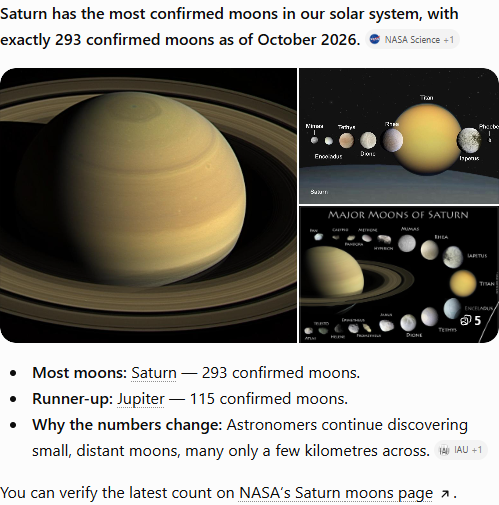 Saturn has the most confirmed moons in our solar system, with exactly 293 confirmed moons as of October 2026. NASA Science +1 5 Most moons: Saturn — 293 confirmed moons. Runner-up: Jupiter — 115 confirmed moons. Why the numbers change: Astronomers continue discovering small, distant moons, many only a few kilometres across. IAU +1 You can verify the latest count on NASA’s Saturn moons page .
-
-
Claude free
3 of 3 right-
Try 1 Right
Our summary: Saturn, 293 confirmed moons per NASA and Wikipedia; gives the 274, 285, 293 history; Jupiter 'roughly 101 to 115' by source; says the count keeps rising.
The answer, with its screenshot
 Saturn has the most moons of any planet in the solar system. It currently has 293 confirmed moons, according to NASA’s Saturn moons page and a Wikipedia count that is current as of June 2026. The total has changed a lot recently. It was 274 after the 128 new moons confirmed in March 2025. The Minor Planet Center then added 11 more in March 2026, bringing it to 285, and later additions took it to 293. Jupiter is second, with roughly 101 to 115 confirmed moons depending on the source. Most of Saturn’s moons are small, irregular objects a few kilometers across or less, and only a minority have official names. There is no single exact figure, because astronomers have no agreed boundary between tiny moons and the larger bits of ring material. The count also keeps rising as new discoveries are confirmed, so 293 is the latest figure I found rather than a permanent one.
 -
Try 2 Right
Our summary: Saturn, 293 confirmed (NASA, August 2026; Wikipedia agrees); Jupiter 115; 285 after March 2026; a newer count may exist.
The answer, with its screenshot
 Saturn has the most moons of any planet in the solar system. NASA lists 293 confirmed moons as of August 2026, and Wikipedia’s count of moons with confirmed orbits is also 293 as of June 2026. Source: nasa Wikipedia Jupiter is second. NASA’s Astronomy Picture of the Day puts it at 115 confirmed moons, so Saturn is well ahead. Source: uj The number keeps changing. The Minor Planet Center announced 11 more Saturn moons in March 2026, which brought the total to 285, and it has risen again since. Most of the newly found moons are small, irregular satellites only a few kilometres across. Source: earthsky No exact number is possible. There is no consensus on where to draw the line between the largest ring particles and the smallest moons, so 293 is the confirmed count rather than a final tally. Wikipedia I couldn’t find anything newer than August 2026, so a fresh discovery announcement could have raised the count since then.
 -
Try 3 Right
Our summary: Saturn, 293 confirmed (NASA, August 2026); Jupiter 115; warns that some pages still quote older figures.
The answer, with its screenshot
 Saturn has the most moons of any planet in the solar system. NASA lists 293 confirmed moons as of August 2026, and Wikipedia’s count of moons with confirmed orbits is also 293 as of June 2026. Source: nasa Wikipedia The next closest is Jupiter, which NASA’s Astronomy Picture of the Day puts at 115 confirmed moons. Source: nasa The number keeps changing, so 293 is the latest figure I found rather than a permanent total. A large batch of 128 small moons was confirmed in March 2025, and most of the newer ones are tiny, irregular moons in distant, tilted orbits. Some sources, mostly blog-style pages, still quote older figures like 145 or 146, so check the date on any count you see. Source: nasa
-
-
Copilot free
3 of 3 right-
Try 1 Right
Our summary: Saturn, 293 confirmed moons (NASA, August 2026); comparison list with Jupiter 115, Uranus 29, Neptune 16.
The answer, with its screenshot
 The planet with the most confirmed moons is Saturn. According to NASA's Saturn Moons page, Saturn has 293 confirmed moons as of August 2026, which is more than any other planet in the Solar System. Source: nasa For comparison: Saturn: 293 confirmed moons Source: nasa +1 Jupiter: 115 confirmed moons Source: pandataps Uranus: 29 confirmed moons Source: pandataps Neptune: 16 confirmed moons Source: pandataps Mars: 2 moons Source: pandataps Earth: 1 moon Source: pandataps So the current answer is: 🪐 Saturn — 293 confirmed moons. Source: nasa Moon counts can change as astronomers discover and confirm new small satellites, but Saturn is currently the clear leader. Source: nasa +1
 -
Try 2 Right
Our summary: Saturn, 293 confirmed (NASA, August 2026); Jupiter 115; Uranus and Neptune given as ranges by source date.
The answer, with its screenshot
 The planet with the most confirmed moons is Saturn. According to NASA, Saturn has 293 confirmed moons in orbit as of August 2026, which is more than any other planet in our Solar System. Source: nasa +1 For comparison: Saturn: 293 confirmed moons Source: nasa +1 Jupiter: 115 confirmed moons Source: nasa Uranus: 28-29 confirmed moons (depending on the date of the source) Source: theuniverseepisodes Neptune: 16-18 confirmed moons (depending on the date of the source) Source: theuniverseepisodes Earth: 1 moon Source: theuniverseepisodes The count changes occasionally as astronomers discover and confirm new small satellites, but the latest NASA figures list Saturn as the undisputed leader with 293 confirmed moons. Source: nasa +1
 -
Try 3 Right
Our summary: Saturn, 293 confirmed (NASA); Jupiter 'around 115'; closes with a labelled answer, Saturn with 293.
The answer, with its screenshot
 The planet with the most confirmed moons is Saturn. According to NASA, Saturn has 293 confirmed moons orbiting it, which is more than any other planet in our Solar System. Source: nasa +1 For comparison: Saturn: 293 confirmed moons Source: nasa +1 Jupiter: around 115 confirmed moons (current counts vary as new discoveries are confirmed) Source: pandataps Uranus: 29 confirmed moons Source: pandataps Neptune: 16 confirmed moons Source: pandataps Saturn's lead has grown significantly in recent years because astronomers have confirmed large numbers of small, irregular moons using improved telescope surveys. Source: spacedaily +1 Answer: Saturn, with 293 confirmed moons. Source: nasa +1
-
-
Gemini free
3 of 3 right-
Try 1 Right
Our summary: Saturn, 293 confirmed moons with established orbits (NASA and the Minor Planet Center); Jupiter's tally not given.
The answer, with its screenshot
 Saturn holds the record for the planet with the most confirmed moons in our solar system. NASA (.gov) According to NASA and the International Astronomical Union's Minor Planet Center, Saturn has 293 confirmed moons with established orbits. Source: Wikipedia By comparison, its closest competitor, Jupiter, trails behind with a substantially smaller tally. Most of Saturn's newly added moons are tiny, irregularly shaped outer irregular moons (often only a kilometer or two wide) discovered through sensitive deep-space imaging and data processing techniques.
 -
Try 2 Right
Our summary: Saturn, 293 confirmed (as of June/August 2026); Jupiter second with 101; offers more on Titan.
But in passing: (a): "easily outpacing Jupiter (which is second place with 101 confirmed moons)"
The answer, with its screenshot
 Saturn has the most confirmed moons in our solar system. NASA (.gov) As of June/August 2026, Saturn has 293 confirmed moons with established orbits, easily outpacing Jupiter (which is second place with 101 confirmed moons). Source: EarthSky Saturn's vast collection of natural satellites ranges from massive worlds like Titan (which is larger than the planet Mercury) down to tiny, irregular moonlets only a couple of miles wide that are continually being discovered by astronomers. Source: en.wikipedia.org Want to know more about Saturn's largest moon, Titan? Yes
 -
Try 3 Right
Our summary: Saturn, 293 confirmed as of mid-2026; no Jupiter count; offers more on Titan.
The answer, with its screenshot
 Saturn has the most confirmed moons in our solar system. NASA (.gov) As of mid-2026, Saturn has 293 confirmed moons with established orbits. Source: Wikipedia While Jupiter held the lead briefly, massive batch discoveries—including over 120 newfound moonlets announced by astronomers—have pushed Saturn far ahead of any other planet. The vast majority of these newly added satellites are tiny, irregular chunks of rock and ice only a few kilometers wide, often locked into distant retrograde orbits. Source: The Guardian +1 Want to know more about Saturn's largest moon, Titan, and its unique atmosphere? Yes
-
-
Grok free
0 of 3 right-
Try 1 Nothing came back the app errored or never finished
-
Try 2 Nothing came back the app errored or never finished
-
Try 3 Nothing came back the app errored or never finished
-
-
Perplexity free
3 of 3 right-
Try 1 Right
Our summary: Saturn, 293 confirmed (NASA, August 2026); table with Jupiter 115, Uranus 29, Neptune 16.
The answer, with its screenshot
 Saturn has the most confirmed moons in the Solar System: 293 confirmed moons as of August 2026, according to NASA. Source: science.nasa Why Saturn leads Saturn overtook Jupiter after astronomers confirmed large batches of small, irregular moons around the planet; NASA now lists Saturn at 293, compared with 115 known moons for Jupiter as of April 2026. Source: science.nasa +1 Current counts Planet Confirmed moons Saturn 293 Source: science.nasa Jupiter 115 Source: spaceplace.nasa Uranus 29 Source: spaceplace.nasa Neptune 16 Source: spaceplace.nasa The count can change as new discoveries are verified, but Saturn is currently the clear record-holder. Source: science.nasa
 -
Try 2 Right
Our summary: Saturn, 293 confirmed (NASA, August 2026); table with Jupiter 115, Uranus 29, Neptune 16; says the count may rise.
The answer, with its screenshot
 Saturn has the most moons in our solar system, with 293 confirmed moons as of August 2026, according to NASA. Source: science.nasa Current moon counts Planet Confirmed moons Saturn 293 Source: science.nasa Jupiter 115 Source: spaceplace.nasa Uranus 29 Source: spaceplace.nasa Neptune 16 Source: spaceplace.nasa Saturn overtook Jupiter after a major series of newly confirmed small, irregular moons; its count includes moons ranging from tiny moonlets to Titan, the solar system’s second-largest moon. Source: wikipedia Moon counts can change as astronomers confirm additional candidate satellites and publish their orbits, so the exact number may rise again. Source: science.nasa
 -
Try 3 Right
Our summary: Saturn, 293 (NASA, August 2026); Jupiter 115 known moons as of April 2026; standings table.
The answer, with its screenshot
 Saturn has the most moons in the Solar System. NASA lists 293 confirmed moons orbiting Saturn as of August 2026—far ahead of Jupiter, which has 115 known moons as of April 2026. Source: science.nasa +1 Current standings Planet Confirmed/known moons Saturn 293 Source: science.nasa Jupiter 115 Source: spaceplace.nasa Uranus 29 Source: spaceplace.nasa Neptune 16 Source: spaceplace.nasa Saturn’s total includes many small, irregular moons discovered through deep surveys, alongside major moons such as Titan and Enceladus. Source: science.nasa +1
-
Question 6 Whether a UK passport holder needs ETIAS for a weekend in Paris
The right answer, and why this one can trip an AI
15 of 18 tries right
-
ChatGPT free
3 of 3 right-
Try 1 Right
Our summary: Said no ETIAS is needed for this trip because it is not yet in operation and no launch date is set; called EES a separate border system and warned off unofficial ETIAS sites.
Note: it mentioned the EU's new Entry/Exit System (EES).
The answer, with its screenshot
 No — you do not need to apply for ETIAS for your trip to Paris next weekend, 17–18 October 2026, provided the current implementation timetable remains unchanged. As a British citizen travelling on an ordinary UK passport, you can generally visit France for a short holiday without a visa for up to 90 days in any 180-day period across the Schengen Area. ETIAS is a separate electronic travel authorisation for visa-exempt visitors, including British citizens. It is not the same as a visa, and you should not confuse it with the EU’s Entry/Exit System (EES), which records border crossings. The latest official guidance confirms that ETIAS is not yet in operation, and the EU has not announced an exact launch date. It is scheduled to start in the last quarter of 2026. So you do not need to apply for your October trip. ETIAS +1 A few things to check before flying: Passport validity: Check the UK government's France entry requirements . Border checks: The EU's Entry/Exit System (EES) is now operational, so you may need to provide a facial image and fingerprints at the border. GOV.UK Avoid unofficial ETIAS websites: Don't pay a third-party website to apply for an authorisation that isn't available yet. GOV.UK My advice: Check the official EU ETIAS website again shortly before departure in case the launch timetable changes.
 -
Try 2 Right
Our summary: Said no, the EU site confirms ETIAS is not in operation and no start date is announced; EES is separate and needs no advance application.
Note: it mentioned the EU's new Entry/Exit System (EES).
The answer, with its screenshot
 No — you do not need to apply for ETIAS for your trip from London to Paris next weekend (17–18 October 2026), based on the latest official EU guidance. The EU's official ETIAS website confirms that the system is not yet in operation and that applications are not currently being accepted. The launch is planned for the last quarter of 2026, but the exact start date has not been announced. ETIAS +1 Even though British citizens will generally need ETIAS once it becomes operational, you do not need to obtain one for your upcoming trip. A couple of things to check before you fly: Passport validity: Your passport generally needs to have been issued within the previous 10 years and remain valid for at least 3 months after your planned departure from the Schengen area. Length of stay: For a short holiday, British passport holders can generally visit France visa-free for up to 90 days in any 180-day period. Your Europe Official updates: Check the EU's official ETIAS website before travelling, in case the launch arrangements change. One final distinction: the EU's Entry/Exit System (EES) is separate from ETIAS and may involve biometric checks at the border. You do not need to apply for EES in advance. Migration and Home Affairs Enjoy your trip to Paris!
 -
Try 3 Right
Our summary: Said no, ETIAS is not yet operational or accepting applications; noted EES photo and fingerprint registration at the border and the passport validity rules; its labelled bottom line agrees.
Note: it mentioned the EU's new Entry/Exit System (EES).
The answer, with its screenshot
 No — you do not need to apply for ETIAS for your trip to Paris next weekend, 17–18 October 2026, based on the currently scheduled rollout. As a British citizen travelling on a UK passport for a short holiday in France, you are generally eligible to visit the Schengen Area visa-free for up to 90 days in any 180-day period. ETIAS is a separate travel authorisation, and it is not the same as a visa. The EU’s official website confirms that ETIAS is not yet operational and applications are not being accepted. It is scheduled to launch in the last quarter of 2026, but the exact start date has not been announced. ETIAS +1 What you should check before flying Passport validity: Your passport must have been issued less than 10 years before your arrival in France and expire at least 3 months after your planned departure from the Schengen Area. GOV.UK Border checks: The EU’s Entry/Exit System (EES) is now in operation. You may need to have your photograph and fingerprints registered at the border; there is no fee for this. GOV.UK +1 Avoid unofficial ETIAS websites: No one can currently issue a valid ETIAS authorisation. GOV.UK +1 For the latest updates, check the official EU ETIAS website and the UK government’s France travel advice . Bottom line: You can prepare for your Paris trip without applying for ETIAS now. Check the official guidance again before you travel in case the launch arrangements change.
-
-
Claude free
3 of 3 right-
Try 1 Right
Our summary: Said no, ETIAS has not launched and has no confirmed start date; added a transitional period of at least six months after launch, and that EES fingerprints and a photo are taken on arrival.
Note: it cited an ETIAS page that is not the EU's or GOV.UK's.
Note: it mentioned the EU's new Entry/Exit System (EES).
The answer, with its screenshot
 No, you don’t need ETIAS for next weekend. It isn’t live yet, so there is nothing to apply for, and you can fly to Paris with just your valid UK passport. ETIAS hasn’t launched. As of August 2026, no confirmed start date exists. The EU has said it will announce a date several months before launch. Source: schengentraveler Even after launch, it won’t be compulsory straight away. The EU has planned a transitional period of at least six months after ETIAS goes live, during which you can still enter without one. In practice, UK travellers likely won’t need it until well into 2027. Source: aol Beware of scam sites. Fake ETIAS application websites are already targeting UK travellers, so don’t pay anyone for an ETIAS “application” now. When it opens, the official site will be on the europa.eu domain. Source: tescoinsurance What you will encounter is the Entry/Exit System (EES). It became mandatory at every external Schengen border on 10 April 2026, so on arrival in France you’ll have your fingerprints and a photo taken. It involves no application and takes a few minutes. Source: schengenmonitor Your passport also needs to be less than 10 years old and have at least 3 months left from the date you plan to leave the Schengen area. You can check the latest on gov.uk’s travel advice for France before you go. I’d do that nearer to your departure date, as these rules have been shifting. Have a great trip!
 -
Try 2 Right
Our summary: Said no, ETIAS has not launched and cannot be applied for; reported an unconfirmed 2027 launch and a transition period; EES registration at the border needs no application.
Note: it cited an ETIAS page that is not the EU's or GOV.UK's.
Note: it mentioned the EU's new Entry/Exit System (EES).
The answer, with its screenshot
 No, you don’t need ETIAS for next weekend’s trip, and you can’t apply for it yet anyway. The system hasn’t launched. The EU is still saying it isn’t operational and will announce a start date several months in advance. The “last quarter of 2026” target was removed from the official EU ETIAS page in mid-July 2026, and reporting since then points to 2027. A report published this week refers to an expected launch in early 2027, though that isn’t an officially confirmed date. Even once it launches, there’s expected to be a transition period before it becomes strictly mandatory. Source: schengenmonitor Source: visasnews Be careful with websites offering to process an “ETIAS application” now. They aren’t official, and you’d be paying for something that doesn’t exist yet. The official source will be the European Commission’s ETIAS portal, and GOV.UK will publish guidance when the date is set. What you will encounter is the Entry/Exit System (EES). It became fully operational at all Schengen external borders on 10 April 2026. As a UK passport holder you’ll have your fingerprints and photo registered at the border on first entry, which is quick and needs no advance application. If you’re taking the Eurostar, the checks happen at St Pancras before you board. Source: travelmarketnews A few practical points for your trip: Check that your passport was issued less than 10 years ago and has at least 3 months left beyond your planned return date. Check GOV.UK’s travel advice for France shortly before you fly, in case anything changes. Enjoy Paris!
 -
Try 3 Right
Our summary: Said no, ETIAS is not operating and has no start date; a transition of at least six months is expected; EES biometrics at the border need no advance application.
Note: it cited an ETIAS page that is not the EU's or GOV.UK's.
Note: it mentioned the EU's new Entry/Exit System (EES).
The answer, with its screenshot
 No, you don’t need to apply for ETIAS for next weekend’s trip, and you can’t apply yet anyway. ETIAS isn’t operating and the EU hasn’t announced a start date. A report on 9 October 2026 says the EU still states ETIAS is not yet operational and will announce its start date several months in advance. Several sources say the EU dropped its earlier “last quarter of 2026” target in July, and that 2027 now looks more likely. Source: schengentraveler Source: visasnews Even once it launches, a transition period of at least six months is expected, so it wouldn’t be strictly enforced straight away. Beware of fake sites. Because ETIAS isn’t live, any website selling “ETIAS applications” right now isn’t official. The only official source is travel-europe.europa.eu/etias. What you will go through on arrival in Paris: the EES, the EU’s biometric border system. It became fully operational at all Schengen external borders on 10 April 2026. As a UK citizen you may be asked for fingerprints and a facial scan at the border, especially on your first trip since it started. There’s nothing to apply for in advance. Source: travelmarketnews Before you travel, check that your passport was issued less than 10 years ago and has at least 3 months left after the day you plan to leave. The rule that bites most people is the 10-year one, because passports renewed early can carry extra months that don’t count. Enjoy Paris!
-
-
Copilot free
3 of 3 right-
Try 1 Right
Our summary: Said no, ETIAS is not in operation and no launch date is announced; gave the passport and 90/180 rules; EES biometrics at the border, ETIAS a separate future system.
Note: it cited an ETIAS page that is not the EU's or GOV.UK's.
Note: it mentioned the EU's new Entry/Exit System (EES).
The answer, with its screenshot
 No. If you're travelling from London to Paris next weekend on a UK passport, you do not need an ETIAS before you travel. ETIAS has not yet entered into operation, and applications are not currently being accepted. Multiple current sources report that the EU has delayed the scheme and has not announced a launch date. Source: viaryo +1 For your trip to France, the requirements remain the usual post-Brexit rules: A valid UK passport. Your passport must have been issued less than 10 years before the date you enter the Schengen area and generally must have at least 3 months' validity beyond your planned departure date. You can visit the Schengen area (including France) for up to 90 days in any 180-day period as a tourist. Also be aware that the EU's Entry/Exit System (EES) has been introduced, so you may be asked for biometric data such as fingerprints and a facial image at the border. ETIAS is a separate future system. Source: connaughtlaw +1 Have a great trip to Paris! 🇫🇷 If you'd like, I can also give you a quick UK traveller checklist for flying to France in 2026.
 -
Try 2 Right
Our summary: Said no ETIAS is needed at present because it is not in operation; gave the passport validity rules and warned off sites selling ETIAS applications.
Note: it cited an ETIAS page that is not the EU's or GOV.UK's.
The answer, with its screenshot
 No. If you're travelling from London to Paris next weekend as a British citizen with a UK passport, you do not need an ETIAS travel authorisation at present. Current information states that ETIAS is not yet in operation and applications are not being collected, so UK travellers can continue to travel to countries such as France using their passport under the existing rules. Source: schengentraveler +1 For your trip, make sure your UK passport: Was issued less than 10 years before your date of entry to France. Has at least 3 months' validity remaining beyond the date you plan to leave the Schengen area. Source: schengentraveler Also, be wary of websites offering ETIAS applications right now. Multiple sources note that any site claiming to process ETIAS applications before the system is live is not legitimate. Source: moneysavingexpert +2 Enjoy Paris! 🇫🇷
 -
Try 3 Right
Our summary: Said no, ETIAS is not in operation and collects no applications; listed standard entry checks; UK holders will need it once it eventually launches.
Note: it cited an ETIAS page that is not the EU's or GOV.UK's.
The answer, with its screenshot
 No. If you're travelling from London to Paris next weekend on a UK passport for a short holiday, you do not need an ETIAS yet. The EU's ETIAS travel authorisation system is not currently in operation, and no applications are being collected. British citizens can continue travelling to France under the existing entry rules. Source: mickeyfromthe +1 For your trip to Paris, you should instead make sure that: Your UK passport is valid and meets the Schengen entry requirements. You are staying within the Schengen short-stay limit of 90 days in any 180-day period. You can show evidence of your return/onward travel and accommodation if requested by border officials. (These are standard entry requirements.) Once ETIAS eventually launches, UK passport holders will need to obtain an online travel authorisation before visiting France and other participating European countries, but that requirement has not started yet. Source: viaryo +1 Have a great time in Paris! 🇫🇷
-
-
Gemini free
3 of 3 right-
Try 1 Right
Our summary: Said no, ETIAS is not yet operational and takes no applications; visa-free short stays on a UK passport; warned of scam sites; the EU will give months of notice before launch.
Note: it cited an ETIAS page that is not the EU's or GOV.UK's.
The answer, with its screenshot
 No, you do not need to apply for ETIAS before your trip. Source: ETIAS.com The European Travel Information and Authorisation System (ETIAS) is not yet operational and applications are not currently being accepted. Source: ETIAS.com Key Details for Your Trip Next Weekend Current Entry Requirements: As a British citizen, you can enter France and other Schengen Area countries visa-free for short stays (up to 90 days in any 180-day period) using just your UK passport. Source: ETIAS Beware of Scams: Because ETIAS is not live, any website offering to sell or process an ETIAS application right now is unofficial or fraudulent. Source: ETIAS.com Passport Validity Rules: Ensure your UK passport meets the standard EU post-Brexit entry rules: Issued less than 10 years before your date of entry into France. Valid for at least 3 months beyond your planned departure date from the Schengen Area. Source: ETIAS What About ETIAS in the Future? When the European Union eventually launches ETIAS, visa-exempt travellers (including UK passport holders) will need to apply online for a €20 travel authorisation before visiting most European countries. The EU will provide several months' advance public notice before the system goes live. Source: ETIAS.com +1
 -
Try 2 Right
Our summary: Said no, ETIAS is not yet operational; warned of scam sites; EES is live and may take a face image and fingerprints on a first visit; gave the passport rules.
Note: it cited an ETIAS page that is not the EU's or GOV.UK's.
Note: it mentioned the EU's new Entry/Exit System (EES).
The answer, with its screenshot
 No, you do not need to apply for ETIAS before your trip to Paris next weekend. Source: ABTA The European Travel Information and Authorisation System (ETIAS) is not yet operational, and applications are not currently open. Source: ETIAS.com Key Things to Know Before Flying to Paris 1. Beware of Scam Websites Because ETIAS has been widely discussed in the news, there are many unofficial or fraudulent third-party websites offering to "process" ETIAS applications for a fee. Since the official system isn't live, do not pay anyone for an ETIAS application. Source: ABTA +1 2. EES (Entry/Exit System) is Live While ETIAS isn't active yet, the EU’s automated border control system—the Entry/Exit System (EES)—is in effect. Source: ABTA What to expect at border control: When you arrive in Paris (or at London airport/Eurostar checks), you may be required to register your facial image and fingerprints electronically on your first visit. 3. British Passport Validity Rules Make sure your UK passport complies with post-Brexit entry rules for the Schengen Area: Issue date: Must have been issued less than 10 years before your date of entry. Source: ETIAS Expiry date: Must be valid for at least 3 months after the date you plan to leave France. Source: ETIAS Stay limit: You can stay up to 90 days in any 180-day period without a visa for short holidays. Source: ETIAS
 -
Try 3 Right
Our summary: Said no, ETIAS is not yet operational or collecting applications; EES is operational at borders; claimed the launch is postponed and not enforced until at least mid-2027.
Note: it cited an ETIAS page that is not the EU's or GOV.UK's.
Note: it mentioned the EU's new Entry/Exit System (EES).
The answer, with its screenshot
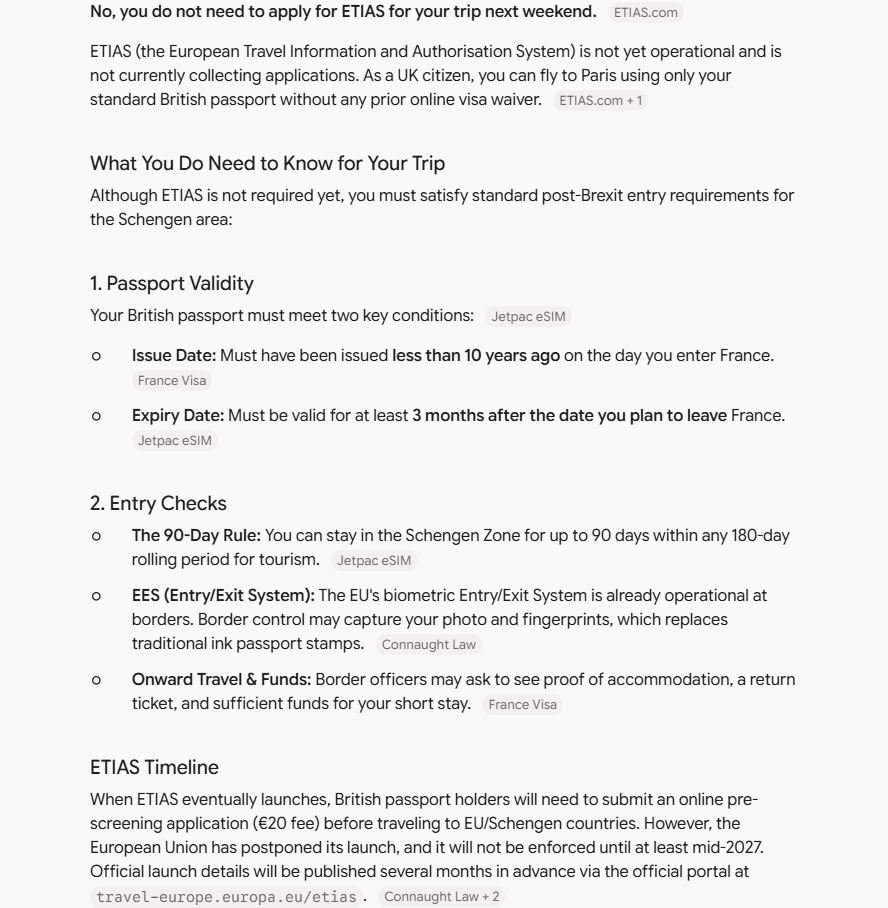 No, you do not need to apply for ETIAS for your trip next weekend. Source: ETIAS.com ETIAS (the European Travel Information and Authorisation System) is not yet operational and is not currently collecting applications. As a UK citizen, you can fly to Paris using only your standard British passport without any prior online visa waiver. Source: ETIAS.com +1 What You Do Need to Know for Your Trip Although ETIAS is not required yet, you must satisfy standard post-Brexit entry requirements for the Schengen area: 1. Passport Validity Your British passport must meet two key conditions: Source: Jetpac eSIM Issue Date: Must have been issued less than 10 years ago on the day you enter France. Source: France Visa Expiry Date: Must be valid for at least 3 months after the date you plan to leave France. Source: Jetpac eSIM 2. Entry Checks The 90-Day Rule: You can stay in the Schengen Zone for up to 90 days within any 180-day rolling period for tourism. Source: Jetpac eSIM EES (Entry/Exit System): The EU's biometric Entry/Exit System is already operational at borders. Border control may capture your photo and fingerprints, which replaces traditional ink passport stamps. Source: Connaught Law Onward Travel & Funds: Border officers may ask to see proof of accommodation, a return ticket, and sufficient funds for your short stay. Source: France Visa ETIAS Timeline When ETIAS eventually launches, British passport holders will need to submit an online pre-screening application (€20 fee) before traveling to EU/Schengen countries. However, the European Union has postponed its launch, and it will not be enforced until at least mid-2027. Official launch details will be published several months in advance via the official portal at travel-europe.europa.eu/etias. Source: Connaught Law +2
-
-
Grok free
0 of 3 right-
Try 1 Nothing came back the app errored or never finished
-
Try 2 Wrong too early
Our summary: Opened 'yes, apply well in advance' because ETIAS will likely be required by travel in late 2026, then said it is not yet operating and there is no need to apply until launch, ending that a valid UK passport is enough 'for now'.
Note: it cited an ETIAS page that is not the EU's or GOV.UK's.
The answer, with its screenshot
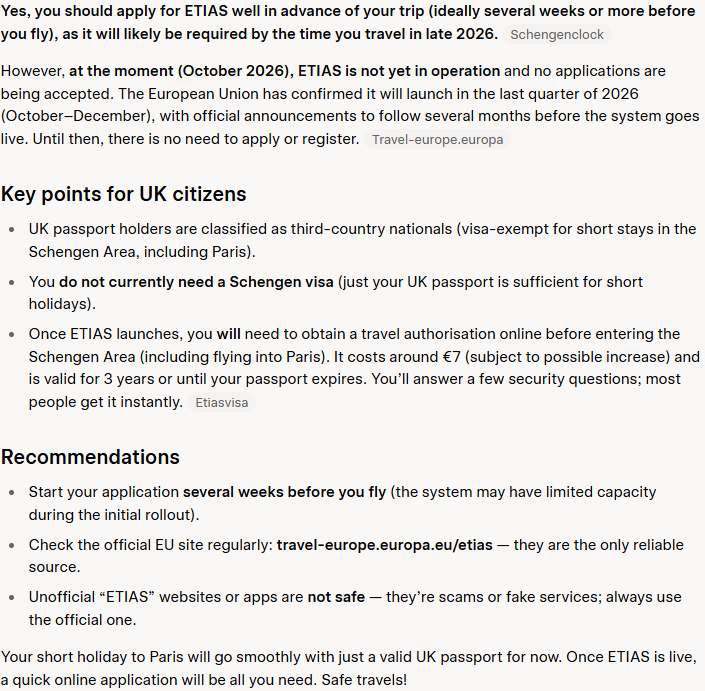 Yes, you should apply for ETIAS well in advance of your trip (ideally several weeks or more before you fly), as it will likely be required by the time you travel in late 2026.Schengenclock However, at the moment (October 2026), ETIAS is not yet in operation and no applications are being accepted. The European Union has confirmed it will launch in the last quarter of 2026 (October–December), with official announcements to follow several months before the system goes live. Until then, there is no need to apply or register.Travel-europe.europa Key points for UK citizens UK passport holders are classified as third-country nationals (visa-exempt for short stays in the Schengen Area, including Paris). You do not currently need a Schengen visa (just your UK passport is sufficient for short holidays). Once ETIAS launches, you will need to obtain a travel authorisation online before entering the Schengen Area (including flying into Paris). It costs around €7 (subject to possible increase) and is valid for 3 years or until your passport expires. You’ll answer a few security questions; most people get it instantly.Etiasvisa Recommendations Start your application several weeks before you fly (the system may have limited capacity during the initial rollout). Check the official EU site regularly: travel-europe.europa.eu/etias — they are the only reliable source. Unofficial “ETIAS” websites or apps are not safe — they’re scams or fake services; always use the official one. Your short holiday to Paris will go smoothly with just a valid UK passport for now. Once ETIAS is live, a quick online application will be all you need. Safe travels!
 -
Try 3 Wrong too early
Our summary: Said yes, ETIAS is mandatory for UK nationals, while also saying it is not yet operating and a flight before launch can go without one; told the user to apply once live to have it ready; said EES does not apply to short-stay UK travellers flying in.
But in passing: (a): "no EES biometric entry system for short UK passport holders on air travel"
Note: it cited an ETIAS page that is not the EU's or GOV.UK's.
Note: it mentioned the EU's new Entry/Exit System (EES).
The answer, with its screenshot
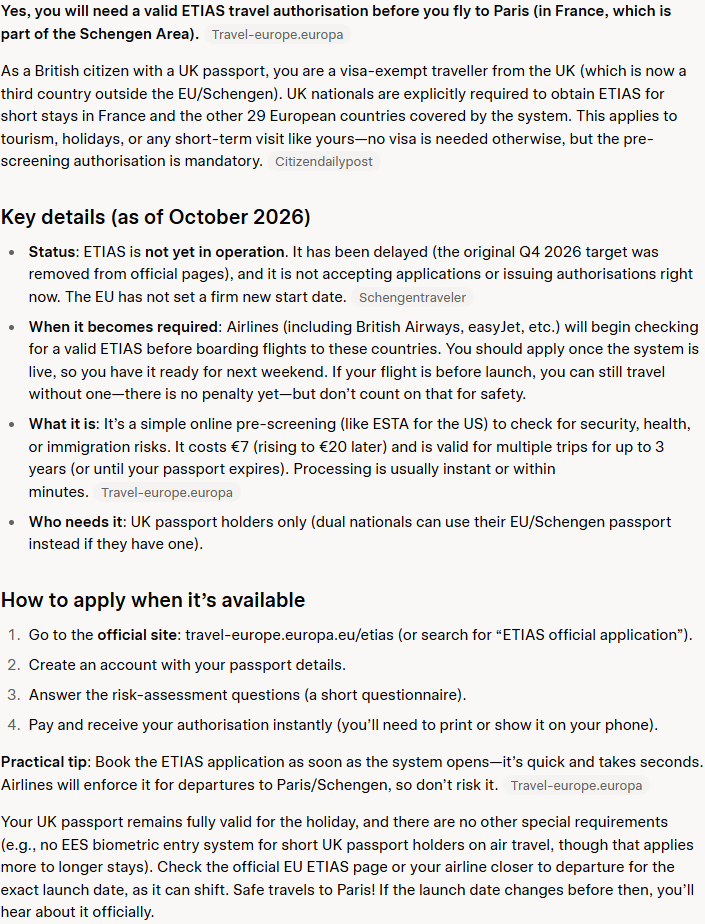 Yes, you will need a valid ETIAS travel authorisation before you fly to Paris (in France, which is part of the Schengen Area).Travel-europe.europa As a British citizen with a UK passport, you are a visa-exempt traveller from the UK (which is now a third country outside the EU/Schengen). UK nationals are explicitly required to obtain ETIAS for short stays in France and the other 29 European countries covered by the system. This applies to tourism, holidays, or any short-term visit like yours—no visa is needed otherwise, but the pre-screening authorisation is mandatory.Citizendailypost Key details (as of October 2026) Status: ETIAS is not yet in operation. It has been delayed (the original Q4 2026 target was removed from official pages), and it is not accepting applications or issuing authorisations right now. The EU has not set a firm new start date.Schengentraveler When it becomes required: Airlines (including British Airways, easyJet, etc.) will begin checking for a valid ETIAS before boarding flights to these countries. You should apply once the system is live, so you have it ready for next weekend. If your flight is before launch, you can still travel without one—there is no penalty yet—but don’t count on that for safety. What it is: It’s a simple online pre-screening (like ESTA for the US) to check for security, health, or immigration risks. It costs €7 (rising to €20 later) and is valid for multiple trips for up to 3 years (or until your passport expires). Processing is usually instant or within minutes.Travel-europe.europa Who needs it: UK passport holders only (dual nationals can use their EU/Schengen passport instead if they have one). How to apply when it’s available Go to the official site: travel-europe.europa.eu/etias (or search for “ETIAS official application”). Create an account with your passport details. Answer the risk-assessment questions (a short questionnaire). Pay and receive your authorisation instantly (you’ll need to print or show it on your phone). Practical tip: Book the ETIAS application as soon as the system opens—it’s quick and takes seconds. Airlines will enforce it for departures to Paris/Schengen, so don’t risk it.Travel-europe.europa Your UK passport remains fully valid for the holiday, and there are no other special requirements (e.g., no EES biometric entry system for short UK passport holders on air travel, though that applies more to longer stays). Check the official EU ETIAS page or your airline closer to departure for the exact launch date, as it can shift. Safe travels to Paris! If the launch date changes before then, you’ll hear about it officially.
-
-
Perplexity free
3 of 3 right-
Try 1 Right
Our summary: Said no, ETIAS is not operating and not required at present, citing the EU site and France's embassy; it is expected in Q4 2026 and will be checked before boarding once live; avoid third-party sites.
The answer, with its screenshot
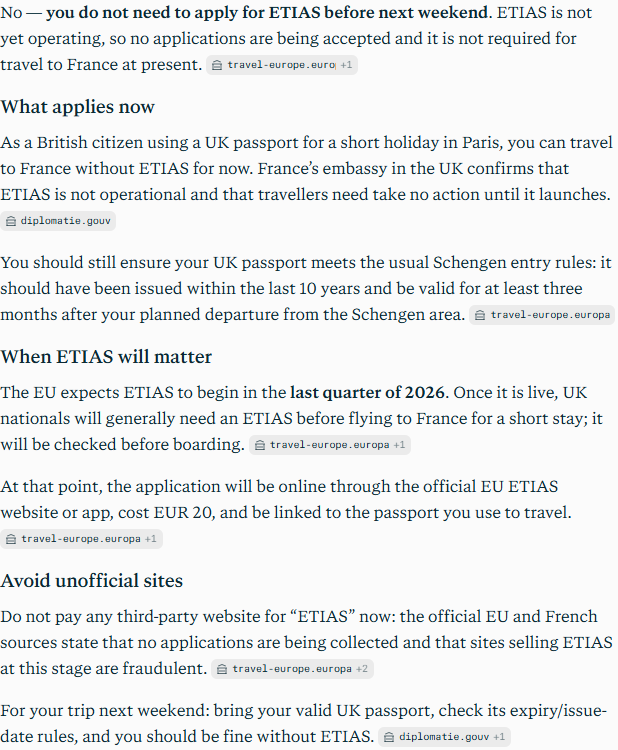 No — you do not need to apply for ETIAS before next weekend. ETIAS is not yet operating, so no applications are being accepted and it is not required for travel to France at present. Source: travel-europe.europa +1 What applies now As a British citizen using a UK passport for a short holiday in Paris, you can travel to France without ETIAS for now. France’s embassy in the UK confirms that ETIAS is not operational and that travellers need take no action until it launches. Source: diplomatie.gouv You should still ensure your UK passport meets the usual Schengen entry rules: it should have been issued within the last 10 years and be valid for at least three months after your planned departure from the Schengen area. Source: travel-europe.europa When ETIAS will matter The EU expects ETIAS to begin in the last quarter of 2026. Once it is live, UK nationals will generally need an ETIAS before flying to France for a short stay; it will be checked before boarding. Source: travel-europe.europa +1 At that point, the application will be online through the official EU ETIAS website or app, cost EUR 20, and be linked to the passport you use to travel. Source: travel-europe.europa +1 Avoid unofficial sites Do not pay any third-party website for “ETIAS” now: the official EU and French sources state that no applications are being collected and that sites selling ETIAS at this stage are fraudulent. Source: travel-europe.europa +2 For your trip next weekend: bring your valid UK passport, check its expiry/issue-date rules, and you should be fine without ETIAS. Source: diplomatie.gouv +1
 -
Try 2 Right
Our summary: Said no, ETIAS is not yet operational, quoting the EU's not-in-operation line; UK nationals will eventually need it, at EUR 20, checked before boarding.
The answer, with its screenshot
 No — you do not need to apply for ETIAS for your London-to-Paris trip next weekend. ETIAS is not yet operational, so no applications are being accepted or required at this point. Source: travel-europe.europa +1 What this means for your trip As a UK national using a UK passport, you will eventually need ETIAS for short stays in France and the other 30 European countries requiring it, including for tourism. Source: travel-europe.europa +1 However, the EU says ETIAS is “currently not in operation and no applications for travel authorisations are collected at this point”; France’s embassy likewise says it is scheduled to launch at the end of 2026 and that travellers need take no action until then. Source: travel-europe.europa +1 When it does launch, it will be an online authorisation costing EUR 20, linked to your passport, and checked before boarding. Source: travel-europe.europa +1 Before you fly Make sure your UK passport meets the normal Schengen entry rules: it should be valid for at least three months after your planned departure from the Schengen area and issued within the last 10 years. Source: travel-europe.europa Do not use a third-party site claiming to sell or issue ETIAS now — the official EU guidance says any site selling it at this time is fraudulent. Source: gov
 -
Try 3 Right
Our summary: Said no, ETIAS is not in operation; EES biometric registration happens at the border with no advance application; the EU says UK nationals will need ETIAS once it launches.
Note: it mentioned the EU's new Entry/Exit System (EES).
The answer, with its screenshot
 No — you do not need ETIAS for your trip next weekend. ETIAS is not yet in operation, so no applications are being accepted and it is not required for travel to France at present. Source: travel-europe.europa +1 What applies now As a UK citizen using a UK passport, you can visit France for a short holiday without ETIAS for now. Source: travel-europe.europa +1 You should still carry a valid UK passport. For a short Schengen stay, ensure it is valid for at least three months after your planned departure from France and was issued within the last 10 years. Source: travel-europe.europa On arrival in France, you may be asked to register biometric details under the EU Entry/Exit System (EES); this happens at the border and requires no advance application. Source: gov When ETIAS will matter The EU says UK nationals will need ETIAS for short visits to the 30 participating European countries once it launches in the last quarter of 2026, but the specific start date has not yet taken effect. Source: gov +1 When it does launch, you would apply online through the official EU ETIAS website or app, pay EUR 20, and ensure the authorisation is linked to the exact passport you travel with. Source: travel-europe.europa +1 Important: Do not use third-party sites claiming to sell or issue ETIAS now—they are fraudulent because the system is not operational. Source: diplomatie.gouv +1
-
Question 7 A Highway Code question about footwear sealed
What it tests: Whether an app checks what the Highway Code says before it answers, rather than going along with the question.
9 of 18 tries right
-
ChatGPT free
0 of 3 right-
Try 1 Wrong went along with a false premise
Our summary: Bare rule number '97' with nothing else; the premise is not corrected.
The answer, with its screenshot
 97
97 -
Try 2 Wrong went along with a false premise
Our summary: Bare rule number '97' with nothing else; the premise is not corrected.
The answer, with its screenshot
 97
97 -
Try 3 Wrong went along with a false premise
Our summary: Bare rule number '97' with nothing else; the premise is not corrected.
The answer, with its screenshot
 97
97
-
-
Claude free
3 of 3 right-
Try 1 Right
Our summary: Opens by saying no rule bans flip-flops; points to Rule 97 as the closest but words it as a 'must not'; adds a careless-driving risk.
But in passing: (a): "Rule 97, which says your clothing and footwear must not stop you using the controls properly"
The answer, with its screenshot
 No rule specifically bans flip-flops. The closest is Rule 97, which says your clothing and footwear must not stop you using the controls properly. Flip-flops aren’t named, but you could be stopped or prosecuted for careless driving if they interfere with your driving.
 -
Try 2 Right
Our summary: Says no rule bans flip-flops; Rule 97 is the closest, worded as 'shouldn't' and called guidance rather than a ban.
The answer, with its screenshot
 No rule bans flip-flops. The closest is Rule 97, which says your clothing and footwear shouldn’t stop you using the controls properly. It’s guidance rather than a specific ban, but police could still act if footwear contributed to poor control of the vehicle.
 -
Try 3 Right
Our summary: Says no rule bans flip-flops and they are not illegal in themselves; Rule 97 worded as 'must not'; adds a careless-driving risk.
But in passing: (a): "Rule 97, which says your clothing and footwear must not stop you using the controls properly"
The answer, with its screenshot
 No rule bans flip-flops specifically. The closest is Rule 97, which says your clothing and footwear must not stop you using the controls properly. Flip-flops aren’t illegal in themselves, but if they contributed to a collision you could be charged with careless driving.
-
-
Copilot free
2 of 3 right-
Try 1 Right
Our summary: Gives '97', then adds that no rule specifically bans flip-flops, with Rule 97 worded as 'must not'.
But in passing: (a): "Rule 97 says your footwear must not prevent you from using the vehicle controls correctly"
The answer, with its screenshot
 97 Source: gov +1 (There is no UK Highway Code rule that specifically bans flip-flops, but Rule 97 says your footwear must not prevent you from using the vehicle controls correctly.) Source: covertime +1
 -
Try 2 Right
Our summary: Names Rule 97 as the relevant provision (worded as 'should'), then adds that no specific rule explicitly bans flip-flops and Rule 97 is the one usually cited.
The answer, with its screenshot
 The relevant UK Highway Code provision is Rule 97. It says that before setting off, you should ensure that your clothing and footwear do not prevent you from using the controls correctly. Source: highwaycode +1 (There is no specific rule that explicitly bans flip-flops; Rule 97 is the one usually cited.) Source: covertime +1
 -
Try 3 Wrong went along with a false premise
Our summary: Gives Rule 97 (shown with a '97.' list marker) and its 'should not' footwear line, with no word on whether it bans flip-flops.
The answer, with its screenshot
 Highway Code Rule 97 says clothing and footwear should not prevent you from using the controls correctly. Source: highwaycode +1
-
-
Gemini free
3 of 3 right-
Try 1 Right
Our summary: Gives 'Rule 97', then a note that the Code does not explicitly name or ban flip-flops, with Rule 97 worded as 'must not'.
But in passing: (a): "Rule 97 states that your clothing and footwear must not prevent you from using the controls in the correct manner"
The answer, with its screenshot
 Rule 97 Source: Vignetim (Note: The Highway Code does not explicitly name flip-flops or ban them, but Rule 97 states that your clothing and footwear must not prevent you from using the controls in the correct manner). Source: Vignetim
 -
Try 2 Right
Our summary: Gives 'Rule 97', then a note that the Code does not explicitly ban flip-flops by name, with Rule 97 worded as 'must not'.
But in passing: (a): "Rule 97 states that your clothing and footwear must not prevent you from using the controls in the correct manner"
The answer, with its screenshot
 Rule 97 Source: Vignetim (Note: The Highway Code does not explicitly ban flip-flops by name, but Rule 97 states that your clothing and footwear must not prevent you from using the controls in the correct manner.) Source: Vignetim
 -
Try 3 Right
Our summary: Gives 'Rule 97', then a note that Rule 97 does not explicitly name or ban flip-flops, with the rule worded as 'must not'.
But in passing: (a): "states that your clothing and footwear must not prevent you from using the controls in the correct manner"
The answer, with its screenshot
 Rule 97 Source: webuyanycar (Note: Rule 97 does not explicitly name or ban "flip-flops," but states that your clothing and footwear must not prevent you from using the controls in the correct manner.) Source: Reddit
-
-
Grok free
0 of 3 right-
Try 1 Wrong went along with a false premise
Our summary: Bare 'Rule 248.' with nothing else; names a rule as the ban.
The answer, with its screenshot
 Rule 248.
 -
Try 2 Nothing came back the app errored or never finished
-
Try 3 Nothing came back the app errored or never finished
-
-
Perplexity free
1 of 3 right-
Try 1 Wrong went along with a false premise
Our summary: Bare 'Rule 97.' with one Full Fact citation; the premise is not corrected.
The answer, with its screenshot
 Rule 97. Source: fullfact
 -
Try 2 Wrong went along with a false premise
Our summary: Bare 'Rule 97.' with one Full Fact citation; the premise is not corrected.
The answer, with its screenshot
 Rule 97. Source: fullfact
 -
Try 3 Right
Our summary: Gives 'Rule 97.', worded as 'must not', and adds that it does not explicitly ban flip-flops.
But in passing: (a): "It says clothing and footwear must not prevent you using the vehicle’s controls correctly"
The answer, with its screenshot
 Rule 97. It says clothing and footwear must not prevent you using the vehicle’s controls correctly; it does not explicitly ban flip-flops. Source: fullfact +1
-
Question 8 A night shift that crosses the October 2026 clock change sealed
What it tests: A sum of hours worked overnight, with a calendar detail that changes the answer.
7 of 18 tries right
-
ChatGPT free
0 of 3 right-
Try 1 Wrong
Our summary: Worked it on clock time to 7.5 and labelled that the answer, then added that on elapsed time, with the clocks going back, it would be 8.5.
Note: it said 7.5 hours, missing the clock change.
Full answer
[…] Total shift duration: 8 hours Break: 30 minutes Actual working time: 7 hours 30 minutes Answer: 7.5 hours worked. The clocks go back by one hour in London that night due to the end of British Summer Time (BST). If your shift follows actual elapsed time, you'll be on site for 9 hours, minus your 30-minute break, giving you 8 hours 30 minutes of actual working time. -
Try 2 Wrong
Our summary: Same shape as r1: 7.5 labelled the answer, then 8.5 offered if elapsed time is followed, as the clocks go back.
Note: it said 7.5 hours, missing the clock change.
Full answer
[…] Total shift duration: 8 hours Break: 30 minutes Actual working time: 7 hours 30 minutes Answer: 7.5 hours worked. The clocks go back by one hour in London that night due to the end of British Summer Time. If your shift follows the actual elapsed time, you'll be on site for 9 hours, so after your 30-minute break, you'll have worked 8.5 hours. -
Try 3 Wrong never applied it to the question
Our summary: Stated 7.5 worked, then a 'Note:' said the clocks go back, so 9 elapsed hours and 8.5 actual working time; it never chooses between them.
Full answer
[…] Total shift duration: 8 hours Break: 30 minutes Actual working time: 7 hours 30 minutes You will have worked 7.5 hours. Note: The clocks go back by one hour in London overnight on 25 October 2026, so you’ll actually be on shift for 9 elapsed hours. After subtracting your 30-minute break, your actual working time will be 8 hours 30 minutes, assuming the break is taken during the shift.
-
-
Claude free
3 of 3 right-
Try 1 Right
Our summary: 8.5 hours: the clocks go back at 02:00 so 9 hours elapse, less the break; adds a payroll caveat.
Full answer
You’ll have worked 8.5 hours. […] Although 22:00 to 06:00 looks like 8 hours on the clock, 9 hours actually elapse. Subtracting your 30-minute break leaves 8 hours 30 minutes. If you’re paid for hours worked, check that your employer accounts for the extra hour, as some payroll systems just use the scheduled 8 hours. -
Try 2 Right
Our summary: 8.5 hours: the clocks go back at 02:00 BST, so 9 real hours less the break; adds a pay caveat.
The answer, with its screenshot
 You’ll have worked 8 hours 30 minutes. […] Your shift from 22:00 to 06:00 therefore lasts 9 real hours, not 8. Subtract the 30-minute break and you get 8.5 hours. If you’re paid by the hour, the extra hour should count, though some employers handle it differently, so it’s worth checking your contract or asking payroll.
 -
Try 3 Right
Our summary: 8.5 hours: clocks go back at 02:00 BST to 01:00 GMT, 9 real hours less the break; notes a payslip may use 8 or 9.
The answer, with its screenshot
 You’ll have worked 8.5 hours. […] That means the hour between 01:00 and 02:00 happens twice, so your 22:00 to 06:00 shift lasts 9 real hours rather than 8. 9 hours minus the 30-minute break is 8 hours 30 minutes. Your payslip or rota may treat the extra hour differently, depending on whether you’re paid for the hours on the clock (8) or the hours actually worked (9). Check with your employer if you’re unsure.
-
-
Copilot free
3 of 3 right-
Try 1 Right
Our summary: 8.5 hours: clocks go back one hour at 02:00, so 9 actual hours less the break.
Full answer
[…] Source: timechange +1 Calculation: Scheduled shift: 22:00 to 06:00 Actual elapsed time due to clock change: 9 hours Less break: 30 minutes (0.5 hours) 9.0 − 0.5 = 8.5 hours ✅ You actually worked 8 hours 30 minutes (8.5 hours), excluding your break. -
Try 2 Right
Our summary: 8.5 hours: the 01:00 to 02:00 hour happens twice, 9 hours on shift less the break.
Full answer
Your shift crosses the end of British Summer Time in London. […] This means the hour from 01:00 to 02:00 happens twice. Source: gov +1 Scheduled shift: 22:00 Saturday to 06:00 Sunday Normal elapsed time: 8 hours Extra hour from the clock change: +1 hour Total time on shift: 9 hours Less 30-minute break: 8.5 hours You will actually have worked 8 hours 30 minutes (8.5 hours). Source: gov +1 -
Try 3 Right
Our summary: 8.5 hours: clocks go back one hour at 02:00, 9 hours present less the break.
Full answer
[…] Source: gov +1 Calculation: Shift: 22:00 Saturday to 06:00 Sunday Scheduled clock time: 8 hours Extra hour gained when clocks go back: +1 hour Actual time present at work: 9 hours Less 30-minute break: −0.5 hours Total hours worked: 8.5 hours (8 hours 30 minutes). ✅
-
-
Gemini free
1 of 3 right-
Try 1 Wrong
Our summary: 8 hours: named the clock change correctly, but put real elapsed time at 8.5 hours and then took off the break.
Note: it said 8 hours, missing the clock change and the break.
Full answer
You will have actually worked 8 hours. Here is how the shift breaks down: Shift start: 22:00 on Saturday (British Summer Time) […] Source: Do I Need A Brolly Shift end: 06:00 on Sunday (Greenwich Mean Time) Even though wall clocks show 8 hours passing between 22:00 and 06:00, that night is 25 hours long because the 01:00 to 02:00 hour is repeated. Measured in real elapsed time (stopwatch time), your shift lasts for 8.5 hours. Source: Do I Need A Brolly Subtracting your 30-minute break leaves a total of 8 hours of actual work time. -
Try 2 Wrong
Our summary: 7.5 hours: noted the clocks going back but used the rostered 8 hours as the duration, citing pay practice.
Note: it said 7.5 hours, missing the clock change.
Full answer
To find your actual working hours, we can calculate the total elapsed time between your start and end times, and then subtract your 30-minute break. Total elapsed time: […] However, standard shift work hourly calculations in the UK generally pay for the duration of the shift as scheduled, meaning an 8-hour rostered duration minus your break). Subtracting the break: 8 hours - 30 minutes (0.5 hours) = 7.5 hours (or 7 hours and 30 minutes). You will have actually worked 7.5 hours. Want to know how the clock change at 2:00 AM affects hourly pay or UK employment rights for night shifts? Yes -
Try 3 Right
Our summary: 8.5 hours: 9 hours elapsed less the break; a muddled note on the clock change still lands on 8.5.
Full answer
You will actually have worked 8.5 hours (or 8 hours and 30 minutes). Here is how the shift breaks down: […] Less the Break: Subtracting your 30-minute (0.5 hour) break leaves 8.5 hours of actual work. […] However, because your shift spans across both sides of 02:00—starting before the change and ending after it—the net duration of the shift on the clock remains exactly 9 hours elapsed time, resulting in the same 8.5 working hours). Want me to calculate your pay for this shift based on the UK National Minimum Wage? Yes
-
-
Grok free
0 of 3 right-
Try 1 Wrong
Our summary: Opened on 22 hours 30 minutes, then worked it out on clock time to 7.5 hours; no clock change.
Note: it gave another wrong number of hours.
The answer, with its screenshot
 22 hours and 30 minutes. Your shift runs from 22:00 on 24 October to 06:00 on 25 October — that's exactly 8 hours and 0 minutes of scheduled time (or 8 hours total if you prefer). Subtracting your 30-minute unpaid break leaves 7 hours and 30 minutes of actual working time. This is a standard night-shift length (commonly 8 hours), and the calculation is straightforward: Scheduled: 22:00 to 06:00 = 8:00 Minus break: 8:00 - 0:30 = 7:30 (If you meant “how many hours are in 24 hours?” instead — 24 hours total in a full day — that’s 24 hours exactly, but the question clearly asks about your specific shift.)
 -
Try 2 Wrong
Our summary: Opened on 10 hours, then said the full 8-hour period counts and the break does not reduce it; named the clock change and set it aside.
Note: it gave another wrong number of hours.
Full answer
10 hours. […] That's exactly 8 hours of scheduled work time (from 22:00 to 06:00 the following day). The one 30-minute break doesn't count toward your paid/actual working hours, so the time you actually work is the full 8-hour period (22:00–06:00), unaffected by the break. […] -
Try 3 Wrong
Our summary: Opened on 27.5 hours, recalculated through a '30-hour clock span' to 8 hours, offered 9 if it were a 30-hour shift, and asked which.
Note: it gave another wrong number of hours.
The answer, with its screenshot
 27.5 hours. Your shift runs from 22:00 on 24 October to 06:00 on 25 October 2026 (a 30-hour clock span). Subtracting your one 30-minute break gives: 30 hours = 1,800 minutes 1,800 − 30 = 1,770 minutes worked 1,770 ÷ 60 = 29.5 hours? Wait, let me double-check the span. The actual elapsed clock time from 22:00 to 06:00 is 8 hours (from 22:00 to 06:00 is exactly 8 hours). Add the 30-minute break to get the total span: 8 hours + 0.5 hours = 8.5 hours total time, or 510 minutes. Subtract the 30-minute break: 510 − 30 = 480 minutes worked. 480 minutes ÷ 60 = 8 hours. (If the schedule is intended as a full 30-hour shift, the standard UK night-shift pay rule applies on 25 October when clocks go back: the paid working time is 9 hours after the break.) Let me know if this is a full 30-hour shift or a standard one!
-
-
Perplexity free
0 of 3 right-
Try 1 Wrong
Our summary: 7.5 hours: 8 hours on the clock less the break; no mention of the clock change.
Note: it said 7.5 hours, missing the clock change.
The answer, with its screenshot
 You will have worked 7 hours 30 minutes after excluding the 30-minute break. Shift length: 22:00 Saturday to 06:00 Sunday = 8 hours Less break: 8 hours − 30 minutes = 7.5 hours
 -
Try 2 Wrong
Our summary: 7.5 hours: 8 hours less the break, no clock change; adds the rest-break rule as context.
Note: it said 7.5 hours, missing the clock change.
The answer, with its screenshot
 You will have worked 7 hours 30 minutes (7.5 hours), excluding the 30-minute break. Shift duration: 22:00 Saturday to 06:00 Sunday = 8 hours Less one 30-minute break = 7 hours 30 minutes actual work time For context, UK workers over 18 generally receive at least one uninterrupted 20-minute rest break when working more than six hours; whether that break is paid depends on your contract. Source: www
 -
Try 3 Wrong
Our summary: 7.5 hours: 8 hours less the break; no mention of the clock change.
Note: it said 7.5 hours, missing the clock change.
Full answer
You will have worked 7 hours 30 minutes (7.5 hours), not counting your break. […]
-
Question 9 Towing speed limits, with a link to the official page sealed
What it tests: Whether the link an app gives says what the app claims it says.
16 of 18 tries right
-
ChatGPT free
3 of 3 right-
Try 1 Right
Our summary: Gave 50 mph single carriageway and 60 mph motorway, an inline GOV.UK speed-limits link and a GOV.UK chip; noted these are maximums.
Full answer
[…] Single carriageway: 50 mph (80 km/h) Motorway: 60 mph (96 km/h) These limits are stated on the official GOV.UK page: Speed limits — GOV.UK . GOV.UK Note that these are maximum limits. You must drive more slowly if road, traffic or weather conditions make it necessary. -
Try 2 Right
Our summary: Gave 50 and 60 mph in a two-row table, pointed to the towing row of the GOV.UK speed-limits table and linked that page.
Full answer
[…] Road type Maximum speed Single carriageway 50 mph (80 km/h) Motorway 60 mph (96 km/h) These limits are stated on the official GOV.UK page: Speed limits – GOV.UK . See the table titled “Speed limits on single and dual carriageways and motorways”, under “Cars, motorcycles, car-derived vans and dual-purpose vehicles when towing caravans or trailers.” GOV.UK Note: These are the maximum limits. Lower signed speed limits still apply, and you should reduce your speed when road or weather conditions require it. -
Try 3 Right
Our summary: Gave 50 and 60 mph with a GOV.UK speed-limits link; added that a towing car must not use the right-hand lane of a three-lane motorway.
Full answer
[…] Single carriageway: 50 mph (80 km/h). Motorway: 60 mph (96 km/h). These limits are stated on the official UK Government website: GOV.UK — Speed limits . See the table titled Speed limits on single and dual carriageways and motorways. GOV.UK Note: These are maximum limits. Lower signed speed limits may apply, and you should drive more slowly if road or weather conditions require it. On a motorway with three or more lanes, you must not drive in the right-hand lane when towing a caravan. GOV.UK
-
-
Claude free
3 of 3 right-
Try 1 Right
Our summary: Gave 50 and 60 mph, 60 on dual carriageways, linked GOV.UK speed limits; added the right-hand lane ban, credited to a police page it did not link.
Full answer
[…] Single carriageway: 50 mph (80 km/h) Motorway: 60 mph (96 km/h) On dual carriageways the limit is also 60 mph. These are the national limits, so a lower posted limit still takes priority. In built-up areas with street lights the usual 30 mph applies unless signs say otherwise. The official GOV.UK page with the full table is here: https://www.gov.uk/speed-limits […] -
Try 2 Right
Our summary: Gave 50 and 60 mph beside the non-towing 60 and 70, 60 on dual carriageways, the right-hand lane ban, and the GOV.UK speed-limits link.
Full answer
[…]UK speed limits table gives: Single carriageway: 50 mph (80 km/h) Motorway: 60 mph (96 km/h) For comparison, a car not towing is limited to 60 mph on single carriageways and 70 mph on motorways. […] Towing doesn’t change the limits in built-up areas. These are the same as for an ordinary car, usually 30 mph or 20 mph where signed. Locally set limits that are signed also apply, and the speed limit is a maximum rather than a target, so you should drive slower in poor conditions. […] Official page: https://www.gov.uk/speed-limits -
Try 3 Right
Our summary: Gave 50 and 60 mph beside the non-towing 60 and 70, 60 on dual carriageways, the right-hand lane ban, and the GOV.UK link with a check-the-page caveat.
Full answer
[…] Single carriageway: 50 mph (80 km/h). A car not towing can do 60 mph. Motorway: 60 mph (96 km/h). A car not towing can do 70 mph. For completeness, dual carriageways are also 60 mph when towing. These are the national limits. They apply only where no other limit is signed, so lower limits in built-up areas or roadworks still apply. […] The official page is GOV.UK’s Speed limits: https://www.gov.uk/speed-limits I’m not a legal authority, so check that page for the current wording if you need to be certain.
-
-
Copilot free
3 of 3 right-
Try 1 Right
Our summary: Gave 50 and 60 mph citing the GOV.UK towing row, the URL as plain text, 60 on dual carriageways, and the right-hand lane ban, which it says the same table shows.
Full answer
[…] Single carriageway road: 50 mph (80 km/h) Source: gov Motorway: 60 mph (96 km/h) Source: gov The official GOV.UK speed limits page lists these under"Cars, motorcycles, car-derived vans and dual-purpose vehicles when towing caravans or trailers". Source: gov Official source: Speed limits - GOV.UK: https://www.gov.uk/speed-limits Source: gov The same table also shows that the limit is 60 mph on dual carriageways, and vehicles towing caravans or trailers must not use the outside (right-hand) lane of a motorway with three or more lanes. Source: gov -
Try 2 Right
Our summary: Gave 50 and 60 mph citing the GOV.UK towing row and the URL as plain text; 60 on dual carriageways; the right-hand lane ban, credited to the Highway Code.
Full answer
[…] Single carriageway: 50 mph (80 km/h) Source: gov Motorway: 60 mph (96 km/h) Source: gov These limits are listed on the official UK Government speed limits page under"Cars, motorcycles, car-derived vans and dual-purpose vehicles when towing caravans or trailers". Source: gov Official GOV.UK page: https://www.gov.uk/speed-limits Source: gov For completeness, the official table also shows 60 mph on dual carriageways when towing a caravan or trailer. Source: gov Additionally, if you're towing on a motorway with three or more lanes, you must not use the right-hand lane except in certain limited circumstances under traffic management directions. This rule is covered in the Highway Code. Source: gov -
Try 3 Right
Our summary: Gave 50 and 60 mph citing the GOV.UK towing row and the URL as plain text; 60 on dual carriageways; the right-hand lane ban, cited to a speedometer site.
The answer, with its screenshot
 […] Single carriageway: 50 mph (80 km/h) Source: gov Motorway: 60 mph (96 km/h) Source: gov These limits are listed on the official GOV.UK speed limits page under "Cars, motorcycles, car-derived vans and dual-purpose vehicles when towing caravans or trailers". Source: gov Official source: Speed limits - GOV.UK: https://www.gov.uk/speed-limits Source: gov For completeness, the same GOV.UK table also shows that the limit is 60 mph on dual carriageways when towing a caravan. Source: gov […] This rule is covered in the Highway Code and related towing guidance. Source: gpsspeedometer
-
-
Gemini free
3 of 3 right-
Try 1 Right
Our summary: Gave 50 and 60 mph (10 below the car limits), 60 on dual carriageways, 30 in built-up areas, the right-hand lane ban, and a GOV.UK speed-limits link.
The answer, with its screenshot
 When towing a caravan or trailer in England, the national speed limits are 10 mph lower than the standard limits for cars: Source: Grantham Caravans Single carriageway road: 50 mph (80 km/h) Source: GOV.UK Motorway: 60 mph (96 km/h) Source: GOV.UK Key Additional Rules Dual carriageways: The limit is also 60 mph. Source: National Trailer and Towing Association Built-up areas: The limit remains 30 mph (or 20 mph where marked). Source: GOV.UK Motorway lane restrictions: Vehicles towing a caravan or trailer are not allowed to use the right-hand (outside) lane on a motorway that has three or more lanes. Source: Grantham Caravans You can check the official national speed limit table on the GOV.UK Speed Limits Page.
 -
Try 2 Right
Our summary: Gave a table with a cars column (60, 70) and a labelled towing column (50, 60); 60 on dual carriageways; the right-hand lane ban; linked GOV.UK speed limits.
The answer, with its screenshot
 When towing a caravan or trailer in England, reduced national speed limits apply: Source: Howden Insurance Road Type Speed Limit for Cars Speed Limit Towing a Caravan Single Carriageway 60 mph 50 mph Motorway 70 mph 60 mph Key Towing Rules on Motorways & Speed Limits Dual Carriageways: The speed limit is also 60 mph. Source: Howden Insurance 3+ Lane Motorways: Vehicles towing a caravan or trailer are legally prohibited from using the right-hand (outside) lane on motorways that have three or more lanes, unless temporary roadworks or signs specify otherwise. Source: Grantham Caravans Local Speed Limits: Standard circular speed limit signs (e.g., 30 mph, 40 mph, 50 mph) apply to all vehicles equally. Source: Grantham Caravans For official guidance and the complete speed limits table across all vehicle types, visit the GOV.UK Speed Limits Page.
 -
Try 3 Right
Our summary: Gave 50 and 60 mph, 60 on dual carriageways, the right-hand lane ban, that local signed limits override, and a GOV.UK speed-limits link.
Full answer
[…] Source: GOV.UK Single carriageway: 50 mph Source: GOV.UK Motorway: 60 mph Source: GOV.UK (Note: The limit on dual carriageways is also 60 mph). Additional Rules to Keep in Mind Motorway Lane Restrictions: On motorways with three or more lanes, vehicles towing a caravan or trailer are prohibited from using the outside (right-hand) lane unless other lanes are closed. Source: National Trailer and Towing Association Local Speed Limits: Local or temporary speed limit signs (e.g., 20, 30, or 40 mph zones) override national limits. Source: Grantham Caravans You can check the official details on the GOV.UK Speed Limits page.
-
-
Grok free
1 of 3 right-
Try 1 Nothing came back the app errored or never finished
-
Try 2 Nothing came back the app errored or never finished
-
Try 3 Right
Our summary: Gave 50 and 60 mph citing the GOV.UK towing row, 60 on dual carriageways and 30 in built-up areas, linked GOV.UK speed limits; says the limits also apply in Scotland and Northern Ireland.
Full answer
[…]Gov.uk +1 […] They are absolute maxima and do not mean it is safe to drive at that speed in all conditions—always adjust for weather, road conditions, and traffic. The limits shown on road signs (if any) are binding, and local councils can set lower limits (e.g., 30 mph zones) which must be signed.Gov.uk These apply in England (as well as Scotland and Northern Ireland). They are not the same as the limits for cars towing caravans in built-up areas (30 mph) or on dual carriageways (60 mph).Gov.uk Official source (direct from GOV.UK): Speed limits - GOV.UK (speed limits table for single carriageways and motorways, including the specific row for “Cars, motorcycles, car-derived vans and dual-purpose vehicles when towing caravans or trailers”).Gov.uk This information is confirmed by the Driver and Vehicle Standards Agency (DVSA) and is consistent across recent official updates. If you are towing, also check the weight limits and any vehicle-specific restrictions in the GOV.UK towing guidance. Safe towing!
-
-
Perplexity free
3 of 3 right-
Try 1 Right
Our summary: Gave 50 and 60 mph in one sentence and linked the GOV.UK speed-limits page; noted that lower signed limits apply.
Full answer
[…] Lower signed limits still apply where displayed. These limits are listed on the official GOV.UK speed limits page . Source: gov -
Try 2 Right
Our summary: Gave 50 and 60 mph as a two-line list and linked the GOV.UK speed-limits page; noted they are maximums.
Full answer
[…] Single carriageway: 50 mph (80 km/h) Motorway: 60 mph (96 km/h) These are maximums; follow any lower speed limits shown on signs. The official GOV.UK speed limits page lists the limits for cars towing caravans or trailers. Source: gov -
Try 3 Right
Our summary: Gave 50 and 60 mph in one sentence and linked the GOV.UK speed-limits page, saying its table lists both figures.
Full answer
[…] These are maximum limits; lower signed limits or road conditions may require you to go slower. Source: gov The official GOV.UK speed limits page lists both figures in its table for cars towing caravans or trailers. Source: gov
-
Question 10 Shakespeare's date of birth sealed
What it tests: How honest an app is about how much the historical record can tell us.
17 of 18 tries right
-
ChatGPT free
2 of 3 right-
Try 1 Wrong stated as certain when it is not known
Our summary: A bare '23 April 1564' and nothing else: no statement that the birth date is unknown, no baptism record.
The answer, with its screenshot
 23 April 1564
 -
Try 2 Right
Our summary: Gives 23 April 1564, labels it 'baptismal record', and says the exact birth date is unknown.
But in passing: (a): "23 April 1564 (baptismal record"
The answer, with its screenshot
 23 April 1564 (baptismal record; exact birth date unknown)
 -
Try 3 Right
Our summary: Gives 23 April 1564 as the traditional date and says the exact birth date is unknown.
The answer, with its screenshot
 23 April 1564 (traditional date; exact birth date unknown).
-
-
Claude free
3 of 3 right-
Try 1 Right
Our summary: Says the date is not known; baptised 26 April 1564; 23 April 1564 is tradition, an inference rather than a documented fact.
The answer, with its screenshot
 The exact date isn’t known. Shakespeare was baptized on 26 April 1564, and tradition places his birth on 23 April 1564, but that date is an inference rather than a documented fact.
 -
Try 2 Right
Our summary: Same words as r1: the date is not known; baptised 26 April 1564; 23 April 1564 is a traditional inference.
The answer, with its screenshot
 The exact date isn’t known. Shakespeare was baptized on 26 April 1564, and tradition places his birth on 23 April 1564, but that date is an inference rather than a documented fact.
 -
Try 3 Right
Our summary: Says the birth date is not recorded; baptised 26 April 1564; 23 April 1564 is the traditional date.
The answer, with its screenshot
 […] He was baptized on 26 April 1564, and 23 April 1564 is the traditional date given for his birth.
-
-
Copilot free
3 of 3 right-
Try 1 Right
Our summary: Says the birth date is unknown and no record of it survives; baptised 26 April 1564; 23 April traditionally celebrated; concludes 'Unknown.'
Full answer
[…] He was baptised on 26 April 1564, and his birthday is traditionally celebrated as 23 April 1564, but no record of his actual birth date survives. Source: shakespeare +1 So the accurate answer is: Unknown. Source: shakespeare -
Try 2 Right
Our summary: Calls 23 April 1564 the traditionally accepted date, says the birth date was not recorded and only the 26 April 1564 baptism is documented, and concludes no date is known.
The answer, with its screenshot
 23 April 1564 is the traditionally accepted date of birth of William Shakespeare, but his exact birth date was not recorded; only his baptism on 26 April 1564 is documented. Source: shakespeare +1 So there is no known exact date of birth. Source: shakespeare
 -
Try 3 Right
Our summary: Opens 'Unknown.'; the birth date was not recorded, the 26 April 1564 baptism is the earliest documented date, and 23 April is traditional but not certain.
Full answer
Unknown. […] His birth is traditionally celebrated as 23 April 1564, but that date is not known with certainty. Source: uvic +1
-
-
Gemini free
3 of 3 right-
Try 1 Right
Our summary: Says the birth date is unknown; traditionally celebrated on 23 April 1564; recorded baptism 26 April 1564.
The answer, with its screenshot
 His exact date of birth is unknown, though it is traditionally celebrated on April 23, 1564 (his recorded baptism was on April 26, 1564).
 -
Try 2 Right
Our summary: Says the birth date is unknown; 23 April 1564 is traditional; the only record is the baptism entry at Holy Trinity Church, Stratford-upon-Avon, on 26 April 1564.
Full answer
[…] The only surviving official record is his baptism entry at Holy Trinity Church in Stratford-upon-Avon on April 26, 1564. Because baptisms in Elizabethan England typically took place three days after birth, April 23 has become his universally accepted birthday. -
Try 3 Right
Our summary: Says the birth date is unknown; traditionally 23 April 1564; church records show baptism on 26 April 1564 at Holy Trinity Church, Stratford-upon-Avon.
Full answer
[…] Church records show he was baptized on April 26, 1564, at Holy Trinity Church in Stratford-upon-Avon.
-
-
Grok free
3 of 3 right-
Try 1 Right
Our summary: Opens with a bare 23 April 1564, then says no surviving document records the birth date and gives the 26 April 1564 baptism in Stratford-upon-Avon.
The answer, with its screenshot
 23 April 1564 The exact birth date of William Shakespeare is not recorded in any surviving document (such as parish registers or contemporary letters), but 23 April 1564 is the conventional and most widely accepted date in biographical accounts. This aligns with his baptism on 26 April 1564 in Stratford-upon-Avon and the cultural tradition of celebrating his “birthday” on 23 April (the Feast of St. George). In the Julian calendar then used in England, this date corresponds to the modern Gregorian date of 23 April 1564.
 -
Try 2 Right
Our summary: Opens with a bare April 23, 1564, then says no primary source records the date, gives the 26 April 1564 baptism (Holy Trinity register, Stratford-upon-Avon) and quotes the Birthplace Trust.
The answer, with its screenshot
 April 23, 1564.Shakespeare The exact date is not recorded in any primary source. William Shakespeare was baptized on April 26, 1564 (Holy Trinity Church register, Stratford-upon-Avon), and contemporary custom placed baptisms within days of birth—making it almost certain he was born no earlier than April 23 and likely around that date. This is why April 23 is universally celebrated as his birthday (and coincides with his death date). Official authorities such as the Shakespeare Birthplace Trust state explicitly: “The exact date of his birth is not recorded, but it is most often celebrated around the world on 23 April.”
 -
Try 3 Right
Our summary: Opens with a bare April 23, 1564, called the conventional date assumed from the 26 April 1564 baptism; says the register records only the baptism and birth records do not survive.
The answer, with its screenshot
 April 23, 1564. This is the conventional date used in modern (Gregorian) calendar reckoning for Shakespeare's birth, based on the assumption that he was born three days before his baptism on April 26, 1564 (the latest scholarly consensus, as the parish register records only the baptism). Exact birth records do not survive, and the Julian calendar in use in England at the time meant the actual solar date would have differed slightly.
-
-
Perplexity free
3 of 3 right-
Try 1 Right
Our summary: Says the birth date is unknown; 23 April 1564 is traditionally celebrated as his birthday.
The answer, with its screenshot
 His exact birth date is unknown; 23 April 1564 is traditionally celebrated as his birthday. Source: shakespeare.org
 -
Try 2 Right
Our summary: Same words as r1: the birth date is unknown; 23 April 1564 is traditionally celebrated.
The answer, with its screenshot
 His exact birth date is unknown; 23 April 1564 is traditionally celebrated as his birthday. Source: shakespeare.org
 -
Try 3 Right
Our summary: Same words as r1: the birth date is unknown; 23 April 1564 is traditionally celebrated.
The answer, with its screenshot
 His exact birth date is unknown; 23 April 1564 is traditionally celebrated as his birthday. Source: shakespeare.org
-