This is the kind of thing the Bluff Filter catches. It’s free →
// On this page
The short answer to whether ChatGPT makes up sources: mostly no, once web search is on. But I asked it a money question and it gave me an answer with a source attached, a real link, to a real government website. I felt reassured, the way you do when a claim comes with a footnote. So I clicked it.
The page loaded. It was a genuine gov.uk page. And it didn’t say what ChatGPT had told me it said.
The gap is the whole post. The worry most people carry about AI sources is that the model invents them: a citation to a study that was never written, a URL that goes nowhere. That happens, and it’s a real failure. But it’s the easy one to catch: a dead link gives itself away. The harder failure is the one I hit here, where the link works, the site is real, and the source still doesn’t back the claim. The footnote loads, and it opens a page on a different subject.
The two ways ChatGPT sources go wrong
There are two separate failures, and most writing on this collapses them into one.
The first is fabrication, the well-documented one: the model makes up a source that doesn’t exist. A 2023 study in Scientific Reports found ChatGPT inventing 18% of the references an older version cited, rising to 55% on the weaker model it tested, and other studies put the rate higher still in specialist subjects like medicine. It happens most when the model isn’t searching the web and is reaching back into what it half-remembers from training. You catch it instantly: the link is dead, or the paper isn’t real.
The second is misattribution. The model cites a source that exists (the page is real, it loads, it’s even from an authoritative site) but the page doesn’t contain the claim. The figure is different, the rule has a nuance the page doesn’t mention, or the model stitched a claim together from several places and pinned it on one. This is the failure web search makes more common, and it’s the one that slips past you. The link worked, so you stop checking.
I wanted to see which of these I’d hit if I used ChatGPT the way an ordinary person would, for real money questions, with the answer-with-sources behaviour switched on.
The setup
Two claims, each one checkable against a single named source: a fund fee and an ISA rule. I ran each on ChatGPT (free tier, web search on, temporary chat with memory off, the same way a first-time user gets it), and asked it to cite its sources. Then, for every link it gave me, I did one thing: I opened the page and looked for the specific claim on it.
I graded each cited source on a three-point scale:
- Real and supports: the page loads and the claim is right there on it.
- Real but wrong: the page loads, but the claim isn’t on it.
- Fabricated: the page doesn’t exist, or goes somewhere unrelated.
I ran the same questions through Perplexity and Claude alongside, because the more interesting question is whether this is a ChatGPT problem, a web-search problem, or something that happens to all of them on the same question.
Claim one: the fund fee, and why “it lied” is the wrong story
I started with a plain one: the ongoing charge on a popular global index fund (the Vanguard FTSE All-World ETF, ticker VWRL, a fund that holds a slice of thousands of companies worldwide, the kind of thing a lot of people hold in an ISA). What’s the annual fee?
ChatGPT said 0.19%. It cited four links, all on Vanguard’s own domains, and noted the figure used to be 0.22% before Vanguard cut it. I opened the links. Real Vanguard pages. The figure checked out.
Then I ran the same question through Perplexity and Claude. Both also said 0.19%. Both cited real Vanguard pages. Claude added, unprompted, that you’ll still see the old 0.22% floating around in stale sources, and flagged it.
Update, 28 July 2026: Vanguard has cut the charge again since these runs, 0.19% to 0.14%. The captures above were correct on their day; if you repeat the check now, the current figure on Vanguard’s page is 0.14%.
So here’s the honest result, and it matters: on this question, nobody made anything up. Three tools, the correct number, real sources from the fund provider itself. If I’d set out to write a post called “AI invents your fund fees,” this claim kills it on the first try. Which is the point. The number was fine. I had to keep looking for where the cracks were.
The scary version of this story, AI invents your sources, isn't the true one. The real failure is quieter, and it survives the click.
Claim two: the ISA rule, where the source went wrong
The cracks showed up on the next question. This is the one the whole post is built on, so I’ll be precise about it.
I asked about a rule a lot of UK savers need: an ISA is a tax-free savings or investment account, with a £20,000-a-year limit, and the question was: if you’ve paid into a Stocks and Shares ISA this tax year, can you move just part of it to a new provider, or do you have to move the whole lot? I asked ChatGPT for the answer and the source for the transfer rule.
It got the answer roughly right in the prose: yes, partial transfers are now allowed, since a rule change in April 2024. Then it gave me its source: a gov.uk link.
I clicked it. The page loaded. It was a real, current gov.uk page. And it was the wrong page. It was the page about what happens to your ISA if you move abroad or die. Nothing on it about transferring part of your current-year money to a new provider. The rule ChatGPT was citing lives on a different gov.uk page entirely, the one titled “Transferring your ISA,” which says in plain words: “You can transfer all or part of the savings in your Individual Savings Account (ISA) from one provider to another at any time.”
That’s the real-but-wrong grade, exactly. The citation isn’t fabricated. Gov.uk is as authoritative as a UK source gets, and the link is alive. But it points at a page that doesn’t hold the rule. If you’d clicked it to check the answer, you’d have landed on an official government page, felt reassured by the domain, skimmed, and never noticed it was about something else. The footnote loaded. The page had nothing to do with the transfer rule.
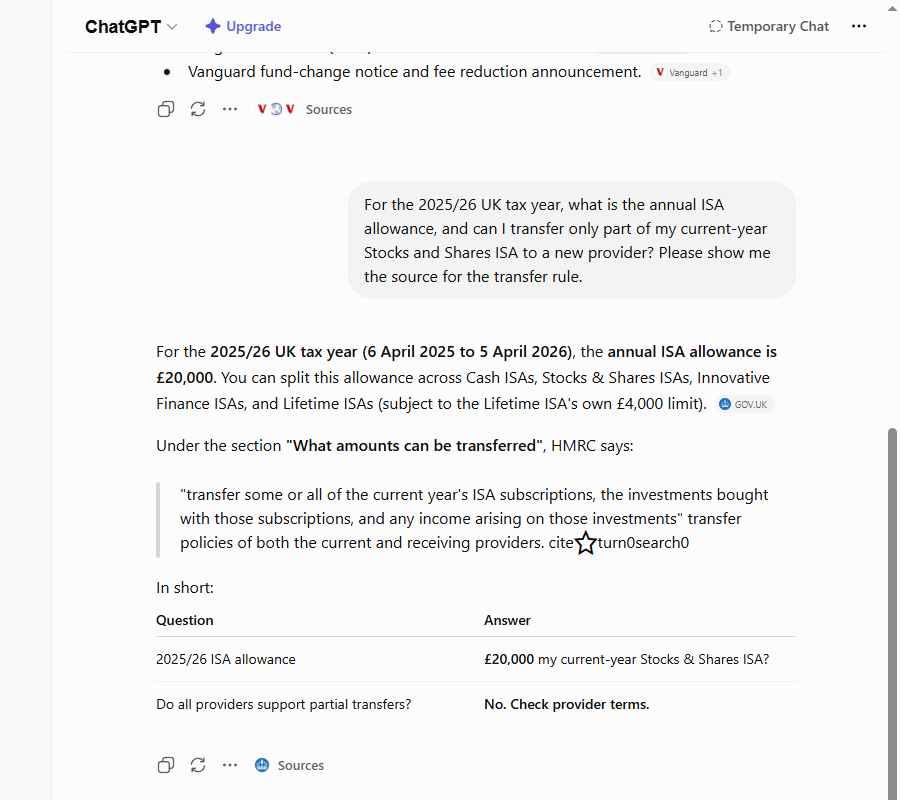
Here’s what makes this a fair test: not every tool did this. I gave Perplexity the same question on the same day. It cited the correct gov.uk page, “Transferring your ISA”, and quoted the actual line that contains the rule. Claude searched, flagged that the sources disagreed, reconciled them, and landed on the right rule too. So this isn’t “AI can’t cite gov.uk.” One tool, on one run, attached the right answer to the wrong page, and presented it with the same confidence it used when it got the fund fee exactly right.
That’s the part worth sitting with. The misattribution doesn’t look any different from a good citation. There’s no warning colour, no lower confidence in the wording. On screen, a good citation and a bad one are rendered identically.
Why web search makes this trickier, not easier
You’d think turning on web search would fix all of this. In one way it does. It kills most outright fabrication, because the model is pulling from pages that exist. The fund-fee question shows it: real sources, real number.
But it introduces the subtler problem at the same time. When there’s no sources button, you already know to be sceptical. The model is clearly working from memory, and you treat the answer accordingly. When there is a sources button, with tidy link pills under the answer, it feels checked. The presence of citations does the reassuring; almost nobody opens them. And that’s precisely the gap the misattributed source lives in.
It’s not just me finding this. The Tow Center for Digital Journalism ran 200 queries asking ChatGPT’s search to identify where news quotes came from, and found it wrong or misattributed in over three-quarters of cases: real URLs, wrong attribution. That was a different task (tracing quotes rather than sourcing a fund fee), so I won’t stretch the number onto my finance test. But the shape is the same as what I hit: web search returns you a real page, and “real page” and “page that backs the claim” turn out to be two different things.
This is one specific shape of a broader pattern I keep running into: the model inheriting confidence from a source’s format without checking whether the source earns it. I’ve written about that as borrowed certainty; the misattributed citation is one of its cleaner examples.
The 10-second check
The fix costs almost nothing, which is the only reason it’s worth writing down, and why it’s the first check on the Guardrails page. When ChatGPT gives you a sourced claim that matters (a fee, a rule, a date, a number you’re about to act on), open the link and look for the specific claim on the page. Read it, and confirm the page actually says the thing.
For the fund fee, that’s searching the page for the charge (0.19% on the day I ran this; 0.14% since the 28 July 2026 cut). For the ISA rule, it’s reading the heading and asking: is this page even about transfers? Ten seconds, and the wrong-page citation falls apart the moment you look, because the page is about moving abroad and you’re asking about transfers.
If an answer leans on a stack of citations, do the existence half in bulk first: open every link before you read any of them. The dead ones and the invented ones fall out in a single pass, and you are left with a shorter list of pages that at least exist. Whether a real page actually backs the specific claim is still your ten seconds, and the four-step version is here.
I do this now by reflex, and it’s changed which answers I trust. A sourced answer I haven’t opened is, to me, an unsourced answer with better presentation. The ISA question in this post is part of a broader pattern: I ran four AI tools through a set of UK ISA questions, and the partial-transfer rule was exactly where the tools split: the ones that searched got it right; the ones working from memory gave the abolished rule. I later ran a harder version of this exact check, six UK questions across five assistants with every inspectable source checked, and three failed the strict source rubric: some linked a real page that didn’t back the claim, while another exposed only opaque labels. Perplexity, for what it’s worth, builds its whole interface around making this check easier, putting each citation next to the sentence it backs, though as I found in a longer look at Perplexity for investment research, that helps most when the topic is well-covered enough to have good sources in the first place.
The short version
What worked: With web search on, ChatGPT cited real, live pages on every question, and got the fund-fee number exactly right with sources from the fund provider itself. Outright fabrication didn’t show up in this test.
What didn’t: On the ISA transfer rule, it cited a real gov.uk page that doesn’t contain the rule: the right answer pinned to the wrong page, rendered with the same confidence as a correct citation. Perplexity, given the same question the same day, cited the correct page.
Bottom line: Useful, with one habit attached. ChatGPT mostly doesn’t invent sources once web search is on. The real finding is that a working link can still fail to back the claim, and the difference is invisible until you open the page. What would change the verdict: if the sources button reliably linked to the exact page holding the claim, the 10-second check would stop earning its place. It doesn’t yet.
The most dangerous source isn’t the one that’s obviously made up. The real risk is the one that loads, wearing the costume of due diligence, and still doesn’t say what it was cited to say. A source like that survives the click. The only thing that catches it is reading the page it sent you to.
I’ve since written that habit up as a reusable ten-second method: how to check if a ChatGPT citation is real or fake.
Common questions
- Does ChatGPT make up sources?
- Mostly no, once web search is on: it cites real, live pages. The subtler failure is misattribution, where a real page loads but doesn't actually contain the claim it was cited for.
- What are the two ways ChatGPT sources go wrong?
- Fabrication, where the model invents a source that doesn't exist and you catch it instantly because the link is dead; and misattribution, where it cites a real page that loads but doesn't hold the claim. Web search makes the second one more common, not less.
- Does turning on web search fix AI sources?
- In one way yes: it kills most outright fabrication because the model pulls from pages that exist. But tidy citation link pills make an answer feel checked, so almost nobody opens them, and that gap is exactly where a misattributed source hides.
- How do you check whether a ChatGPT source actually backs the claim?
- Open the link and look for the specific claim on the page, not just whether the link works. For a fund fee, search the page for the number; for a rule, read the heading and ask whether the page is even about that rule. It takes about ten seconds.

Ben tests how far you can trust the main AI assistants, and publishes exactly where they get things wrong. Every post here is a first-hand test with the receipts, including the times a tool simply wasn’t worth the trust. About Ben →
The site tests how far you can trust the main AI assistants, on real decisions. Start with the Prompt Stack for the four-stage framework, free and ungated, or the Bluff Filter for the paste-ready version with a real before and after.