
Prompt Stack · List
AI earnings call red flags: three phrases to watch for in the transcript
- Updated 18 Oct 2026
- 9 min read
This site is the AI Reliability Tracker: we check six AI apps’ answers every month.
Language checks can read restrained CEOs as hedging, and Tim Cook's services framing has been that restrained for years.
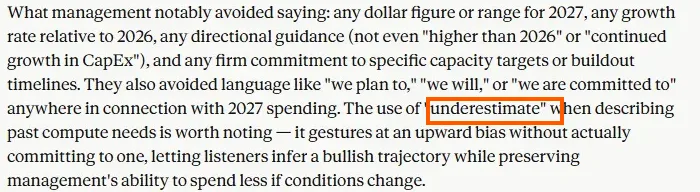
On META’s Q1 2026 call, Claude and ChatGPT caught a word that Gemini missed. Susan Li said Meta had “continued to underestimate” its compute needs. That word points upward, we’ll need more than we said, and we’ve kept needing more, without committing to a number. Perplexity listed the phrase among the hedges without saying which way it pointed. Claude flagged it. The catch is on the catches log.
Three AI earnings call red flags recur across companies regardless of sector. This post names them, shows the META evidence for each, and gives you the prompt that runs all three checks on any transcript. The five-prompt post covers what to ask about one call; this one names patterns that show up across calls, so the next release you read, you know what to watch for.
I held META into Q1 2026. The numbers were strong; the language was the problem.
Pattern 1: The upward-pointing hedge
Language that creates a positive impression without making a commitment. Susan Li’s “continued to underestimate” is the cleanest example I have. It reframes a pattern of misses as a discovery: management gets credit for noticing the gap without committing to what they’ll spend next. Structurally different from a commitment (“we will invest $X by [date]”) and from a real hedge (“we remain cautious”).
It is the third thing: an upward cue wearing neutral clothes.
The word continued makes it stronger, not weaker: it says the gap is ongoing, not a one-off.
The tell is the construction. “Continued to underestimate” / “we now see” / “we have more confidence than we did”, each one points one way without taking on a number. If the next sentence doesn’t carry a figure or a date, the cue is doing the work the commitment would normally do, without the accountability.
I ran the same passage through four tools when META reported; Claude and ChatGPT both flagged the word on first read. The tool comparison records the catch with the screenshot.
Correction, 17 October 2026: I first called this passage Susan Li’s prepared remarks. It was not. It came later in the call, in her answer to an analyst’s question about 2027 capex, shortened where the dots show and with a few small wording changes. “Continued to underestimate our compute needs” is her exact wording in Meta’s official call transcript. All four tools got the same passage, so the catch stands. One thing does change: the phrase is not in Meta’s prepared remarks, so the prompt below, run on the prepared remarks alone, would not have met it. I had also linked the wrong test for the screenshot; the link above now goes to the four-tool run.
Update, 18 October 2026: I re-ran the same passage and prompt three times on Claude Opus 5.5, now the Max plan’s default, and all three runs read “continued to underestimate” as pointing upward without a commitment.
Free, with Confidently Wrong every fortnight.
Pattern 2: The guidance band that lost its timeline
META’s guidance, the company’s own forecast of what it will spend, came in at $125–145bn of capex for the full year, against FactSet consensus of around $122.6bn going in. Capex is the money a company commits to long-term assets, here the data centres and chips behind its AI push; consensus is the average forecast analysts had pencilled in beforehand. The top of the band was the surprise. Management said the signs it was seeing gave it “confidence in this investment”, but supplied no quantified return or payback horizon. Between Q4 2025 and Q1 2026 the guidance moved from $115–135bn to $125–145bn: floor up $10bn, ceiling up $10bn, top end now well above consensus. Same $20bn spread, no commitment date attached to when the spend pays off.
A guidance band is a number, so it sounds precise. But two bands in a row, both wide, both wrapped in narrative, that carries less information than a single tight number with a date. The upward shift and the qualitative justification are the signal. “Confidence in this investment” is doing the work “we expect to start seeing returns by [date]” would normally do, without the commitment. When management is confident in the timeline, they give one. When they’re not, they give a rationale.
The stock fell roughly 8% in the session.
For me, the numbers weren't the problem; the absent timeline was.
Pattern 3: The absent topic
A topic a careful investor would expect to see addressed, that doesn’t appear in the prepared remarks at all. Silence isn’t a direct claim, but it is a choice. On the META Q1 2026 release I was reading into, two absences stood out: any payback figure for the capex itself (Zuckerberg used the word “return” without producing a number while adding $10bn to an already-record capex line) and any mention of tariffs, in a quarter where the capex revision was pinned on “higher component costs.”
The mechanism: management controls the prepared remarks. The absence of a topic is a decision. AI is better at auditing for absences than a human reader is, because humans track presences: we notice what is said and build a picture from it, then feel well-informed about a call that carefully skipped the one number we wanted. A systematic list of “what should be here given the sector and the prior call” requires pre-defining expectations before reading. Which is what the prompt below makes you do.
Humans track what management says; the prompt makes you track what they didn't.
The prompt: three AI earnings call red flags, one pass
I built this after the META session: three checks I’d been running by hand, collapsed into one pass. One consolidated Prompt Stack block, built on the same facts-from-inference discipline the site’s other prompts start from. Paste the prepared remarks in once; the model runs all three patterns on the same text.
SCOPE: Work only from the prepared remarks I paste below; don’t bring in outside facts or figures from memory, and if something you’d need isn’t in the text, say so rather than fill it in. Your job is not to evaluate whether the business is performing well. It is to identify three language signals experienced analysts learn to notice: upward-pointing hedges (language that implies good news without committing to it), guidance bands that have widened or lost their timeline, and topics a careful investor would expect to appear but that do not.
FILTER: Below are the prepared remarks from [COMPANY NAME]’s [QUARTER] results. Read them once, then produce the following.
[PASTE PREPARED REMARKS HERE]
-
UPWARD-POINTING HEDGES: List any phrases that imply an optimistic direction without a commitment. Look for “continued to underestimate”, “we now recognise”, “we have more confidence than we did”, and similar constructions. For each, state what the phrase implies and what management is NOT committing to.
-
GUIDANCE SPECIFICITY: For any forward guidance given, capex, revenue, margin, note whether a timeline accompanies the number. Flag any guidance that is a wide band with a narrative justification but no payback horizon or commitment date. Quote the phrase and note what the specific commitment would look like if management were making one.
-
ABSENT TOPICS: Based on the sector [SECTOR], the prior quarter’s prepared remarks, and any topics raised in the Q&A, list two to three topics a careful investor would expect management to address in the prepared remarks that do not appear. Mark each ABSENT or MENTIONED-WITHOUT-SPECIFICITY.
RISK: For each item flagged in (1), (2) and (3), state whether it is a genuine concern or a normal feature of how this management team communicates. Name the prior quarter’s language as your baseline.
VERDICT: In one paragraph, summarise what the prepared remarks commit management to versus what they imply. Name the single most material thing management said without saying it.
Good output names the phrase verbatim, says what it implies, and names what management is not committing to. If the output stays at a high level (“management was cautious”) the prompt hasn’t done its job. Push back and ask for the exact phrasing.
The short version
What worked: Three recurring language patterns proved easier for AI to catch than for a careful human reader doing one quick pass. Claude flagged each of them on META Q1 2026, across separate runs.
What didn’t: Only the hedge went to all four tools. Gemini missed it and Perplexity listed the phrase without saying which way it pointed, while ChatGPT caught it too.
Bottom line: The prompt above is the consolidated version I run going into each earnings release I hold a position into.
Where this prompt falls short
Naturally restrained CEOs read as hedged on any language check. Tim Cook’s services framing has carried that register for years without it meaning anything new. Some people just talk like that, and the prompt can’t tell cautious from constitutionally vague. The patterns appear on most calls; the question is frequency and context, which is a judgement it leaves to you. Language analysis is the second pass, not the first. Numbers first, then the read. And none of this catches rumours, off-call commentary, or intra-quarter shifts. The prompt reads what management put on paper.
It also only works on a stock you know. The baseline (“how does this management normally communicate?”) needs filling in. On a name you don’t follow, the model has nothing to compare against, which is why every example here is META, the company I held into the release.
The five-prompt earnings call analysis post covers the broader set (omissions, confidence calibration, prior-call drift, the unasked question) for a deeper pass on a single call. This post reads the language; the quality-of-earnings review reads the numbers, stripping the one-time items out of the headline profit before you trust any of it. Run both on a quarter you care about. The Prompt Stack has the underlying method.
Confidently Wrong, every fortnight.
Which AI told the truth this month, with the receipts, plus an AI story worth retelling in between.
Free. Leave whenever you like.