
Prompt Stack · List
Claude prompts for investing: 6 real examples
Six Claude prompts tested on MSFT, META and NVDA, with their real outputs and the source audit that found the NVDA input itself was wrongly labelled.
- Updated 24 Aug 2026
- 16 min read
This site is the AI Reliability Tracker: we check six AI apps’ answers every month.
Free, with Confidently Wrong every fortnight.
I asked Claude what to verify before Microsoft's results, and it pointed out they were already out.
The four Claude-investing prompt lists I read on 20 May 2026 showed the prompts and stopped. You’re meant to take it on trust that the templates work, on names you don’t know, with outputs nobody’s seen. Which is a curious way to write about not trusting AI blindly. They gave the prompts. They didn’t give the outputs.
This post does both. Six Claude prompts for investing, real examples of what each one returned when I ran it on MSFT, META or NVDA, and an honest note on what I still had to check before the output was usable. I chose those names because the May runs and their source material were already captured. This article didn’t test smaller companies, so it can’t tell you whether the same prompts work as well there.
One rule ties the six together. In these May runs, Claude was most useful when reviewing supplied material rather than generating an investment case from nothing. Every prompt below feeds it a filing excerpt, transcript, news passage or stated thesis and asks it to find what was missed. One run also shows the limit: a model can follow bad source material perfectly. That reviewer-versus-generator distinction is the single prompt change that made AI analysis worth using, and it sits underneath everything below.
What’s a quick snapshot of this company?
A first pass on any name you’re considering. Business model, segment split, the risks the company itself names. The “flag anything I should verify” instruction is the bit most published prompts skip. In the captured MSFT run, Claude used it to identify its own stale segment figures.
I just re-ran this on MSFT (Claude Opus 4.7, 20 May 2026). The business model paragraph was tight. The segment split came back as FY2024, roughly two years behind current reporting, and the Verdict section flagged exactly that, told me Microsoft has since restructured its segments as of Q1 FY2025, and instructed me to check the live 10-K (a US company’s annual report) before quoting the percentages anywhere.
SCOPE: Work only from published sources you can name (the company’s filings and annual report, audited accounts) and anything I paste in; don’t fill gaps from memory, and say so if you can’t verify something rather than guess. Give me a factual snapshot of [COMPANY NAME] as a business, not a view on whether to buy it.
FILTER: Provide: (1) one-paragraph business model description; (2) primary revenue segments with approximate % split (use the most recent annual report you have training data on, and state the period clearly); (3) top three risks the company itself names in its most recent filing; (4) one sentence on who the main listed competitors are.
Do not generate price targets, earnings forecasts, or buy/sell recommendations. Where you are working from training data rather than a specific cited source, say so.
VERDICT: Flag any item in the above where you are uncertain of accuracy and I should verify against the live filing.
What does each side look like: bull and bear, written as separate analysts?
Before buying more of a stock you already own, this prompt makes Claude argue both sides. The useful instruction isn’t “give me a balanced view”. It is to write the cases as two separate analysts who each genuinely believe their case and are trying to convince a sceptical investment committee. In the captured run, that produced two committed arguments rather than one hedged summary.
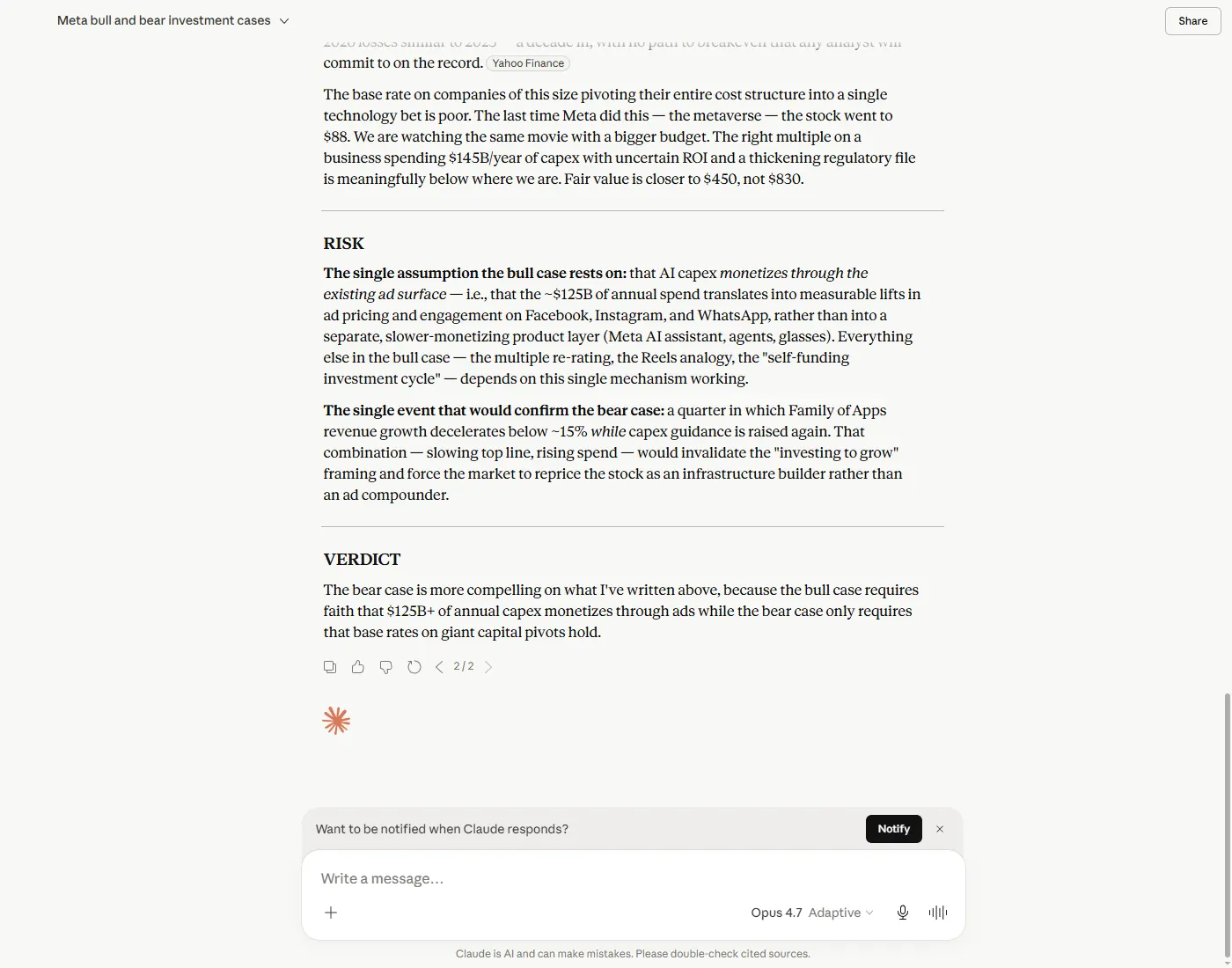
I just re-ran this on META (Claude Opus 4.7, 20 May 2026, with live search on). The bull case argued the market was mistaking a temporary capex peak (capex being the money a company spends building things like data centres, here Meta’s $125–145B 2026 guide) for a permanent return profile. The bear case argued META is being priced like an ad company but now spends like a hyperscaler, $125B+ a year on AI infrastructure, quietly called “growth investment” without management being made to defend the framing. Claude’s own verdict at the close: the bear case is more compelling, because it only needs the base rates for giant capital programmes to hold, while the bull case requires faith that the spending pays off through the existing ad business.
I held META through the Q1 results on a version of the bull case. Reading the bear case back on 20 May, the capex-without-payback-timeline frame still applied, but the drop after earnings meant the next question was “is the bear case priced in at $606?”, not another generic bull-versus-bear pass.
SCOPE: Work only from what you can source and name, plus anything I paste in; don’t invent figures, and flag where a claim is your inference rather than something you can verify. You will write two separate sections: a bull case and a bear case for [COMPANY NAME]. Each section should be written as if the analyst genuinely believes that position and is trying to convince a sceptical investment committee. Do not balance the two views or hedge between them.
FILTER: Bull case: make the strongest possible case for why [COMPANY NAME] could outperform over the next 2–3 years. Cover the business model, competitive position, and the specific market misunderstanding you think exists. Bear case: make the strongest possible case for why the current price is wrong. Cover the risks the bull case papers over, and the scenario where the business underperforms.
RISK: At the end, name the single assumption the bull case depends on most, and the single event that would confirm the bear case.
VERDICT: Which case do you find more compelling based only on what you’ve given me above? One sentence.
Why did the stock move, reading only the pasted context?
For when a name you own moves on news and you want to read it properly before reacting. Paste the source URL, publication date and relevant excerpt, then tell Claude to separate what the text supports from what it doesn’t. The source details matter as much as the instruction: a clean prompt can’t rescue a mislabelled excerpt.
I just re-ran this on NVDA (Claude Opus 4.7, 20 May 2026). The first thing Claude did was flag what I hadn’t given it, the direction of the price move, and answer all three questions conditionally on direction. That part was useful. The excerpt itself was not.
Here’s the correction. The saved prompt shows that the bad numbers were already in the text supplied to Claude. It labelled the passage “Q4 FY2026” but used $39.3B revenue, $35.6B Data Center revenue and a 73.5% non-GAAP margin from NVIDIA’s Q4 FY2025 release. It also called 73.5% GAAP.
The real Q4 FY2026 release reported $68.1B revenue, $62.3B Data Center revenue and a 75.0% GAAP margin, with Q1 FY2027 guidance at 74.9% GAAP. Claude didn’t reach past a correct excerpt and fetch a stale figure. It accepted a mislabelled excerpt and analysed it as instructed. The failure began in the evidence supplied to it, and Claude didn’t catch it.
A constraint cannot rescue bad input. If the pasted excerpt is wrong, a model can follow it perfectly and still mislead you.
SCOPE: Work only from the news context I paste in for [COMPANY NAME]’s move today. Do not add facts from memory. First, state the source URL, publication date, reporting period and accounting basis shown in my input. If any of those are missing, label the passage UNVERIFIED INPUT rather than treating my description as proof.
FILTER: [PASTE: source URL, publication date, reporting period, then the relevant earnings-release or management excerpt, 2–4 paragraphs maximum]
Given only the above, explain: (1) what the likely immediate driver of the price move is; (2) what investors were expecting going in, if you can infer it from the language used; (3) whether the move looks like a sentiment reset or a fundamental revision.
Do not speculate beyond the text I’ve pasted. If you need more context to answer one of the three questions, say which question and what you’d need.
VERDICT: State what the pasted text can support, then list the evidence still missing before anyone could decide whether to act. Do not issue a trade recommendation.
What do I need to verify before clicking buy?
This is the prompt I run before a discretionary buy on any name. Not asking Claude for a recommendation, asking it to list what I don’t know and should check first. The ranked three-item Verdict at the end is the bit that earns its place; it forces prioritisation rather than a dump of every theoretical risk.
I just re-ran this prompt on MSFT (Claude Opus 4.7, 20 May 2026). The first thing Claude did was call out the temporal premise: Q3 FY2026 had already reported on 29 April, so “ahead of” the results was no longer accurate. From there it pivoted the check onto the post-earnings position.
Claude’s output cited a 5.2% share-price drop, calculated total-company gross margin at 67.6%, and treated Microsoft’s $190B calendar-2026 capex commentary as the issue to examine. The 24 August source audit verified the earnings date, financial statements and capex statement. It didn’t support Claude’s added claim that 67.6% was “the narrowest since 2022”, so that phrase isn’t part of the conclusion here. The “single consensus assumption most at risk” came back as the one most worth quoting: “Microsoft’s AI capex is a capital-light, high-return investment that the strong balance sheet easily absorbs.”
The prompt template keeps the model listing what to verify before the trade, not handing you a recommendation.
When the model knows the trade window has already passed, it correctly tells you so, and the prompt does its real job, just on a different question than you intended. That's a feature, not a failure.
It also exposes a lesson worth tagging: a dated prompt can expire before you reuse it. In this run, Claude caught that the supposed pre-earnings window had already closed.
SCOPE: Work only from what I tell you below; don’t fill in figures or events from memory, and if something you’d need to check isn’t here, say so rather than assume it. I am considering [ACTION: buying / adding to / selling some of] [COMPANY NAME] before [EVENT OR DATE]. Your job is not to tell me whether to do it. It is to list everything I should know and verify before I do.
FILTER: I currently [hold / do not hold] [COMPANY NAME]. My reason for the action: [ONE SENTENCE]. What I already know: [3–5 bullet points of what you’ve already checked].
Walk me through:
- What catalyst or data point am I most likely to have missed that is relevant to this action?
- Is there an earnings release, dividend, index event, or macro date inside the next 30 days I should be aware of?
- What is the single consensus assumption about this company that is most at risk of being wrong right now?
Do not invent specific dates. Flag any date you cite as “verify this before acting.”
VERDICT: List the three most important things to check before placing this trade. Ranked by how likely they are to change my mind.
Is the earnings-call language committed or just optimistic?
After an earnings release lands, paste in the prepared remarks and ask Claude to sort the language into what management committed to versus what sounded confident but wasn’t a commitment. In one four-model run on 14 May 2026, Claude made the strongest read of this specific passage. When I gave the same META Q1 2026 CFO text to Claude, ChatGPT, Perplexity and Gemini, Claude and ChatGPT both picked up the word “underestimate” as one-sided phrasing. In that test Perplexity listed the phrase without saying which way it pointed, and Gemini missed it.
I just re-ran this on the META Q1 2026 prepared-remarks capex section (Claude Opus 4.7, 22 May 2026, with Zuckerberg and Susan Li’s commentary pasted in). Different passage from the May test, same task. Claude separated the numbers from the rhetoric cleanly: COMMITTED caught every figure including the precise “increased from our prior range of $115B–$135B”. OPTIMISTIC BUT UNVERIFIABLE flagged the language tell I’d missed on first read: “significant amount of AMD chips”, with Claude noting that the Broadcom clause two lines earlier had a specific number (“more than 1 GW”) and this one didn’t. Claude’s verdict: management commits hard on the audited and near-term numbers, but every statement carrying the multi-year AI thesis (returns, efficiency, strategic advantage) is unfalsifiable. The commentary anchors credibility with figures while preserving optionality on the only claims that justify the spend.
If earnings analysis is your main use of AI, the five-prompt earnings-call sequence goes deeper than this one prompt. This is the single-prompt version for everyone else.
SCOPE: Work only from the management commentary I paste below; don’t bring in outside facts from memory, and say so if the text doesn’t show something rather than fill it in. You are checking whether the prepared remarks reflect genuine confidence or performative confidence.
FILTER: Below is the management commentary section from [COMPANY NAME]’s [QUARTER] results.
[PASTE PREPARED REMARKS: management commentary only, 3–8 paragraphs]
Produce two short lists:
- COMMITTED: statements with a specific number, specific timeline, or falsifiable claim
- OPTIMISTIC BUT UNVERIFIABLE: statements that sound positive but contain no specific number, timeline, or measurable commitment
RISK: For the single most important line in the commentary, the one investors will remember, classify it as COMMITTED or OPTIMISTIC BUT UNVERIFIABLE, and state your reasoning.
VERDICT: One sentence. Does this commentary commit management to anything specific, or does it preserve their optionality?
Where are the holes in my thesis?
You’ve already got a view. This prompt asks Claude to find the weakest assumptions inside it before you act. The Prompt Stack in its most stripped-down form: one prompt, one second opinion, no sympathy. In the captured run, the “do not praise what’s sound” instruction kept the answer on the critique rather than opening with reassurance.
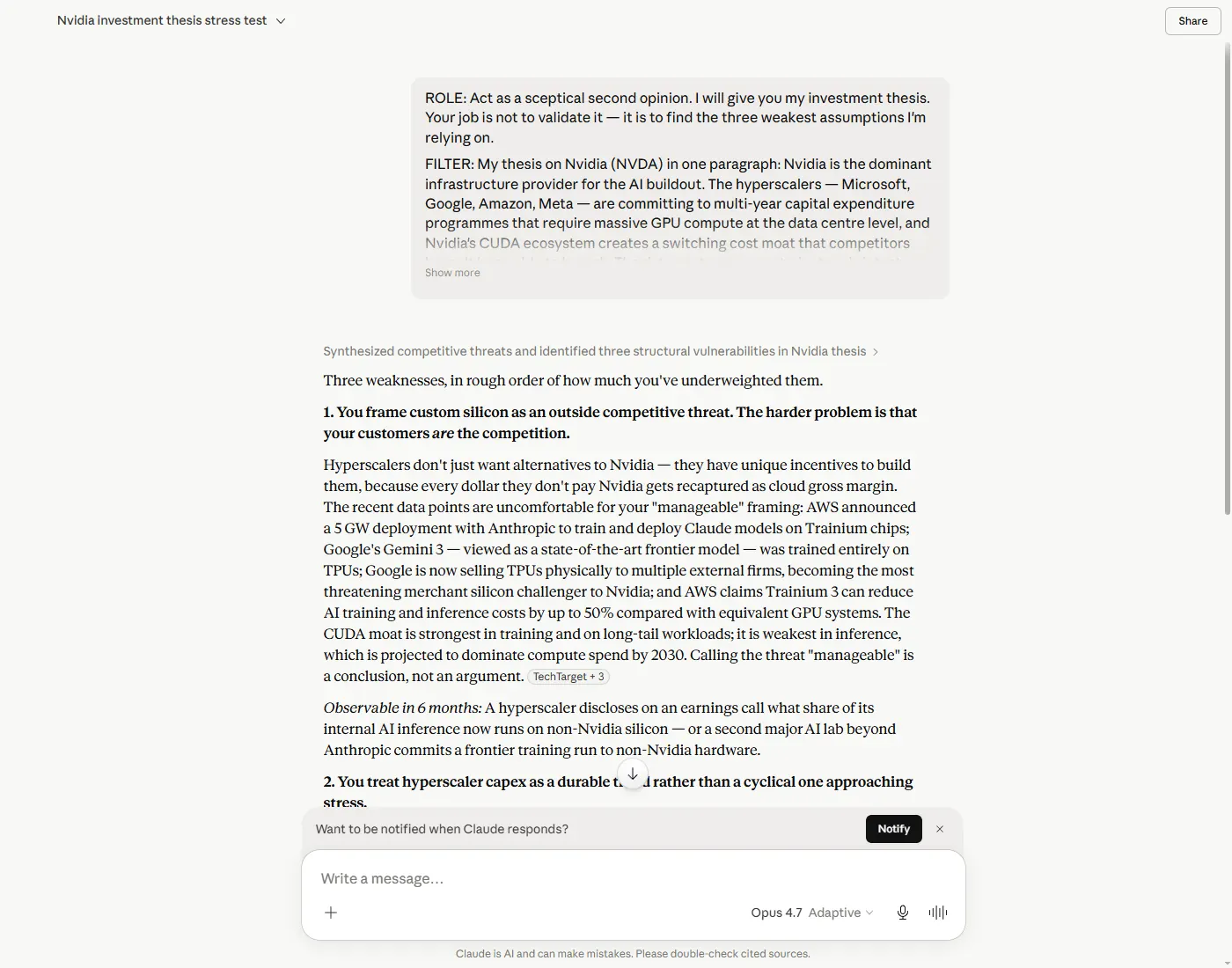
I just re-ran this on a stated NVDA thesis (Claude Opus 4.7, 20 May 2026, live search on). I don’t hold NVDA. The thesis was built as a stress-test exercise, the kind a data-centre bull might construct. Claude named three weaknesses the thesis was understating. The first: cloud buyers and AI labs using custom silicon could become competitors rather than merely customers. The second: the big buyers’ infrastructure spending was being treated as permanent.
Claude supplied four capex-to-revenue percentages to support that second claim, but they mixed guidance, trailing revenue and different reporting periods. The 24 August source audit couldn’t reproduce them consistently, so they aren’t quoted here as facts. The underlying question survives without the false precision: what happens to NVDA if one major buyer cuts or redirects spending? The third weakness was that the thesis’s central claim (“compound earnings at rates that justify the price”) didn’t show what growth the share price already reflected. Claude’s one-sentence verdict picked the infrastructure-spending assumption as the one most likely to matter in the next twelve months.
SCOPE: Work only from the thesis I paste below; don’t bring in facts or figures from memory, and if something you’d need to judge it isn’t here, say so rather than assume it. Your job is not to validate the thesis. It is to find the three weakest assumptions I’m relying on.
FILTER: My thesis on [COMPANY NAME] in one paragraph: [PASTE YOUR THESIS].
Do not praise what’s sound in the thesis. Focus only on the parts that are: (a) assumptions I’m stating as facts, (b) things I’d need to be true but haven’t verified, or (c) risks I appear to have discounted.
RISK: For each of the three weaknesses you identify, name one observable event in the next 6 months that would confirm the risk is real.
VERDICT: Which of the three weaknesses is most likely to matter in the next 12 months? One sentence.
Where these Claude investing prompts fall short
Three honest limits apply to the whole list.
These are dated Opus 4.7 runs, not a benchmark of Claude today. Anthropic released Opus 5 on 24 July 2026 and made it the default Opus model on Max and the strongest model on Pro. The prompts remain reusable; the May behaviour doesn’t automatically carry forward to the current model.
The six runs also used three different evidence routes. Prompts 2, 4 and 6 had live search on. Prompt 1 explicitly worked from training data. Prompts 3 and 5 worked from pasted passages. Claude can search the current web and cite sources when web search is enabled, but a template doesn’t guarantee that search ran or that the cited source is the right reporting period. Check the route, source, date and accounting basis each time.
This article didn’t test smaller or less-covered companies. It can’t support the old claim that their outputs are necessarily thinner, only the narrower rule that verification doesn’t become optional because a ticker is famous. For retrieval-specific comparisons, the tool comparison post covers a different job. The same boundary runs through options work, where the cost of forgetting it is steeper: what AI gets wrong about options trading is the line between a number Claude can reason about and one it will invent. The documented failure cases, where one of these tools invented data rather than flagging the gap, are on the lessons page.
The discipline running through all six prompts is the same.
Claude is a reviewer, not the source of record. The source, date and accounting basis still have to survive a check outside the chat.
The discipline is the same across all six: choose the prompt for the decision, supply source-dated material, then verify anything that could change the action. The Prompt Stack is the longer version of that rule.
Summary
The short version
What worked: Six dated analysis exercises that treated Claude as a reviewer of supplied material rather than an idea generator. Five used named-company research questions; the NVDA thesis was explicitly a hypothetical stress test.
What didn’t: The NVDA move prompt was fed a mislabelled excerpt and Claude never challenged the period or accounting basis. Three runs used web search and three didn’t; none of the templates guarantees current or correctly sourced data.
Bottom line: Useful as reviewer templates in these six May 2026 exercises, not evidence that current Claude or every ticker behaves the same way. These prompts can shorten the read. They do not replace the source check.
Confidently Wrong, every fortnight.
One AI story worth retelling, the proof behind it, and a check you can pinch.
Free. Leave whenever you like.