This is the kind of thing the Bluff Filter catches. It’s free →
// On this page
Meta reported its first-quarter results after the US market closed on 29 April 2026. Its shares closed the next session about 8.6% lower. That sequence supplies the stakes, not the cause: this test cannot prove one phrase moved the stock, or separate the capex guidance from everything else investors absorbed in the release and call.
So on results morning, a useful follow-up to “what were the numbers?” is “what did management commit to, what did they hedge, and what did they carefully avoid saying?” That’s the job I wanted to test. I pasted the same saved excerpt into ChatGPT and Claude, on the same day, and asked both the same plain question. One gave me the figures. One flagged the upward hedge.
This is a narrow ChatGPT vs Claude for earnings call analysis test, not a general comparison of the two tools. The cluster pillar runs that across five research dimensions. One question: reading a transcript excerpt for what was said, hedged, and left out. Which tool to open first for that, in the twenty minutes after a release lands. (For the hours before a release, when there’s time to prepare, the companion is the pre-trade earnings prompt.)
How the test was run
Four dimensions from the same Meta Q1 2026 transcript, fresh conversations on each tool, same day (18 June 2026). Dimensions 1 to 3 used the same saved excerpt; Dimension 4 used a fuller section of the prepared remarks. I saved every output verbatim and screenshotted the ones that decide the verdict.
One source correction matters. Rechecking Meta’s official transcript shows that the saved excerpt combines prepared remarks with Susan Li’s later Q&A answer. It also says the prior capex range was $120–135 billion; Meta’s official prepared remarks say $115–135 billion. I have kept the historical test excerpt unchanged below because it is what both tools actually received. The comparison is still same-input; the excerpt is not a verbatim source quotation.
The models, logged exactly as the apps showed them:
- Claude: Opus 4.8 High, Max plan, on all four dimensions
- ChatGPT: free plan, GPT-4o for dimensions 2 and 3
One honest snag I’m not going to bury. ChatGPT’s free plan hit its GPT-4o message cap partway through, so dimensions 1 and 4 ran on a weaker fallback model. The app wouldn’t say which, only that it was “a less powerful model” until the quota reset. That means the head-to-head on those two is not a same-tier comparison, and I’ve flagged it at each. The dimension that carries the verdict, the unprompted read, ran on GPT-4o for ChatGPT and Opus 4.8 for Claude. That one is clean.
What “winning” looks like here: catching what management implied without committing to it. Not the dollar figures. Both tools get those. The upward hedge in “continued to underestimate.” (For the separate question of which tool is best on the free tier when you can’t pay for either, I’ve written that up in the free AI tools round-up.)
The exact saved test excerpt, including the source error disclosed above:
“Our experience so far has been that we have continued to underestimate our compute needs even as we have been ramping capacity significantly… We anticipate 2026 capital expenditures, including principal payments on finance leases, to be in the range of $125 to $145 billion, increased from our prior range of $120 to $135 billion… If we end up not needing as much as we anticipate, we can choose to bring it online more slowly or reduce our spending in future years.”
Dimension 1: Does it stay inside the document?
The test: paste the passage with one instruction, “work only from the pasted document, do not search the web”, then ask what the company committed to. The thing being checked is discipline. A tool that goes off to fetch external data is doing a different job than the one you asked for. (Perplexity fails this one badly in the broader earnings test: ten web searches when told to read only the passage in front of it.)
Both ChatGPT and Claude stayed inside the document. Neither invented a consensus figure, neither pulled in outside quarterly data. ChatGPT returned a tidy two-sentence extraction: no fixed commitment, a $125–145 billion anticipated range, flexibility to spend less. Correct, and exactly as far as it went.
Claude stayed in the document too, but couldn’t help itself. Even here, asked only to extract, it noted “the upside is implicitly open-ended given the framing that they’ve ‘continued to underestimate’ needs,” and added that “the trap in the question is the word ‘commit’.” It was already reading the language when all I’d asked for was the facts.
A draw on discipline, then: both passed. With the caveat that ChatGPT was on its weaker fallback model here, so this isn’t a fair read on what GPT-4o would have done. I’ll call it a draw and move on rather than manufacture a winner.
Dimension 2: Catching the hedge without being asked
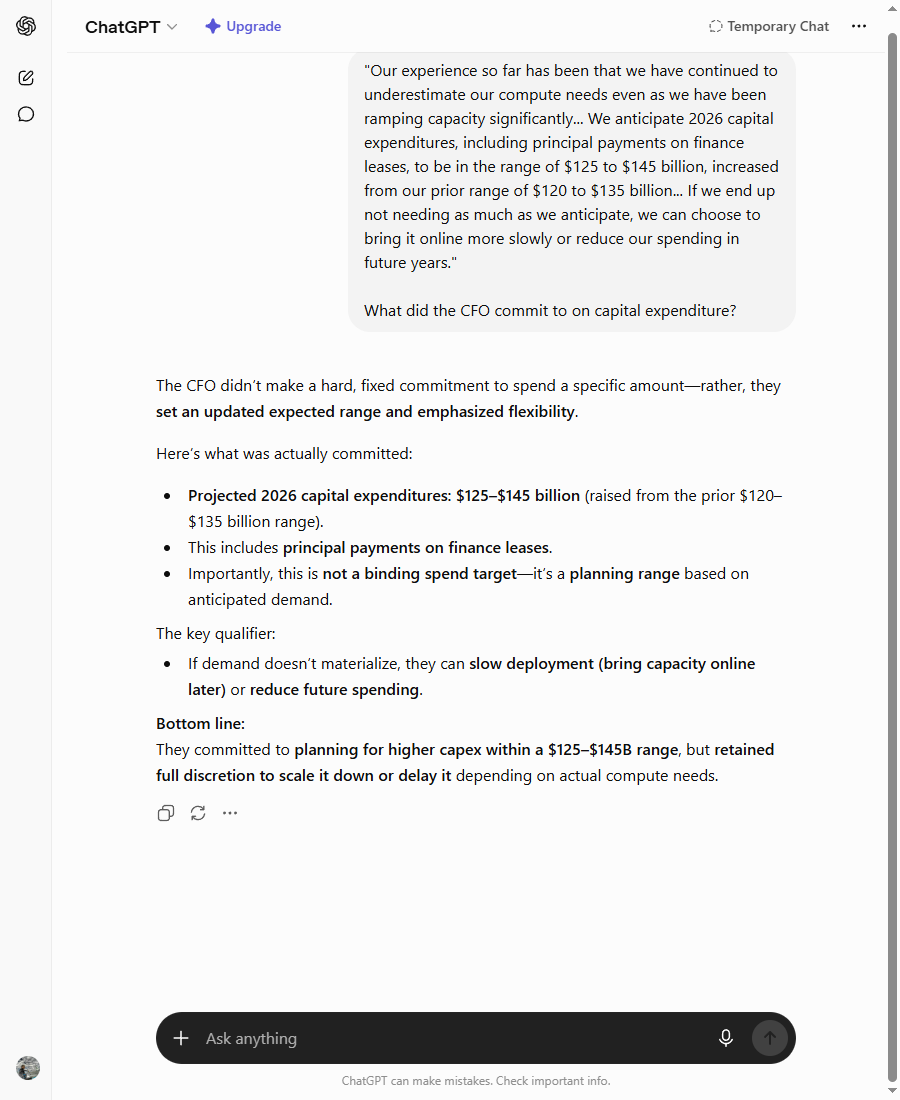
This is the one. Same passage, but the bare question: “what did the CFO commit to on capital expenditure?” No instruction to look for hedges. No structure. Just the question most people would type.
ChatGPT gave a competent extraction. It opened: “The CFO didn’t make a hard, fixed commitment to spend a specific amount. Rather, they set an updated expected range and emphasized flexibility.” It correctly caught the downside escape clause, “if demand doesn’t materialize, they can slow deployment or reduce future spending”, and netted out with a clean bottom line: committed to a planning range, retained full discretion to scale it down.
What it never did was use the word “underestimate.” The upward signal (the bit where the CFO tells you, in passing, that the real number could land above the top of the range) went straight past it, the way a distracted intern skims to the dollar figure and stops reading.
Claude, given the identical question, opened with a sentence I’d have been pleased to write myself: “Read literally, the CFO committed to very little.” Then it did the thing ChatGPT didn’t. Unprompted, it flagged the word: “‘we have continued to underestimate our compute needs’ is a soft warning that the real number could land above the range, not just within it.” It caught the downside escape clause too. And it reframed the whole statement: “the only genuine commitment is to a higher trajectory of intent.”
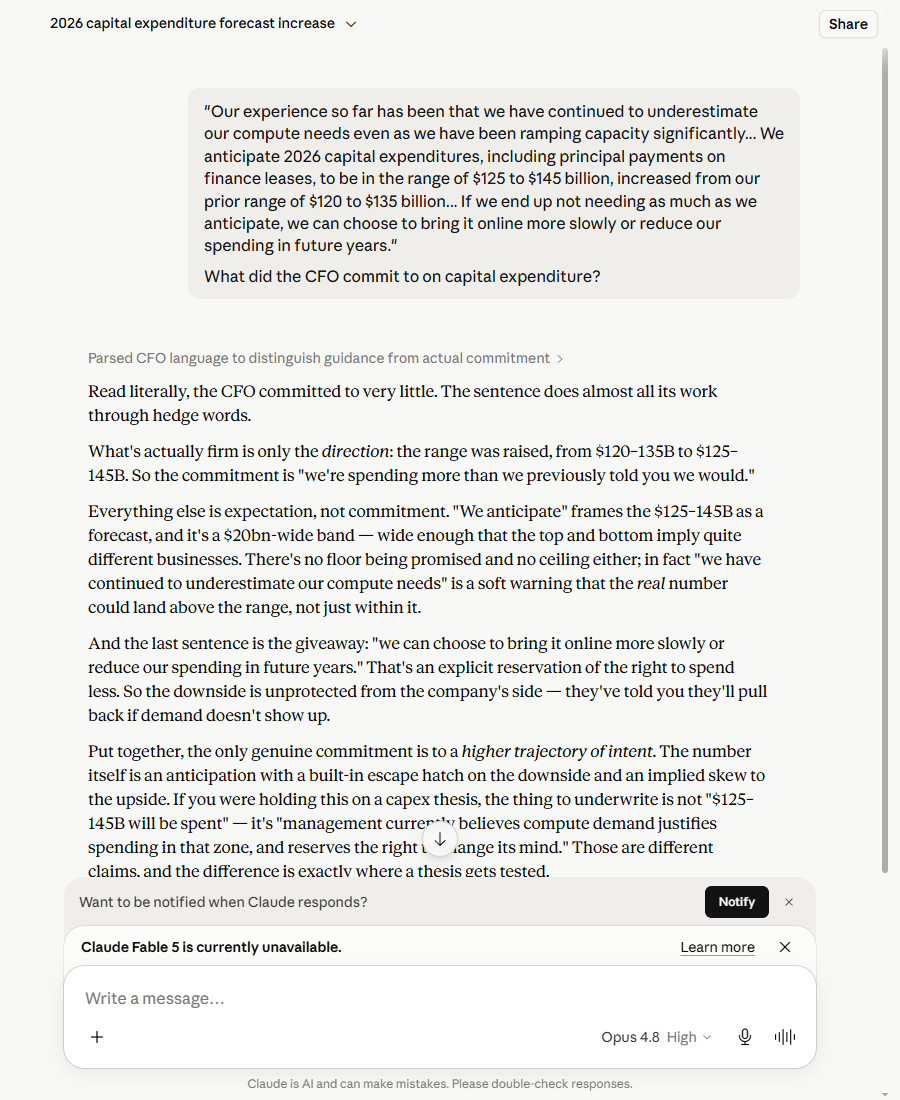
ChatGPT gave me the figures. Claude flagged the upward hedge, and I never told it to look.
That’s the divergence in the two saved answers. ChatGPT read the numbers and the obvious downside hedge. Claude also caught the signal pointing the other way. That difference supports the result of this dimension; it does not establish why Meta shares fell after the release. Claude wins this one outright, and it’s the dimension that matters most in this test.
Dimension 2, same bare question on both, 18 June 2026. ChatGPT (GPT-4o) vs Claude (Opus 4.8 High).
Dimension 3: Does structure close the gap?
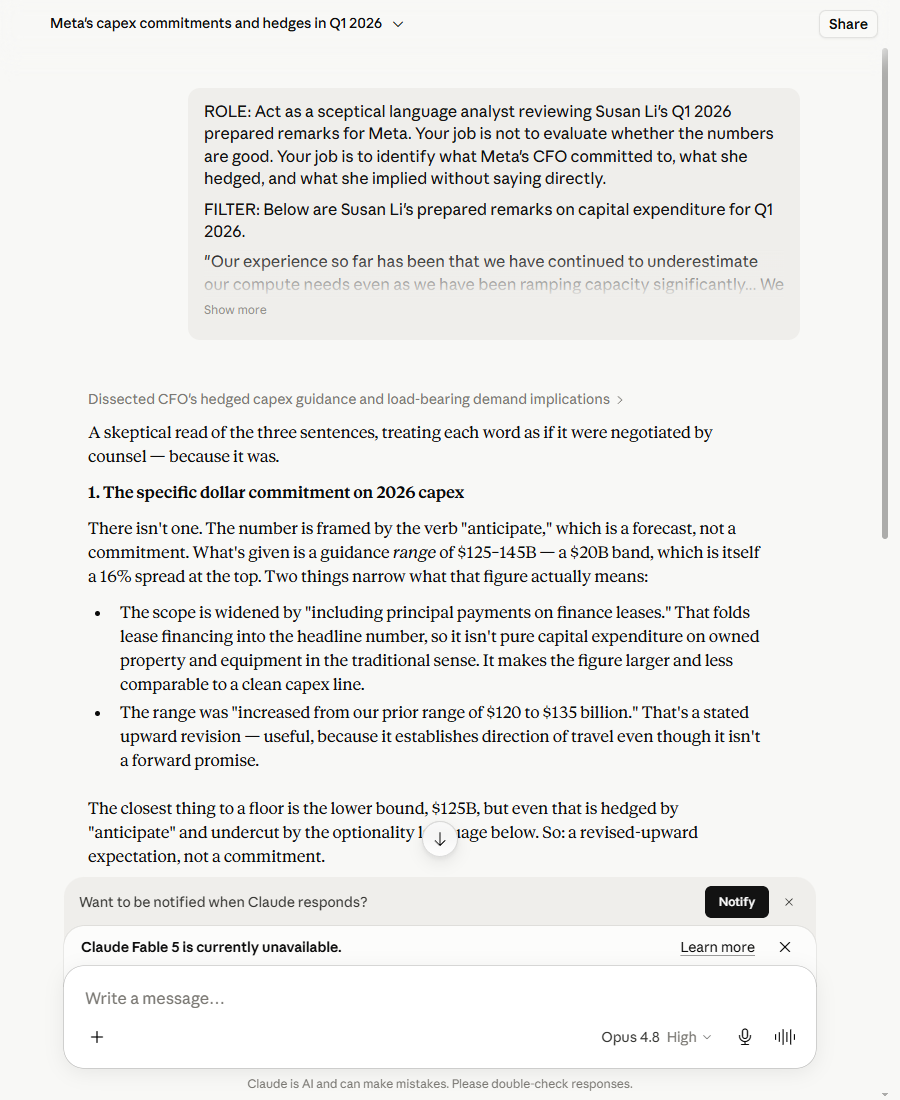
Here’s where the honest version of this post diverges from the hit piece it could have been. I ran the same passage a third time, this time with the Prompt Stack structure: a role, a filter, a risk question, a one-line verdict instruction.
With that scaffolding, ChatGPT caught it. It named “continued to underestimate” as a hedge doing “heavy hedging work,” spelled out five separate phrases that leave Meta room to spend less, and worked out for itself that a bull case on the stock rests on the underestimate framing: “absolutely central to justifying the scale of spending.” That’s the analysis it skipped on the bare question. The structure brought it out.
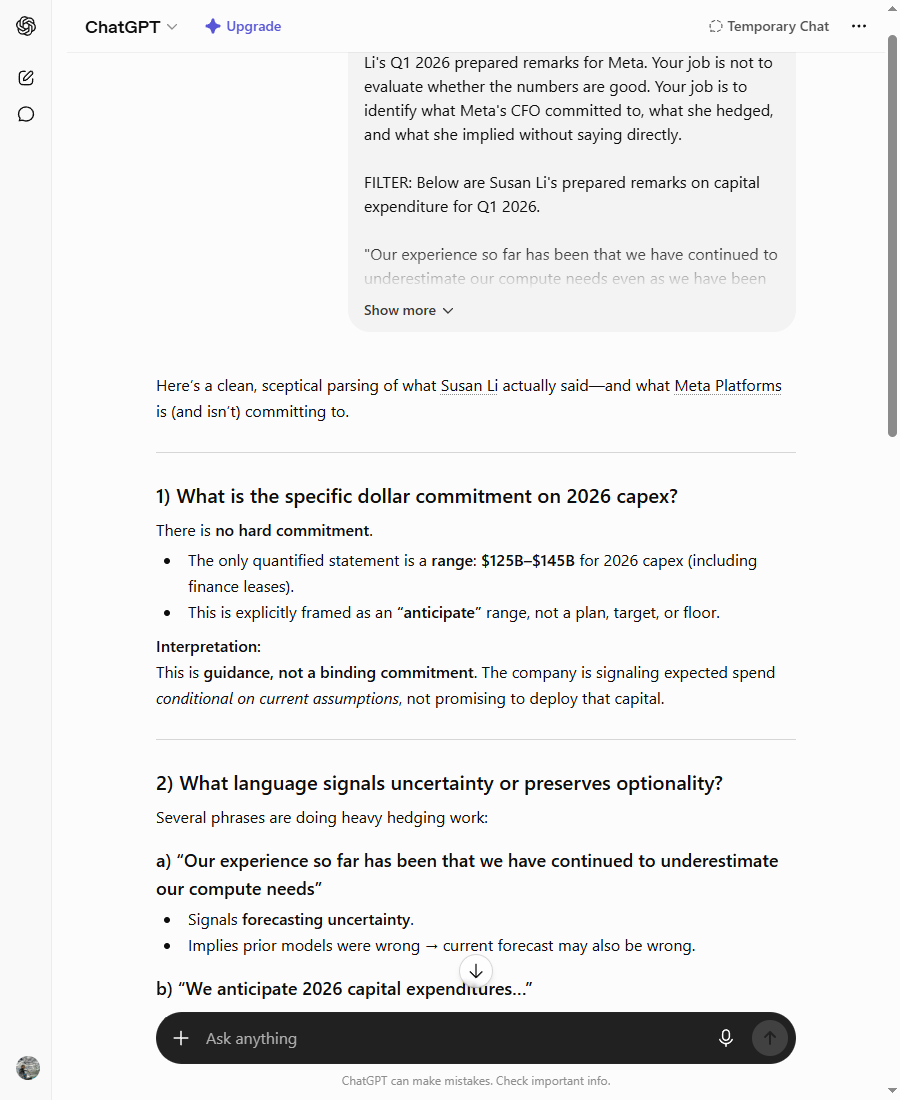
So the finding isn’t “ChatGPT is bad at this.” It’s narrower and dated: in this paired run, ChatGPT surfaced the hedge after the structured prompt; Claude surfaced it on the first plain question.
Claude with the structure went further still. It made one observation neither tool made unprompted: the spend-less escape clause in the saved excerpt is parked in future years, not 2026: “the escape hatch is placed where it costs least to advertise.” Claude therefore read that clause as doing little to soften this year’s range. In these two structured outputs, Claude went further; ChatGPT nevertheless named the same central hedge it had skipped on the plain question.
Dimension 4: What management didn’t address
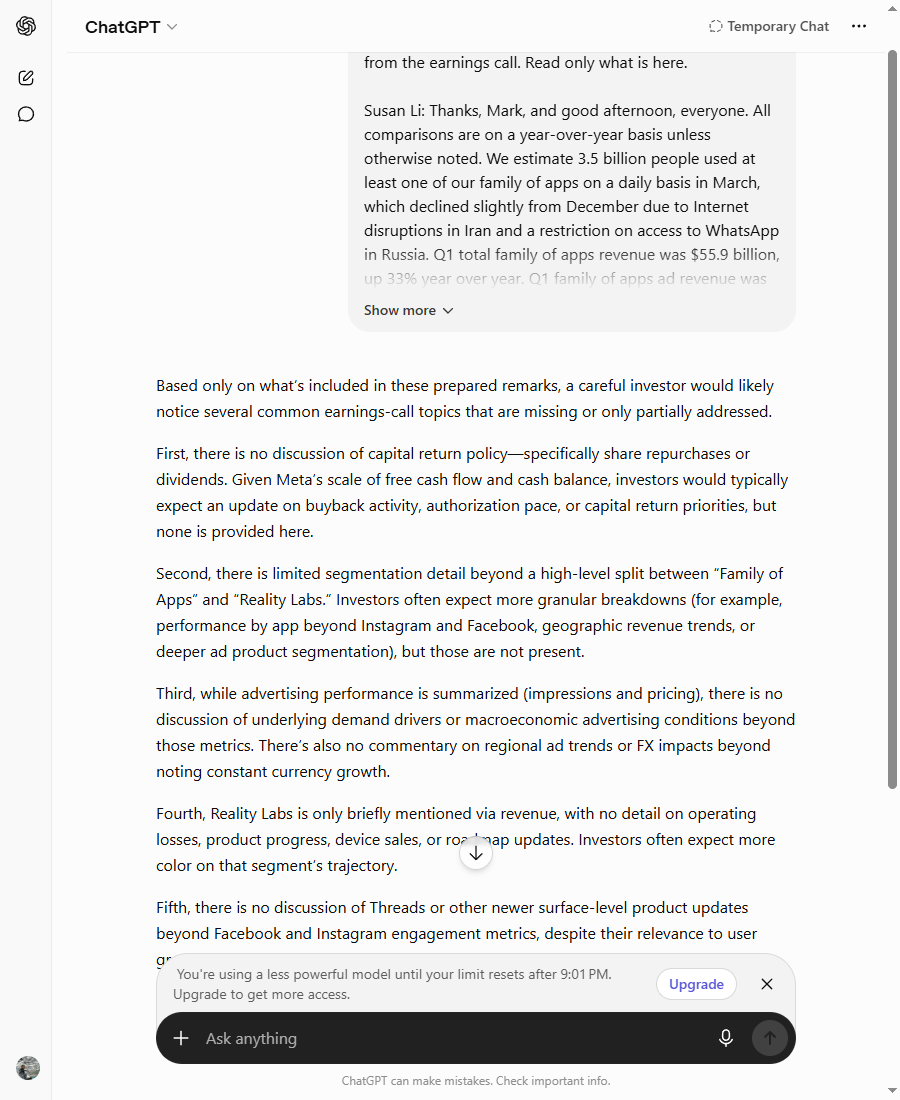
The last test: paste the fuller prepared remarks and ask, with no pre-list to check against, what a careful investor would expect management to cover that simply isn’t here. This is the absent-topic audit: the conspicuous silences.
The same caveat as Dimension 1, louder: ChatGPT was back on the weaker fallback model for this one, so it’s not a same-tier read. With that flagged, ChatGPT did fine, a competent numbered list of generic gaps: no capital-return policy, thin segment detail, no Reality Labs operating loss, vague regulatory specifics. The list any earnings checklist would produce. Accurate, but it reads like a checklist applied to the call rather than an audit of this call.
Claude’s read did the real work. I asked the same bare question and got back eight material absences, ranked by how much they matter. The one that stopped me: it spotted that the section literally headed “capital allocation” discussed only spending and said nothing about buybacks or the dividend, conspicuous when the capex bill is going up and now competes with shareholders for the same cash. I hadn’t clocked that gap myself until it pointed at it. It flagged the missing return on the AI spend in one clean line: “You’re given the cost side of the AI story without the return side.” That’s the audit of this call, not a generic one.
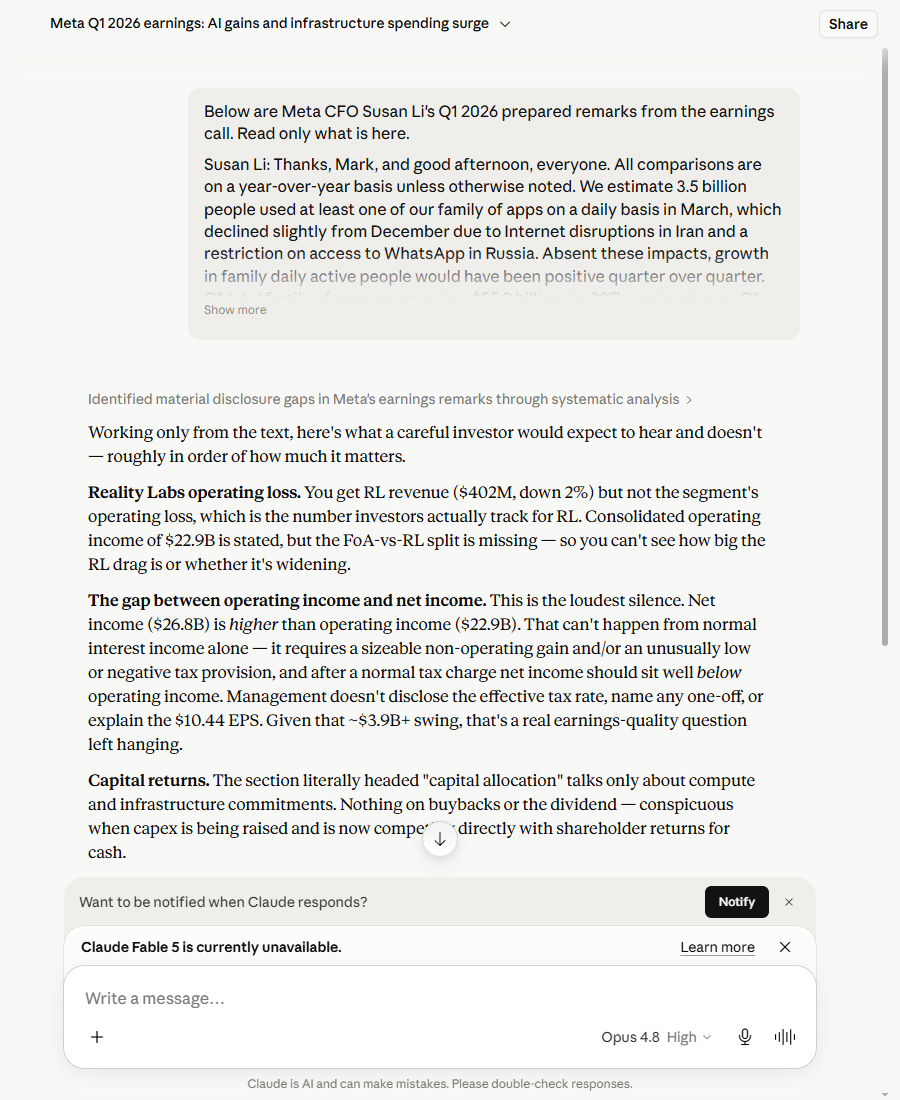
On a fair-tier rerun the gap might narrow. On what I ran, Claude’s absent-topic read was the more useful of the two by a clear margin.
The summary table
| Dimension | ChatGPT | Claude |
|---|---|---|
| Document discipline | Equal* | Equal |
| Hedge detection (unprompted) | Worse | Better |
| Structured prompt (Prompt Stack) | Better than its own bare read | Better |
| Absent-topic detection | Worse* | Better |
| Overall | Better once structured; needs the prompt | Better unprompted, for reading the language |
* ChatGPT was on a weaker fallback model for these two dimensions after hitting its free-plan cap. Not a same-tier comparison. Treat both with caution.
ChatGPT vs Claude for earnings calls: the verdict
For reading a transcript excerpt (what was committed, what was hedged, what was carefully left out) Claude is the one I’d have opened first on these dated runs. It caught the upward signal in “underestimate” on the bare question, the question most people would type, and it read the conspicuous silences as an audit of this specific call rather than a generic checklist. It did that without being coached.
But this isn’t a one-sided result. With the Prompt Stack structure, ChatGPT named the same hedge, spelled out the room to spend less and worked out what the bull case depends on.
In this paired run, structure changed ChatGPT's answer; Claude found the same hedge on the bare question.
If you want the analysis on the first plain question, that’s Claude.
The one condition that would flip this: a fresh model. These tools update faster than posts can keep up. This verdict is dated 18 June 2026, on Opus 4.8 and GPT-4o, and I’d re-run it the morning of any results I cared about rather than trust a comparison from months back.
The short version
What worked: Claude caught the upward “underestimate” hedge unprompted and read the absent topics as an audit of this call, not a generic checklist. ChatGPT, given the Prompt Stack structure, then named the same hedge and its investment implication.
What didn’t: ChatGPT’s bare-question read missed the upward signal entirely. Its free plan also hit a message cap mid-test, dropping two dimensions onto a weaker fallback model. Those two are not a fair same-tier comparison; removing the quota issue would still require a fresh captured rerun, not an assumed result.
Bottom line: Useful, with a clear split. For reading management language on the first plain question, Claude. For ChatGPT, the Prompt Stack structure does the heavy lifting. Re-run on the current models before you lean on either. These change faster than the verdict can.
The catch from this test, Claude flagging “underestimate” without being asked, is logged with the others on the catches page, where I keep a running record of the times an AI caught something I’d have wanted a human analyst to catch. The specific language patterns worth watching for, the words that signal what a management team is hedging, are catalogued in the earnings-call red flags. For the full structured workflow on any earnings call, rather than the one excerpt I tested here, the five-prompt walkthrough is the place to start. This was the two-tool cut; for how all four tools handle real trades, and the specific way each one fails, see the four-tool audit. On these 18 June runs, Claude gave the stronger first plain-question read.

Ben tests how far you can trust the main AI assistants, and publishes exactly where they get things wrong. Every post here is a first-hand test with the receipts, including the times a tool simply wasn’t worth the trust. About Ben →
The site tests how far you can trust the main AI assistants, on real decisions. Start with the Prompt Stack for the four-stage framework, free and ungated, or the Bluff Filter for the paste-ready version with a real before and after.